It provides you with a combination of a useful mirror and light in one device to improve your vision during grooming and modernize your bathroom interior.
Rectangle LED Mirror with Lights: Features, Sizes & Buying Factors
Author
Isha ParmarChoosing a bathroom mirror nowadays does not consist only of picking up the appropriate dimensions or the desired form. Due to its built-in lights, a mirror can contribute to better visibility and convenience in daily use of the accessory.
A rectangular LED mirror with lights is among the common types of bathroom mirrors that people use due to their versatile design as well as other features. But different products have various differences in terms of brightness, color temperature, fogging capacity, control, and installation needs.
Before buying one, it is worth looking beyond appearance and comparing the features that will affect how comfortably and safely the mirror works every day.
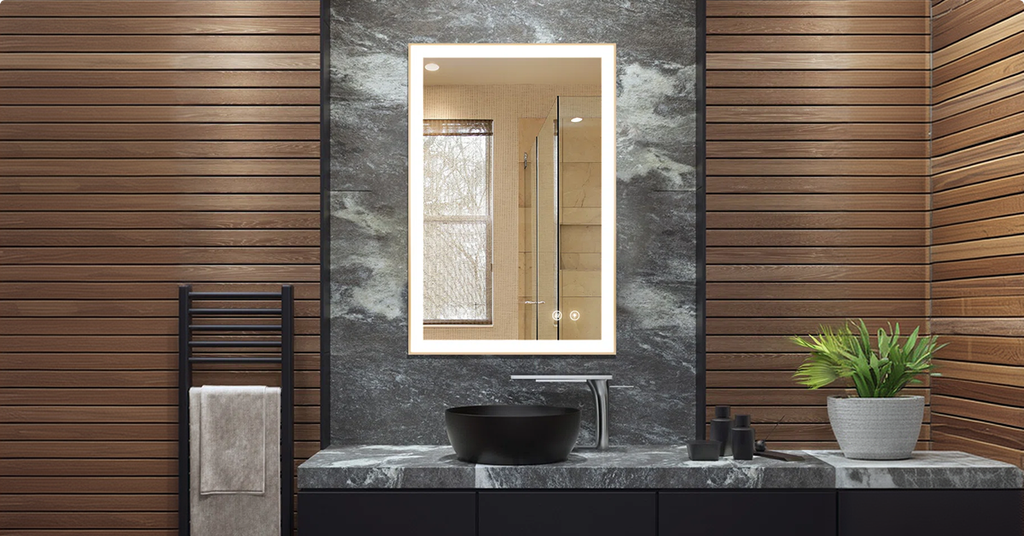
Table of Contents:
- Why Rectangular LED Mirrors Remain Popular
- Frontlit vs. Backlit LED Mirrors
- Choosing the Right Mirror Size
- Understanding LED Color Temperature
- Why Dimming and CRI Matter
- Anti-Fog Technology: Useful or Optional?
- Tempered Glass and Bathroom Safety
- Electrical Requirements and Installation
- Horizontal or Vertical Installation?
- Smart Features: Which Ones Actually Matter?
- Common Mistakes to Avoid
- How LED Mirrors Fit Current Bathroom Design Trends
- Final Considerations
- FAQs
Why Rectangular LED Mirrors Remain Popular
Rectangular mirrors work well because they match the proportions of many bathroom vanities. A wide horizontal mirror can visually connect a double-sink vanity, while a taller vertical model can make sense above a single sink or in a narrow bathroom.
Right angles of the rectangle will fit perfectly into modern cabinets, rectangular tiling, floating vanity units, and minimalist faucets. Unlike fancy mirror shapes, the rectangle tends to be rather neutral in terms of design, allowing it to fit any bathroom finishes without difficulty.
Another practical advantage is a usable reflection area. The rectangular format provides predictable dimensions, making it relatively straightforward to compare the mirror width with the vanity, wall, medicine cabinet, and surrounding clearances.
Frontlit vs. Backlit LED Mirrors
One of the most important distinctions when comparing illuminated bathroom mirrors is where the light comes from.
Frontlit Mirrors
Frontlit mirrors direct illumination toward the user. Because the light is positioned around the reflective surface, it can provide useful facial illumination for grooming and makeup application.
This becomes an important feature in situations where the bathroom ceiling lighting fixture is located behind the user standing in front of the vanity.
Backlit Mirrors
The backlit mirrors have lights located behind the mirror surface, and the illumination takes place at the edges of the mirror to give a halo effect. This lighting is more for an ambient effect and decor, but it adds some general illumination to the space too.
Backlighting tends to emphasize the mirror’s outline and can make a wall-mounted storage or mirror appear to float slightly away from the wall.
Frontlit and Backlit Combinations
Some modern LED bathroom mirrors use both configurations. Retail listings in the U.S. commonly describe these as dual-light or front-and-backlit designs.
This configuration can provide task-oriented facial lighting while also creating ambient wall illumination. It is worth checking the actual lighting layout rather than assuming every illuminated mirror provides the same type of light.
Choosing the Right Mirror Size
Size should be determined by the vanity, wall dimensions, ceiling height, and intended orientation, not simply by choosing the largest mirror that fits. For a single-sink vanity, a mirror approximately equal to or somewhat narrower than the vanity often produces balanced proportions. Double vanities generally benefit from a wider mirror, although two individual mirrors may sometimes provide better visual separation.
The height of the mirror is also an important consideration. A higher mirror will help enlarge the reflecting area and may look good, especially when installed in bathrooms with high ceilings. But one has to allow sufficient space above the countertop, the faucet, the backsplash, the lighting fixture, and the ceiling.
Common residential dimensions include widths around 24, 30, 36, 48, and 60 inches, but available sizes vary considerably by manufacturer. Some large-format models exceed 60 inches in width. Before purchasing, measure the actual wall rather than relying on the nominal vanity width.
Understanding LED Color Temperature
LED color temperature impacts both the aesthetics of the bathroom and the quality of color rendition of the mirror’s lighting. Light with a warm white color temperature (2700K-3000K) creates a softer and cozier impression. With a neutral white color temperature (3500K-4500K), you may create an everyday atmosphere. Cool white light with a color temperature of 5000K-6500K provides a clearer vision of objects.
Many contemporary illuminated mirrors provide two or three selectable color temperatures. Some U.S. listings, for example, offer combinations around 3000K, 4000K, and 6000K.
There is no universally correct setting. For a bathroom used primarily for relaxing evening routines, warmer light may feel more comfortable. For detailed grooming, a neutral or daylight-like setting may be more useful.
Why Dimming and CRI Matter
Adjustable brightness is more valuable than having just an intense LED strip. A mirror that cannot be dimmed may feel excessively bright at night, while insufficient brightness can make detailed grooming difficult.
Dimming allows the same fixture to serve different purposes throughout the day.
The Color Rendering Index, or CRI, is another important characteristic that should be studied. CRI shows how precisely a particular light source reproduces colors in comparison with a standard reference. High CRI lights are more appropriate in cases where precise color rendering is needed, especially during the process of applying makeup. Some LED mirrors have a CRI higher than 90.
CRI, however, should not be assessed separately from other parameters such as brightness, color temperature, and room lighting.
Anti-Fog Technology: Useful or Optional?
Bathroom steam can quickly cover an ordinary mirror after a hot shower. Anti-fog technology addresses this problem through a built-in heating element behind part of the mirror. When activated, the heated area raises the mirror surface temperature enough to reduce condensation. Some models use a dedicated control, while others integrate the function into touch controls.
Modern-day devices include anti-fogging technology with a built-in timer. The anti-fogging technology proves to be very helpful, especially in bathrooms with poor ventilation or regular showers. This feature is less essential in a ventilated powder room that does not experience much humidity.
The important detail is that anti-fog coverage may not extend across the entire mirror. Check the manufacturer’s specifications to understand the actual heated area.
Tempered Glass and Bathroom Safety
The glass used in the bathroom setting should be analyzed for both safety and longevity. Tempered glass goes through a heating process that makes it stronger than regular glass. In case it shatters, it tends to break up into small pieces and not big, jagged pieces like normal glass would.
Some illuminated bathroom mirrors are specifically marketed with tempered or shatter-resistant glass construction.
That does not necessarily mean it is impossible to break the mirror. The bigger mirrors still can be broken by accidents during handling or installation. The method of mounting the mirror plays a crucial part as well.
Electrical Requirements and Installation
An illuminated mirror is an electrical fitting as well as a reflecting device. This is important to note when mounting the fixture. Some are made to be plugged into an outlet, while others are made to be hard-wired to the home’s electrical setup. In the latter case, installation will have to adhere to appropriate local electrical guidelines and possibly need a qualified electrician.
Bathroom electrical safety also deserves particular attention because water and electricity present obvious hazards. The mirror’s listed environmental or ingress-protection rating, installation instructions, and electrical certification should be reviewed before installation.
Listings for U.S. models may reference certifications such as UL or ETL and ratings such as IP44 or IP54, depending on the product.
It would be wrong to think that all LED mirrors are suitable for every environment just because they are referred to as bathroom mirrors.
Horizontal or Vertical Installation?
There are some rectangular backlit mirrors that can be installed either horizontally or vertically. However, this must not always be taken for granted since the orientation would have an impact on the control switch placement, light diffusion, electrical hook-up, mount and reflector location. It is best to confirm first whether the specific model allows such an installation method.
A horizontal installation generally works well over wide vanities, especially double-sink configurations. Vertical installation can make better use of narrow walls and can provide more height for grooming.
The mounting surface must also be strong enough to support the mirror. Large glass mirrors can be substantially heavier than ordinary decorative wall mirrors, so appropriate anchors and mounting hardware are essential.
Smart Features: Which Ones Actually Matter?
Modern LED mirrors now come with many electronic features such as touch sensors, memory settings, motion sensors, Bluetooth speakers, clocks, etc. While some of these features are truly helpful, some just add to the complexity of the product without addressing an actual problem.
A memory function, for example, can restore a preferred brightness or color-temperature setting after the mirror is switched on. This is a practical convenience documented on several current models.
Bluetooth speakers might seem like an interesting addition for homeowners who enjoy listening to music/podcasts while getting ready, but they have nothing to do with the mirror’s primary functionality.
When comparing models, prioritize functions that affect daily use—lighting quality, dimming, anti-fog performance, controls, and installation compatibility—before secondary electronics.
Common Mistakes to Avoid
The most common mistake is choosing a mirror based solely on appearance. A visually impressive mirror can still be the wrong choice if it is too wide for the wall, too tall for the available clearance, poorly suited to the vanity, difficult to wire, or inadequately supported.
Another common mistake would be thinking that the brighter the light is, the better. Very bright LEDs might not necessarily mean a good quality of lighting. It may feature uneven lighting, excessive glare, bad color rendering, or inappropriate color temperature.
Buyers should also avoid assuming that every “anti-fog” mirror performs identically. Coverage area, activation method, heating time, and automatic shutoff can differ between models.
Lastly, do not forget about the installation process. It must be done right, because large glass mirrors need special care.
How LED Mirrors Fit Current Bathroom Design Trends
The general direction in the design of bathrooms is the development of functional elements that have an aesthetic function at the same time. Lighting integrated in this way can reduce the number of elements in the room since it is no longer necessary to use an additional vanity light in some cases.
Frameless illuminated mirrors are particularly compatible with minimalist bathrooms because the lighting becomes part of the mirror rather than appearing as a separate fixture. Meanwhile, framed versions can introduce contrast through finishes such as black, bronze, or brushed metal. Current U.S. retail listings show both approaches.
In this way, the trend involves incorporating useful features into the bathroom design as opposed to incorporating technology just for the sake of it.
Final Considerations
The combination of reflection, task lights, and ambient lights in a rectangular LED Mirror with Lights may be a very convenient solution, but the optimal combination will depend on the room in question, rather than on the number of features provided by the mirror. You should begin with its size and placement. Then consider front and back lighting, lighting control, color temperature, CRI, anti-fog protection, glass material, electrical requirements, certification, and mount type.
The most useful mirror is not necessarily the one with the most features. It is the one whose size, lighting behavior, safety characteristics, and installation requirements make sense for the bathroom in which it will actually be used.
By treating an illuminated mirror as both a lighting fixture and a glass product, homeowners can make a more informed decision and avoid many of the compatibility problems that only become apparent after installation.
FAQs
What is the purpose of the rectangular LED mirror with lights?
Should I pick a front-lit or backlit LED mirror?
The front-lit mirrors are more efficient for the facial area light, whereas the backlit mirrors provide you with soft background lighting.
Which is the best color temperature for LED mirror bathroom?
Daylight temperature or neutral light may be a good option for grooming and makeup application; on the other hand, warmer temperatures give a softer mood.
What are the most important characteristics of LED mirrors to consider when buying?
Among others, consider the proper size, light quality, dimming capability, color temperature, CRI, anti-fog effectiveness, glass composition, and installation capabilities before additional features.