Yes, it is popular to provide better safety and keep the bathroom looking open and spacious.
Best Fixed Panel Shower Screen with Clear Tempered Glass: Pros & Sizing
Author
Swati MishraA best fixed panel shower screen with clear tempered glass can give your bathroom a clean and open look without the struggle of a traditional door swing. But before deciding to install one, it is important to consider other aspects, apart from the looks. The placement, size and drainage considerations all play a major role in deciding how it controls water.
Clear tempered glass is a popular choice because it gives a feeling of openness without cluttering the space and remains visible.
Keep reading this post to explore the benefits and other considerations for a fixed panel shower with clear tempered glass.
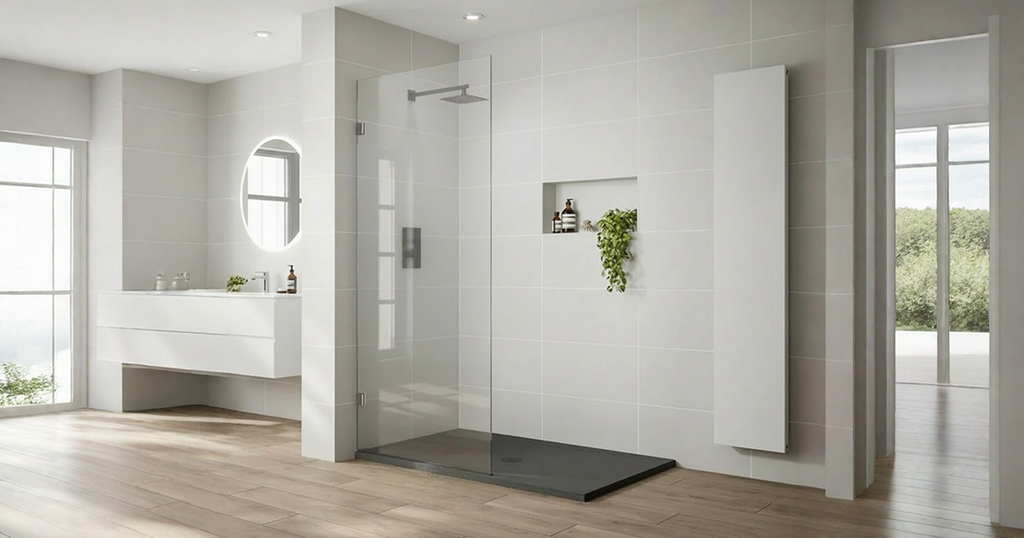
Table of Contents:
- Fixed Shower Panel Explained
- Why Clear Tempered Glass Is Commonly Used
- Fixed Panel vs. Shower Door: Which Performs Better?
- The Most Important Design Factor: Water Control
- Choosing the Right Panel Size
- Frameless or Framed?
- Installation Matters More Than Most Homeowners Expect
- Common Mistakes to Avoid
- Cleaning and Maintenance
- When a Fixed Panel Makes Sense
- When a Fixed Panel May Not Be the Best Choice
- Final Considerations Before Choosing
- FAQs
Fixed Shower Panel Explained
A fixed shower panel is a glass sheet that is secured to the wall, floor or both. No swing, slide or folding issue. Glass serves as a splash barrier, while the open side gives entry to the shower.
This configuration is commonly associated with doorless or walk-in showers. A single panel may be enough for a relatively spacious shower, while a second return panel can create an L-shaped configuration and improve splash control.
A fixed panel and a shower door are not the same. A door can close an opening and serve wide water containment. A fixed panel simply disturbs the water path and directs it towards the drain. This way, the panel turns into a design component instead of an isolated product decision.
Why Clear Tempered Glass Is Commonly Used
Shower glazing needs to be treated as a safety-critical component, not ordinary household glass. In the United States, federal requirements apply to glazing used in shower doors and enclosures, with testing requirements based on safety glazing performance. The Consumer Product Safety Commission specifically identifies shower doors and enclosures among the architectural products covered by its mandatory safety standard.
When broken, tempered glass spreads in small pieces. But still, the right installation and handling matter, as it is not unbreakable.
ANSI Z97.1 establishes safety-performance specifications and testing methods for safety glazing materials used in buildings. The current 2026 edition supersedes the earlier editions.
Clear glass means clear view across the bathroom, making space feel connected. Also, the tiles and other work remain visible.
However, clear glass provides little privacy. Homeowners who share a bathroom or prioritize visual separation may prefer frosted, patterned, or textured glass instead.
Also, explore easy bathroom upgrades that improve daily life.
Fixed Panel vs. Shower Door: Which Performs Better?
A fixed shower panel works best when properly positioned to control water splash. The showerhead should face away from the open entrance, while the panel blocks splash and the floor slopes toward the drain.
A shower door provides another layer of containment because the opening can be closed. This can be particularly valuable in smaller bathrooms where there is less distance between the showerhead and entry.
Hinged doors ask for hinges and require swing clearance. A sliding system needs rollers and other components. A fixed panel removes this need.
So, the question is not whether one configuration is universally better. It is whether the bathroom layout supports an open shower design.
The Most Important Design Factor: Water Control
Don’t focus on glass width alone. Water control depends on the shower’s layout, including the showerhead, drain, floor slope, entry, and panel placement.
Similarly, increasing panel size does not automatically solve every water problem. A larger panel may reduce splash, but can also require stronger structural support, more careful handling, and appropriate hardware.
A well-thought-out walk-in shower gives water the required distance to fall and drain. For this reason, fixed-panel showers are more inclined towards layout decisions instead of being just a glass choice decision.
Choosing the Right Panel Size
There is no single universal panel width or height that works for every bathroom. Finished dimensions, wall conditions, shower depth, plumbing locations, and hardware requirements all affect the appropriate size.
For instance, a shallow shower with a showerhead close to the opening may require unique configurations as compared to a deeper shower where the spray is not close to the entrance.
Current industry guidance commonly discusses 3/8-inch tempered glass for frameless fixed shower screens, with 1/2-inch glass sometimes considered for larger or more minimally supported panels. The appropriate thickness depends on panel dimensions, support conditions, and hardware limitations rather than thickness alone.
Large panels also include deflection. Free edges for an unsupported glass can move. This is why hardware and engineering demands become crucial.
The practical lesson is simple: do not select glass thickness based solely on the idea that “thicker is always safer.” Panel size and support are part of the equation.
Frameless or Framed?
Frameless shower glass looks more attractive. With minimal elements, it gives a clean boundary between wet and dry areas.
Fixed frameless panels typically use hardware such as glass clamps, channels, or stabilizing supports. The hardware may be relatively subtle, but it still performs an important structural function.
The metal is very visible in the framed systems. For perimeter support, this might be a good choice. The end choice should be based on the complete shower configuration rather than just design.
Installation Matters More Than Most Homeowners Expect
Fixed glass installation is not simply a matter of holding a panel against the wall and attaching brackets. The installer needs to account for wall plumb, finished tile dimensions, structural backing, waterproofing, hardware locations, panel tolerances, and the condition of the shower floor.
Often, a glass panel may be fabricated completely, but the nearby opening may still not be a complete square. These aspects make it important to accommodate and measure.
The substrate behind the finished wall also matters. Heavy glass requires appropriate structural support at mounting locations. Drilling into tile without considering what lies behind it can create both installation and waterproofing problems.
This is why it makes more sense to take measurements after the tile work is done to set the actual completed opening.
Common Mistakes to Avoid
One of the most common mistakes is treating a fixed panel as a universal replacement for a shower door. It is not. If the bathroom is too shallow or the spray pattern points toward the entrance, water may escape regardless of how attractive the glass looks.
Shower walls, tile thickness and finished surfaces can alter the final opening. This is why it is not a standard practice to measure too early.
Another mistake is ordering based on rough construction dimensions. Shower walls, tile thickness, and finished surfaces can change the final opening. Measuring too early can result in a panel that does not fit correctly.
Ordinary glass should also not be used. For safety considerations, shower glazing should be checked before installation.
Finally, homeowners sometimes overlook the shower floor. Glass cannot compensate for poor drainage. If the floor does not direct water toward the drain, splash and runoff can reach the bathroom floor regardless of panel configuration.
Cleaning and Maintenance
Cleaning and maintenance are one of the crucial aspects to ensure a long life of the glass.
- Fixed panels are actually simple – no hinges to lubricate, no roller to manage, and no door track running across the floor.
- That does not mean maintenance disappears. Hard-water minerals, soap residue, and body oils can accumulate on clear shower glass. Regular rinsing and wiping can reduce buildup. A squeegee used after showering is particularly useful because it removes water before dissolved minerals dry onto the glass.
- Abrasive materials can damage the glass surface, avoid them. Cleaning products should also be checked properly before use.
- The surrounding hardware deserves attention as well. Periodically check visible fasteners, clamps, channels, and seals for movement, corrosion, or deterioration.
When a Fixed Panel Makes Sense
A fixed panel is best for a bathroom with enough space and open access. When the showerhead is away from the entry and floor drainage is set up the right way, fixed panels actually make sense. Also useful when a swinging shower door hinders movement for the toilet or vanity. No door can simplify things.
Accessibility is another consideration. An open shower entry can make access easier, particularly when paired with an appropriately designed curbless shower. However, accessibility involves the complete shower design, not simply removing the door, and should be planned according to applicable building requirements and the user’s needs.
When a Fixed Panel May Not Be the Best Choice
Minimal distance between the shower and the opening, overflow of warmth created inside the space and privacy issues might make a fixed panel a bad choice. Clear glass often provides no visual screening.
In bathrooms where water containment is the overriding priority, a hinged, pivot, or sliding enclosure may be more practical. A return panel can also provide a middle ground by maintaining an open entry while adding another stationary barrier.
Also, explore things to know before you start a bathroom remodel.
Final Considerations Before Choosing
At the end of the day, a fixed panel shower can be an effective and long-term choice when the bathroom layout suits the open shower. Clear tempered glass provides a spacious look, while making the space look less cluttered.
But research plays a major role. The right panel does not just depend on appearance. Shower dimensions, water direction, drainage, glass thickness and installation all play a major role.
FAQs
Is clear tempered glass good for a fixed shower panel?
What size should a fixed panel be?
There is no perfect size. The right size depends on the width and height of the space. Entry opening, drainage and other support also matter.
Is a fixed shower panel better than a shower door?
It depends on the bathroom layout. A fixed panel offers fewer moving parts and a more open appearance, while shower doors offer better water containment.