Greywater is relatively clean wastewater coming from baths, sinks, and washing machines. Black water is total wastewater containing human waste and harmful germs.
Clean, Gray, or Black Water: What Each Means for Your Home
Author
Terri Sander
“A clean house is a happy house.” – Louisa May Alcott (Writer)
When we talk about water damage, it’s not just the amount of water flooding your home; it’s also about how clean, or unclean, it is. A leaking supply pipe is very different from an overflowing toilet. That’s why water damage is classified in three categories professionally: Category 1, 2, and 3. Each one being progreassivly more concerning.
Knowing about these categories helps greatly when you actually have to face a water attack. The right recovery method to normalcy depends highly on this. It decides whether the damaged materials need isolation, removal, drying up, or replacement.
Table of Contents:
- Category 1: Clean Water From Sanitary Sources
- Category 2: Gray Water Carries Greater Contamination Risks
- Category 3: Black Water Requires the Highest Level of Caution
- How Water Categories Change the Restoration Process
- Why Professional Assessment Matters After Water Intrusion
- End Note: Treat Water Damage According to Its Source
- FAQs
Category 1: Clean Water From Sanitary Sources
Category 1, generally called clean water, originates from a sanitary source and does not initially contain significant levels of harmful contaminants. Examples include water from a broken supply line, a leaking heater, an overflowing bathtub, or certain types of rainwater penetrating through a damaged exterior opening.
Although Category 1 has a lower contamination risk, it should not be ignored. Water can quickly migrate beneath flooring, into drywall, behind cabinets, and into insulation. If materials stay wet for a long period, microbial growth can become a concern. Then, the initial classification may no longer hold meaning.
For homeowners seeking damage restoration, recognizing a clean-water incident early can assist in limiting the extent of structural damage. The restoration process generally focuses on stopping the source, extracting standing water, drying affected materials, and monitoring moisture levels. Air movement and dehumidification may be employed to accelerate drying, while porous materials are evaluated to determine whether they can be safely restored.
The key point is that “clean” does not mean harmless. It describes the original contamination class of the water—not the potential damage caused by leaving it untreated.
Category 2: Gray Water Carries Greater Contamination Risks
Category 2, or gray water, has a higher level of contamination and may cause illness if swallowed or otherwise allowed to contact vulnerable areas of the body. Typical sources can include washing-machine discharge, dishwasher overflow, toilet water containing urine but no feces, and some sump-pump losses.
Graywater can contain detergents, dissolved organic matter, microorganisms, and other contaminants. Its composition depends heavily on where it originated. As a result, cleanup normally requires more precautions than a straightforward clean-water loss.
When homeowners require water damage restoration Johnson City TN services after a gray-water incident, restoration professionals can assess both the source and the affected items. Unclean water should be removed promptly. Impacted surfaces must be appropriately cleaned and disinfected. Porous materials that have absorbed contaminated water may also need closer evaluation to determine whether they can be safely mended or should be removed.
Another important consideration is time. Graywater can deteriorate further if it remains stagnant. Microbial activity and contamination can increase. A situation that originally seemed manageable may become more complicated if action is delayed.
Category 3: Black Water Requires the Highest Level of Caution
Category 3 water, typically referred to as black water, is heavily contaminated and presents serious health hazards. Sources can include sewage backups, floodwater from rivers or streams, toilet overflows containing fecal matter, and water that has traveled through areas having significant biological or chemical contamination.
Blackwater should never be treated as an ordinary household spill. It may contain bacteria, viruses, parasites, chemicals, and other harmful substances. The U.S. Environmental Protection Agency states that untreated sewage can carry bacteria, viruses, protozoa, and other disease-causing organisms, while areas affected by sewage require thorough cleaning and disinfection. Direct contact should therefore be avoided, and kids and pets should be kept away from affected areas.
Restoration procedures for Category 3 losses are consequently more controlled. Contaminated water must be removed safely, affected areas may need containment, and materials that cannot be satisfactorily cleaned are often removed. Professional crews may use specialized protective equipment and follow established procedures for handling contaminated materials.
A black-water affair can also affect more than the visible surface. Water may penetrate subfloors, wall cavities, insulation, and other concealed spaces. Restoration therefore involves identifying the full extent of contamination rather than simply cleaning what’s visible.
The infographic summarizes the three water damage categories:
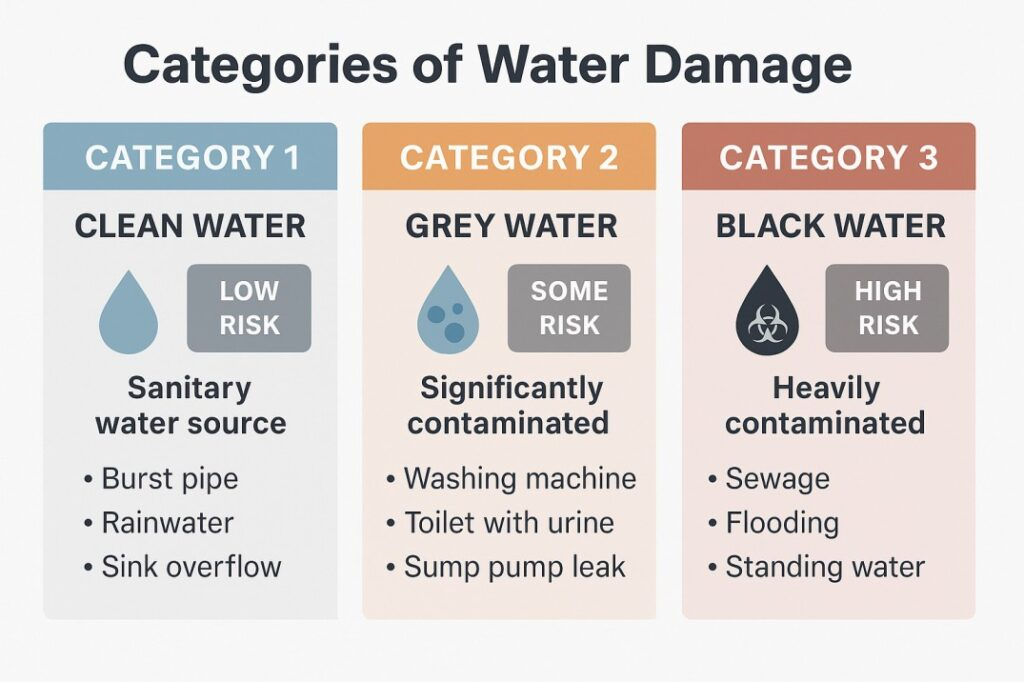
In case it’s not about unclean water but hard water, installing a water softener makes total sense.
How Water Categories Change the Restoration Process
The category influences nearly every stage of restoration, from worker protection to material disposal. The priority is always to address the source of the water when it can be safely controlled. After that, the affected area is evaluated for moisture, contamination, structural impact, and the materials involved.
The major restoration considerations include:
- Water removal: Standing water may require extraction equipment, pumps, or other specialized methods depending on the volume and contamination level.
- Material evaluation: Porous materials such as carpeting, insulation, and drywall may absorb contaminated water and become difficult or impossible to restore safely.
- Cleaning and disinfection: The higher the contamination, the more extensive the cleaning and sanitizing requirements may become.
- Drying and moisture monitoring: Structural materials need to reach appropriate water conditions to reduce the risk of ongoing damage and microbial growth.
- Containment and safety: Heavily contaminated losses may require restricted access, protective equipment, and controlled removal procedures.
The category is not necessarily permanent, either. Conditions can change over time. For example, Category 1 can become more contaminated after sitting for an extended period or contacting contaminated materials. This is why restoration checks consider the source, duration, affected materials, and current conditions rather than relying solely on how the water looked when the incident began.
Why Professional Assessment Matters After Water Intrusion
Water damage can be tricky because visible puddles represent only part of the problem. Moisture may travel through flooring systems, wall assemblies, and other concealed spaces while leaving relatively little evidence on the surface. Determining the category is thus only one part of evaluating a loss.
A proper assessment considers where the water came from, how long materials were exposed, what substances it contacted, and whether moisture has reached areas that are hard to inspect. These details influence decisions about extraction, drying, cleaning, removal, and reconstruction.
Homeowners should also avoid assuming that a familiar source automatically makes water safe. Similarly, in specialized or lab settings, precise mixing requiring sterile solutions like bac water shows how critical water purity and source control are. A leaking line may appear straightforward, while contaminated water may be hidden beneath flooring or inside a wall. Similarly, drying heavily contaminated materials without appropriate precautions can expose occupants to unnecessary perils.
End Note: Treat Water Damage According to Its Source
Clean, gray, and blackwater represent different levels of contamination, and those distinctions directly affect how a property should be restored. Category 1 water generally presents the lowest contamination concern, Category 2 involves potentially harmful contaminants, and Category 3 carries substantial biological and environmental hazards.
The earlier the source is identified and affected areas are evaluated, the easier it is to determine an appropriate restoration strategy. Most importantly, homeowners should avoid judging a water-loss situation solely by appearance. The safest and most effective restoration method depends on understanding what the water contains, where it has traveled, and how deeply it has affected the home.
FAQs
What is grey water and black water?
How to treat greywater at home?
First, ensure it’s grey water (coming from baths and washing machines). A coarse mesh filter can remove hair and lint, and you can use it for activities like irrigation.
Is shower water grey or black water?
It’s clearly grey water, not black water, as it doesn’t contain human waste or harmful germs.
Latest Blog