The following are the considerations:
- Analyzing Your Biggest Pain Point
- Choosing the Right Assistant
- Setting an Installation and Subscription Budget
Author
Isha Parmar
Many homeowners utilize some form of smart home technology in their spaces because of the greater convenience, flexibility, and automation offered by it.
But their benefits do not just stop there. They also play a significant role in savings, personalization, and security for homeowners, powering a huge shift in how we live our daily lives.
This article explores these changes by diving deep into multiple aspects that bring about a great change in our daily lives and what their benefits are.
Key Takeaways
- Smart systems bring about a plethora of benefits that are most welcome by homeowners
- As long as you’re connected to the internet, you can remotely adjust and monitor the schedule, temperature, and usage through dedicated smartphone apps
- It’s also important to understand that some of these systems may not function offline, thereby limiting their functionality of interacting with each other and provide real-time updates
- Fueled by this convenience, flexibility, and personalization, these technologies will soon be a part of more homes across the world
Let’s take a look at some of the most commonly used smart home technologies in America before we learn how each of them has impacted our way of living. Most notably, these are:
Here is how each of them works.
Smart assistants like Amazon Alexa, Apple Siri, or Google Assistant often take the form of speakers that can understand and execute our commands by controlling the relevant technologies, which can also include the ones shared next.
These are internet-supported devices that integrate with your home’s HVAC (heating, ventilation, and air conditioning) system. As long as you’re connected to the internet, you can remotely adjust and monitor the schedule, temperature, and usage through dedicated smartphone apps.
Smart lights are a network of internet-enabled LED bulbs and fixtures that allow you to adjust their schedule, color, and brightness to your liking. Like thermostats, you can also remotely customize and track these settings using the internet and dedicated apps.
These are smart sensors powered by Internet of Things (IoT) technology designed to monitor and optimize inefficiencies in your home’s plumbing system and water usage levels. They can identify leaks or overuse and automatically take action such as shutting off valves or heating water only as needed.
This is a network of AI-powered alarms, cameras, and sensors that function cohesively to safeguard your home inside out. They also actively detect potential threats and notify either you or the relevant authorities to avoid serious damage. Once again, you can also monitor your place in real-time remotely over the internet.
It’s also important to understand that some of these systems may not function offline, thereby limiting their functionality of interacting with each other, provide real-time updates, or upload information to their cloud systems.
To deal with these limitations, it’s recommended that you explore the best home internet service near your location.
Now that we’ve covered the major smart players, let’s take a look at all the smart features they bring to our daily lives.
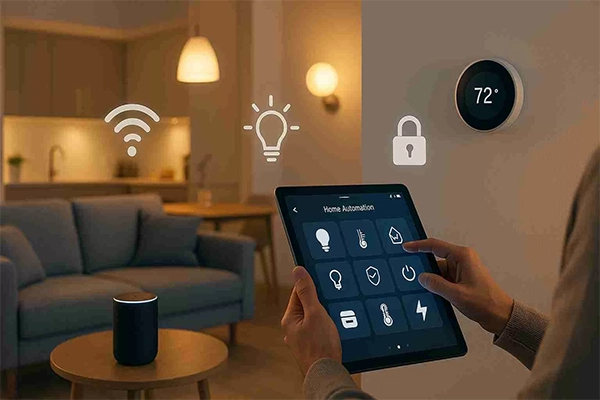
There are 6 significant benefits that smart technologies provide:
Here’s how smart tech unlocks them.
How many times have you forgotten to turn off a light or fan before starting your favorite movie or leaving for work? Instead of getting up or running back home in such cases, you can simply use smart speakers or dedicated apps to turn them off via voice commands or button taps.
By allowing you multiple customization options and the ability to monitor from anywhere, smart home tech unlocks unmatched flexibility.
Additionally, you can alter lighting and temperature for various types of occasions, change schedules almost instantly, especially in the case of emergencies, and travel stress-free thanks to a constant live feed of your home.
By analyzing routines and preferences, smart home technology identifies repeated processes and executes them without the need for manual interruption.
For instance, if you have a cup of coffee every morning, your speaker instructs the coffee maker to prepare a cup automatically whenever you wake up. Similarly, the light and temperature also adjust when you arrive home from work.
Did You Know?
You can get automated pet feeders and even set up cameras that detect when your dog barks or your cat jumps on the counter.
This refers to smart home technology’s ability to identify and customize its performance based on your personal needs and preferences by leveraging data, AI, and machine learning.
For example, if you like the lights turned on dim and the temperature warm while you rest, the relevant smart devices create the same desired environment.
In today’s economy, you need to save in any way possible, and smart home technology allows significant long-term savings through automating processes and monitoring usage. These savings extend to your heating, energy, and water bills, as well as preventing significant repair expenses later on.
For example, by remotely turning off lights or thermostats, you can reduce a potential day’s worth of usage. These technologies can also help you optimize usage to reduce bills by giving you a complete overview of inefficiencies through their respective app’s dashboard.
Similarly, smart water management technologies can also identify and warn you of pipe leaks to get fixed immediately, preventing thousands of dollars in home damages.
American homes lose an average of $2,800 per robbery. Luckily, smart home security devices can prevent intruders from even considering entering your home with threat identification and prevention technology ready to act immediately. Additionally, it can boost the price of your home on the market, as potential buyers highly value homes with smart security already installed.
Now that the most common smart technologies and all the ways they improve our daily lives are covered, let’s get to the most important point: which ones should you choose?
The first step is to arrange a high-quality internet provider, as this will allow smart home devices to communicate with each other, store data to the cloud, and collectively ensure the benefits shared above. With platforms like LocalCableDeals offering plans for diverse needs, this shouldn’t be a problem.
The next step is addressing the 3 crucial considerations below:
Let me explain why each of them matters.
If your most immediate concern is security, you should start with the relevant smart home devices instead of spending excessively. Identifying this aspect will ensure you get the desired results in the right areas. Additionally, the savings you unlock can be used to implement smart devices for other functions.
A smart assistant that is compatible with a larger range of technologies can allow you to seamlessly add more as you need. For example, if you need only automation of basic tasks, a smart assistant alone should be enough. However, if you’re looking for a fully integrated ecosystem, you’ll need to add more devices, each of which your smart assistant should support.
The key is to save, not overspend, so make sure to set a budget and stick to it. Carefully analyze your options based on the price and features they deliver, as you don’t want to compromise on either. Try to find the right balance that caters to these factors as well as your needs.
Smart home technology has made considerable shifts to our daily lives, from automating routine tasks to allowing considerable savings. Fueled by this convenience, flexibility, and personalization, the technology will soon be a part of more homes across America.
As the next phase of the technology’s power unfolds, early adopters will mark the eventual shift to a whole new way to live, one that’s hyper-personalized, extremely intelligent, and efficiently automated.
The following are the considerations:
These functionalities allow you to remotely shut down anything that’s consuming more energy. It even automatically detects excess use and turns off when it reaches a certain threshold.
This refers to smart home technology’s ability to identify and customize its performance based on your personal needs and preferences by leveraging data, AI, and machine learning.
They actively detect potential threats and notify either you or the relevant authorities to avoid serious damage, allowing you to also monitor your place in real-time remotely over the internet.

Premium home decor & furniture — crafted for comfort, designed for you.
Copyright © 2026 Abodelook.