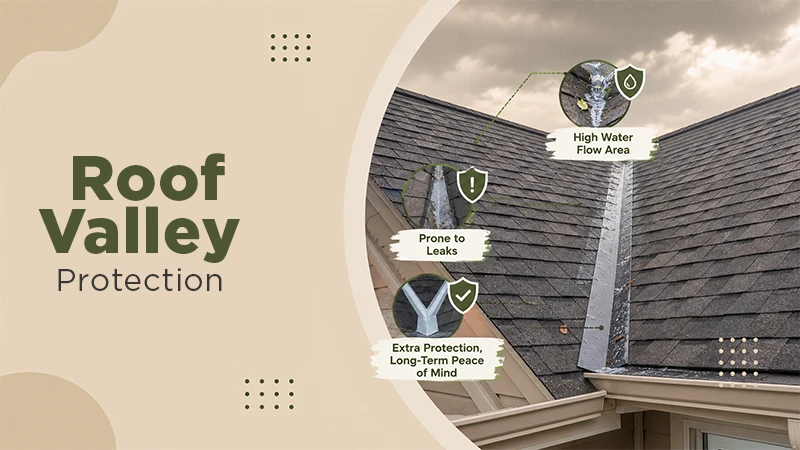
Valleys receive water from two connected roofs. Therefore, valleys get more concentrated amounts of water. If there are any defects such as broken shingles, debris, or improper installation, they will affect the drainage of the valley.
Why Roof Valleys Need More Attention Than the Rest of the Roof
Author
Terri SanderLast Update
September 30, 2026
It is important to note that not all parts of the roof have the same requirements for maintenance. Roof valleys might seem insignificant elements of the roof, but they perform a vital function of moving water from the roof.
Due to the fact that the runoff of several surfaces flows into the valley, the possibility of heavy water flow and accumulation of debris increases, and minor damage, like broken shingles, wrong position of fasteners, or blocked drainage, can evolve into a serious problem in the future.
Knowing the process of water management in roof valleys allows us to focus on potential problems during roofing inspection and roof replacement.
Table of Contents:
- What Happens Where Two Roof Slopes Meet
- Why Debris Creates More Trouble in Valleys
- Open and Closed Valleys Manage Water Differently
- Shingle Cuts Can Influence the Direction of Water
- Fastener Placement Matters Near the Valley
- The Bottom of a Valley Deserves Special Attention
- Warning Signs of a Valley Problem
- Why Caulk Is Not a Long-Term Valley Design
- Repeated Valley Repairs May Point to a Deeper Problem
- Roof Decking Beneath a Valley Can Also Be Affected
- Valleys Should Be Reviewed During Roof Replacement
- Gutter Capacity and Valley Flow Are Connected
- Keep Valley Maintenance Simple and Safe
- Treat Valleys as Part of the Roof's Drainage System
- FAQs
What Happens Where Two Roof Slopes Meet
Valley Roofing occurs when two roof slopes converge towards each other.
Instead of shedding water independently, both surfaces direct runoff into the same path. The valley then carries that water downhill toward the gutter or roof edge.
Therefore, the valley is responsible for conveying the water downwards towards the gutter or roof edge.
During light rain, the difference may not seem significant. During heavier rainfall, however, water from a broad area of roofing can become concentrated into a relatively narrow strip.
The roofing materials in that area must therefore do more than simply cover the roof deck. They must also guide water without allowing it to move sideways beneath nearby shingles.
Why Debris Creates More Trouble in Valleys
Leaves, needles, small branches, moss, and other organic material tend to settle in low points.
Roof valleys naturally create such low areas.
A few scattered leaves on an open roof slope may wash away or dry quickly. The same material can behave differently when it becomes packed into a valley.
Debris can slow the movement of water and keep roofing materials damp for longer periods. It can also interfere with the path water is supposed to follow.
If enough material accumulates, runoff may spread sideways instead of staying within the intended valley channel.
This, however, does not imply that every leaf forms a leak. It involves repeated exposure to moisture and drainage problems.
Homeowners who can safely observe their roofs from the ground may notice piles of leaves or plant material collecting in these areas after storms or seasonal leaf fall.
Open and Closed Valleys Manage Water Differently
Not every roof valley is built the same way.
Two common approaches are open valleys and closed valleys.
Open Valleys
An open valley leaves a visible strip of metal or another approved valley material exposed between the adjoining roof slopes.
Water flows over the surface of the roofing into the middle valley channel and then down towards the eave.
One advantage of this arrangement is that the intended drainage path is visually clear.
The installation still requires careful detailing. The valley material must be properly placed, and surrounding roofing must be cut and secured without creating unnecessary openings where water is concentrated.
Closed Valleys
With a closed valley, shingles cover the valley area rather than leaving a broad strip of metal visible.
Different installation methods may be used depending on the roofing system and manufacturer requirements.
Because shingles remain part of the visible drainage path, their placement and cutting become especially important.
Wrongly cut shingles may cause water to flow to the edge of the shingle instead of the middle of the valley.
Neither valley style is automatically trouble-free. Performance depends heavily on appropriate materials, detailing, and installation.
Shingle Cuts Can Influence the Direction of Water
Water does not always travel in a perfectly straight line down a roof.
It follows surface contours, material edges, and changes in slope.
That is why shingle placement near a valley needs careful attention.
If shingles are cut poorly or extend into the wrong area, water can be redirected toward locations where it should not go.
The smallest irregularities will not lead to immediate leaks inside. Moisture will continue reaching the edge of the roofing material or flow between adjoining layers.
Over time, that can contribute to deterioration that is difficult to see from the ground.
A valley should be treated as a drainage system rather than simply another place where shingles meet.
Fastener Placement Matters Near the Valley
Roofing fasteners are designed to secure materials to the roof deck, but their placement becomes especially sensitive near concentrated water flow.
A nail or other fastener placed in the wrong location can create a penetration where water regularly passes.
Right application technique helps avoid placing sensitive penetrations in the area of water concentration.
This is one reason valley work should not be approached as ordinary shingle installation.
If a homeowner sees exposed nails, patches of roofing cement, or other improvised repairs directly in a valley, the area may deserve closer professional examination.
Surface patches sometimes stop a problem temporarily, but they do not always address why water reached that spot in the first place.
The Bottom of a Valley Deserves Special Attention
A valley eventually ends somewhere.
Often, it empties toward a gutter or roof edge. In more complicated roof designs, it may terminate near a wall, another roof section, or a change in elevation.
The end of the valley can become one of the most important parts of the entire drainage path.
This water can come at a higher speed and volume compared to the water flowing from other sections of the roof.
If the transition does not direct that water cleanly into the next drainage area, runoff can spill behind siding, overshoot a gutter, or concentrate against trim and fascia.
Homeowners working with a Roofing Company in Eugene, OR may benefit from asking how valleys terminate and where the collected water is expected to go, particularly on roofs with dormers, additions, intersecting slopes, or complex gutter layouts.
The question is not only whether the valley itself is covered correctly. It is whether the entire water path continues safely once the valley ends.
Warning Signs of a Valley Problem
Valley issues do not always produce an obvious stream of water inside the house.
Some warning signs are subtle.
Homeowners may notice:
- Shingles that appear cracked or displaced near the valley
- Dark staining along the valley line
- Trash that is still there when other parts of the roof are clean
- Moss or organic growth concentrated in the valley
- Rust or deterioration on exposed metal
- Repeated sealant patches
- Water staining near interior ceilings below intersecting roof sections
- Gutter overflow near the point where the valley discharges
- Damp fascia or siding beneath the end of the valley
All of these factors do not tell you the problem by themselves. They only tell you that you need to investigate further.
Water may enter at one location and appear indoors somewhere else, which is why diagnosing valley leaks often requires looking at the complete drainage path.
Why Caulk Is Not a Long-Term Valley Design
Roof sealants can be useful in specific applications, but they should not be expected to compensate for incorrect valley construction.
The main issue with frequent patching is that each time water starts seeping through, another layer of sealant is applied.
This can create layers of patching without addressing the underlying water path.
If the original issue is poorly cut shingles, incorrect flashing, damaged underlayment, or an unsuitable transition at the bottom of the valley, simply covering the surface may not solve the cause.
A durable roof relies on overlapping materials and gravity to direct water outward.
Waterproofing of the roof requires the use of overlapping materials and the action of gravity.
Repeated Valley Repairs May Point to a Deeper Problem
A valley that has been repaired several times deserves a different kind of evaluation.
Rather than asking where another patch should go, it may be better to ask why the same area keeps failing.
Possible reasons can include:
- An unsuitable original installation
- Deteriorated valley materials
- Poor drainage at the valley exit
- Incorrect shingle cuts
- Fasteners in vulnerable locations
- Movement in the surrounding roofing
- Damage to the roof deck beneath the valley
- Improper repairs from earlier work
Repeated problems usually indicate that the affected section needs to be opened far enough to understand the underlying condition.
Without that inspection, new surface work may simply cover the evidence.
Roof Decking Beneath a Valley Can Also Be Affected
If water has been entering through a valley for a long time, the visible roofing may not be the only material affected.
Moisture can reach the roof deck underneath.
Depending on how long the issue has existed and how much water has entered, the decking may become stained, weakened, or deteriorated.
During a significant valley repair or roof replacement, revealed decking provides an opportunity to inspect the underlying surface.
Installing new roofing over damaged material does not restore the strength of the deck.
Any compromised sections should be considered before the new valley system is completed.
Valleys Should Be Reviewed During Roof Replacement
Replacing a roof is not just about putting on new shingles over the exact same shapes.
It is also an opportunity to reassess how water moves across the roof.
Valleys deserve close attention during this process because they connect multiple roof planes and often carry more runoff than surrounding areas.
The old roof itself holds many hints.
Old staining can indicate past water movement. Layers of roofing cement may show where previous repairs were attempted. Damaged decking can reveal that a leak existed even if the homeowner never saw water indoors.
Rather than automatically recreating every existing detail, the installer should determine whether the previous configuration managed water correctly.
Gutter Capacity and Valley Flow Are Connected
A properly constructed valley can still create problems if the gutter receiving its runoff cannot handle the incoming water.
Because valleys concentrate drainage, the section of gutter below them may receive much more water than nearby areas.
Sometimes overflow in that place is completely attributed to the gutter, whereas the entire system should be evaluated.
The valley, roof edge, gutter position, downspout location, and surrounding drainage all work together.
If water repeatedly spills over in one spot during heavy rain, it may be useful to examine where that concentrated flow enters the gutter and how quickly the gutter can move it away.
Keep Valley Maintenance Simple and Safe
Homeowners do not need to climb onto the roof to monitor every valley.
In many cases, visual observation from the ground can reveal obvious debris buildup, displaced shingles, or unusual staining.
Binoculars can make inspection easier without requiring roof access.
Roof walking introduces fall risks and can damage roofing materials, especially on steep, wet, brittle, or unfamiliar surfaces.
Roof inspection is a potentially dangerous procedure since it entails falling from a height and damaging the roof structure because of its condition.
Treat Valleys as Part of the Roof’s Drainage System
Roof valleys may occupy only a small portion of the total roof surface, but they handle a disproportionate amount of water.
This is why mistakes during installation, obstructions, and material damage take on added importance in a roof valley than on a regular roof surface.
A well-performing valley does more than remain watertight. It receives runoff from adjoining slopes, keeps that water within a controlled path, and delivers it safely toward the roof edge or gutter.
Homeowners who understand that function can look beyond the shingles themselves and pay attention to how water travels across the roof.
The most useful question is not simply whether a valley looks intact. It is whether every part of the valley from the upper intersection to the final discharge point is guiding water in the direction it was designed to go.
FAQs
Why is more care needed for roof valleys than other roof portions?
What are some of the issues with debris in roof valleys?
Some of the issues include accumulation of debris, leaves, branches, moss, etc., in the valleys, which may affect water movement. They may lead to continuous wetness of the roof material, thus causing runoff to spread to other parts.
How do open roof valleys differ from closed roof valleys?
In open valleys, there will be a visible strip of either metal or another valley material, but closed valleys will have shingles covering the valley area. Open and closed valleys can be effective as long as they are installed using proper roofing techniques.
Do valleys need to be inspected during roof replacement?
Yes. When the roof is being replaced, it will give you the opportunity to check the valley materials, placement of shingles, flashing, drainage, and the roof decking underneath.
Latest Blog