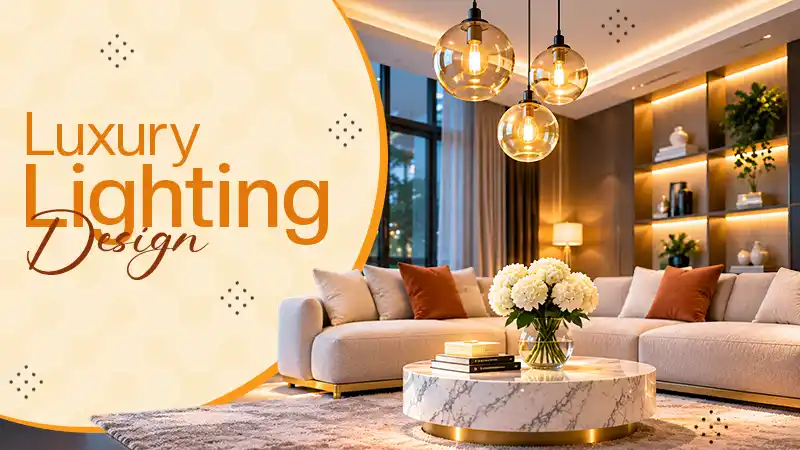
Lighting in interior design is the strategic use of natural daylight and artificial light to illuminate a space. Shape modes highlight architectural features and ensure safety and functionality.
What Luxury Homes Get Right About Lighting (and How to Copy It)
Author
Swati MishraLuxury is no longer defined by excess, expensive stuff, and much more. Luxury rooms are described as the effortless things that are put in a proper manner; lighting has a more impactful effect on luxury. Walls have a different impact that also contributes to a non-expensive luxury room.
Only with the lightning you can make your room luxurious, without any expensive cost. It is the way of thinking about light, and you can copy it in a rental, a starter home, or a family house.
Table of Contents:
1. Light Comes From Many Places, Not One
Designers of high-end homes plan lighting in layers. There is surrounding light for the whole room, task light for reading or cooking, and inflection light that picks out a wall, a painting, or a shelf. A normal living room in a luxury home might have six or more light bases, most of them small.
How to copy it: count the light sources in your living room. If the answer is one or two, add a lamp at eye level and one low light in a dark corner. The room will feel bigger instantly.
2. Walls Get Their Own Light
Wall candelabras are one of the most common features in luxury interiors. They frame a fireplace, flank a mirror, or line a passage, and they make a room look finished. In a custom build, every lantern is hardwired before the drywall goes up.
How to copy it: you do not need an electrician anymore. Rechargeable wall lantern mount with a few turns or a magnetic plate and charge with a USB cable. Design label Tavellio from Amsterdam is a good example: the metal Tavellio wall sconces come with a remote control and a motion sensor, which is perfect for a passage or a staircase.
3. Warm Light After Dark
High-end homes rarely use cool, bluish light in living spaces. Evening light is warm, around 2700K, and it is subdued down as the night goes on.
How to copy it: check the bulbs you already have. Swap anything identified as “daylight” or “cool white” in your living room and bedroom for warm white, and use lamps with a regulator.
4. Lamps Where There Are No Outlets
Look closely at a designated dining table or kitchen island in a luxury home, and you will regularly find a small table lamp. Some of those are wired through the furniture; many are now simply portable.
How to copy it: a refresh table lamp on the dining table or a bookshelf gives you the same effect without a single cable.
5. Materials That Hold Up Up Close
In pricely homes, lamps are chosen like furniture: stone, brass, wood, linen. They look good in daylight, not just when they are on.
How to copy it: choose one statement lamp in a real material rather than three cheap ones. It will last longer and look better every day.
6. Nothing Is Too Bright
The biggest difference is moderation. Luxury interiors are rarely brightly lit in the evening. They are bright just enough, with light in the right places.
The Takeaway
You cannot copy the square footage, but you can copy the light. Add a few derivations at different heights, put some light on the walls, keep it warm, and dim it down in the evening. It is the most reasonable luxury upgrade there is.
FAQs
What is Lighting in Interior Design?
How do I choose the right size for a statement pendant?
Householders frequently buy fixtures that are too small. Luxury design embraces oversized statement pieces. A great rule of thumb for a dining table or kitchen island is to hang the bottom of the fixture 30 to 36 inches above the surface.
How to do lighting in a room?
To properly light a room, you need to layer 3 to five light sources across different heights, then use a single overhead fixture.
Latest Blog