While they have various impressive features, their ability to adapt to any room and look sleek makes them perfect for every space.
A Leather Sofa That Ages Better Than Your Favorite Jeans
Author
Isha ParmarLast Update
September 18, 2026
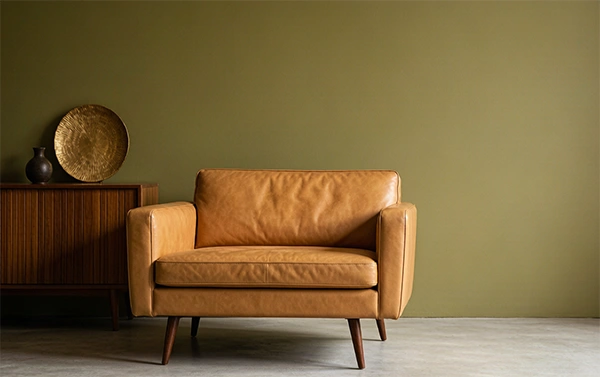
If you’ve ever shopped for a leather piece, you know the feeling. You walk into a showroom, see a beautiful tan selection with clean lines and tapered legs, and something just clicks. That is the pull of mid-century design.
But then you start reading labels: full grain, top grain, semi-aniline, and suddenly a simple purchase starts feeling like a complex equation. Many customers get confused and make mistakes that cost them later.
This article cuts through and tells you what you need to know when choosing mid century leather sofas, how to care for it, and which hide fits your style.
Table of Contents:
- Why Mid-Century Leather Still Matters Today
- Full Grain vs Top Grain: The Hide Decision That Changes Everything
- What Patina Actually Means (And Why You Want It)
- How to Care for Your Leather Sofa So It Lasts Decades
- Which Hide Type Matches Your Household Reality
- Common Mistakes That Ruin Good Leather
- Finding the Right Mid-Century Piece for Your Home
- FAQs
Why Mid-Century Leather Still Matters Today
Mid-century modern design has not faded because it still aligns well with almost any room style. You can drop a tan leather sofa with walnut legs into any space, an industrial loft, or a traditional home, and it still looks sublime. Low profiles make ceilings feel taller. Tapered legs create visual lift so the piece does not dominate.
The material choice matters as much as the silhouette. Leather was the default upholstery in the 1950s and 1960s because it was durable and aged well. Those reasons have not changed. You can now buy a mid-century style sofa in bonded leather for under eight hundred dollars or in full grain aniline for over four thousand. The look is similar. The lifespan is not.
Full Grain vs Top Grain: The Hide Decision That Changes Everything
This is the single most important distinction in leather furniture, and most salespeople do not explain this difference well. Here is the simple truth: both full grain and top grain are derived from the same outer layer of a cowhide. The difference is what happens after the hide leaves the tannery.
Full grain leather receives minimal processing. The surface is not sanded. Natural markings like scars and pore patterns remain visible. The fiber structure stays intact from top to bottom. This means the leather breathes, develops character over time, and can last twenty-five to fifty years with basic care.
Top grain leather begins from the same outer layer, but the manufacturer sands off the surface to get rid of imperfections, then applies a pigment or polymer coating, resulting in a uniform color that looks consistent across every panel.
It resists stains better than full grain. But the coating seals the pores, reduces breathability, and prevents rich patina development. Top grain typically lasts fifteen to twenty years.
| Feature | Full Grain Leather | Top Grain Leather |
| Surface treatment | None or light aniline dye | Sanded + pigment coating |
| Natural markings | Fully visible | Removed or minimized |
| Patina development | Rich, deepens over years | Minimal or none |
| Stain resistance | Low to medium | Medium to high |
| Breathability | Excellent | Good (coating reduces it) |
| Typical lifespan | 25-50+ years | 15-20 years |
Use this table when you shop. Ask the seller specifically which grade they use. If they say “genuine leather” without specifying full grain or top grain, that is often a red flag for split or bonded leather, which is a lower-grade material made from leftover scraps.
What Patina Actually Means (And Why You Want It)
Patina gets used a lot as a marketing term, but it refers to something real. When you make of full-grain leather frequently, natural oils from your skin, friction from sitting, and ambient light cause the smooth surface to darken and develop a soft sheen over time.
This happens unevenly. The armrests darken faster than the back. The seat cushion develops a richer tone where you sit most often.
Patina is not wear. It is character. A well-used full-grain sofa at year fifteen often looks more beautiful than brand new. The color has depth. You cannot fake this with a factory finish.
Top grain leather ages fast, but because the surface is sealed under a coating layer, it tends to display wear as dull spots or cracking instead of developing that organic richness.
If you want furniture that remains the same since day one, top grain is much safer. But if you require a piece that gains personality over time, full grain is worth the extra cost.
How to Care for Your Leather Sofa So It Lasts Decades
Leather care does not demand expensive products. A simple routine keeps your sofa in great shape for years. Here is what I do once a month, and it consumes about ten minutes:
First, dust the coat with a soft, dry microfiber cloth. This removes lumps that act like sandpaper when you sit down. Second, use a small amount of leather conditioner to a clean cloth and work it into the surface with circular motions. Use a product specific for your leather type. Third, let the conditioner absorb for fifteen minutes, then buff off the residue with a dry cloth.
Three things will destroy your leather faster than anything else: direct sunlight, heat vents, and harsh cleaning products. Keep your sofa separate from windows that get strong afternoon sun. UV radiation dries out oils and can cause fading or splitting within one or two seasons. Never use ammonia-based cleaners, bleach, or flexible sprays on leather. They strip natural oils and can irreversibly discolor the surface.
For spills, act fast. Blot, do not apply pressure. Most water-based spills on full grain leather will yield no mark if you catch them within an hour. For oil-based spills, a small quantity of cornstarch left on the site overnight can draw out oil before you clean it.
Which Hide Type Matches Your Household Reality
Most buying guides stop at showing you the technical difference between grades. They rarely help you relate that information to your actual household. Here is a practical tactic.
Ask yourself three things. First, who sits on this sofa daily? If it is adults only, usually in the evening, full grain aniline is a superb choice. The leather will develop a beautiful patina and last for decades. If you have young children who jump on furniture with snacks, or dogs whose nails grind on surfaces, top grain with a protective finish is the smarter pick. You exchange some patina for stain resistance and easier cleanup.
Second, what is your limit for visible variation? Full grain hides show scars, wrinkles, and slight color shifts across panels. Some people love this simplicity. Others find it annoying. If you want every cushion to look the same, go with top grain.
Third, think about the long-term cost. A two-thousand-dollar top grain sofa that lasts eighteen years represents about nine dollars per month of ownership. A four-thousand-dollar full grain piece that spans thirty-five years costs about nine-fifty per month. The economics are closer than the upfront price would indicate.
Common Mistakes That Ruin Good Leather
I have seen people devalue perfectly good leather sofas through habits that seem simple. Here are the top three:
- Using baby wipes or antiseptic wipes on leather: These contain alcohol and chemicals that dry out the leather’s coating. Repeated use over months leaves the surface cracked and thin.
- Placing the sofa firmly against a radiator or heating vent: Dry heat pulls moisture from the hide faster than conditioning can restore it. Leave at least six inches of free space between your sofa and any heat source.
- Ignoring the frame construction: People get stressed over leather grade and forget that the frame underlying it matters just as much. Look for kiln-dried hardwood, not particleboard. A great hide on a weak frame sags within three years irrespective of leather quality.
Finding the Right Mid-Century Piece for Your Home
Choosing a leather sofa comes down to adapting the hide grade to your lifestyle, your patience for maintenance, and your aesthetic designs. Full grain rewards you with decades of beauty if you care for it responsibly. Top grain gives you consistency and efficiency with less attention. Neither is technically better.
When you are ready to analyze options, only trust listings that state the hide grade upfront, so you know exactly what you are getting. A good retailer will notify you whether a piece uses full grain, top grain, or anything else. If they cannot answer that inquiry, keep shopping.
FAQs
What makes mid-century leather still popular?
How to maintain a better quality of leather over time?
Simply avoid using baby wipes over it, keep it away from heating materials like heating vents, and always consider a reliable framing construction.
Can UV rays also affect the leather quality?
Yes, over time, they can dry out the oil present inside it, which eventually leads to a faded colour. It ruins the impressive look.