You’ll need to frequently test and adjust the water’s chemical levels (like chlorine and pH) to maintain a healthy swimming environment.
How Poor Pool Maintenance Increases Water and Energy Costs
Author
Swati MishraLast Update
September 22, 2026
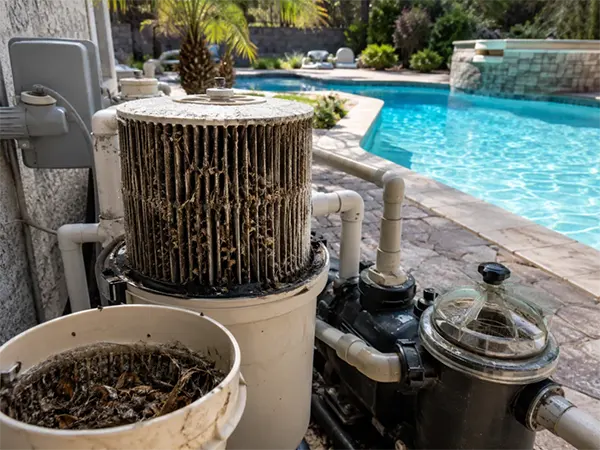
A swimming pool that looks clean enough on the surface can quietly be racking up significant energy and water costs beneath the surface.
Pool owners who don’t stay on top of maintenance rarely see the link between a dirty filter, an unbalanced chemistry reading and a utility bill that just keeps climbing.
The connection exists and is well-documented. Pool pumps already account for 20% to 30% of a home’s total electricity consumption during swimming season, costing homeowners between $30 and $150 per month to operate under normal conditions.
Those costs quickly go well beyond the normal range if your equipment isn’t maintained.
A system that’s working harder than it needs to – pumping water through a clogged filter, or compensating for a chemical imbalance – doesn’t do it for free.
Understanding the specific mechanisms by which deferred maintenance drives up operating costs is the first step toward managing them.
Key Takeaways
- A dirty filter restricts water flow, causing the pump to work harder and consume more energy.
- Poor water chemistry can lead to equipment strain, increased chemical use, and costly maintenance issues.
- Neglected pool equipment often develops wear, inefficiencies, and damage that can increase repair costs.
- Unnoticed water loss can raise utility expenses and lead to additional costs from refilling and maintenance.
Table of Contents:
- How a Dirty Filter Forces the Pump to Work Harder
- Chemistry Imbalance Creates a Cascade of Additional Costs
- What Service Professionals Find When Equipment Has Been Neglected
- Water Loss: The Cost Category Most Pool Owners Do Not Track
- How Pump Run Time Compounds When Maintenance Falls Behind
- The Maintenance Schedule That Keeps Costs in Their Normal Range
- The Utility Bill as a Maintenance Report
- Conclusion
- FAQs
How a Dirty Filter Forces the Pump to Work Harder
The first place deferred maintenance shows up in energy consumption is the filter, and the relationship between filter condition and pump efficiency is straightforward.
A clean filter allows water to flow through with minimal resistance, letting the pump operate at its designed capacity.
As debris, algae, and particulate matter build up in the filter media, the resistance increases, and the pump has to work harder to move the same volume of water.
A larger filter rated at least 50% above the pool’s design flow rate reduces hydraulic resistance, allows a smaller, less energy-intensive pump to do the job, and reduces the frequency of cleaning required.
And the converse is also true: an undersized, clogged or overdue-for-cleaning filter makes the pump work harder and run longer, which means more electricity is used each month and the only evidence that something isn’t right is a utility bill that just keeps getting higher.
Chemistry Imbalance Creates a Cascade of Additional Costs
Water chemistry imbalance is the maintenance gap most likely to create compounding costs across multiple systems simultaneously.
If the pH, alkalinity and sanitiser levels are not within the proper ranges, the pool water will be either corrosive or scale-forming. Both of these conditions will cause damage to equipment.
Corrosive water attacks pump seals, heat exchanger surfaces, and metal fittings, accelerating wear that shortens equipment lifespan.
Scaling deposits accumulate inside pipes and on heat exchanger surfaces, reducing flow efficiency and forcing equipment to work harder to achieve the same output.
Proper chemical maintenance, filter maintenance and pump sizing can reduce pool energy costs by 50% to 80%. If the chemistry is managed consistently, the whole infrastructure runs at designed efficiency.
When it is not, each piece of equipment absorbs additional stress that eventually surfaces either as a higher utility bill, a premature repair, or both.
What Service Professionals Find When Equipment Has Been Neglected
The gap between what a pool owner sees when they look at the water and what is actually happening with the equipment underneath is one of the most consistent patterns pool service technicians encounter.
“We get called in on a lot of pools where the owner has been getting their water bill and their electric bill and just accepting that the numbers are what they are,” said Ricardo Reyes, owner of Reyes Pool Service. “When we actually look at the equipment, the filter is packed, the pump is running longer than it should be trying to compensate, and the chemistry has been off long enough to start building scale in the lines. None of that is visible just from looking at the pool. What we find consistently is that the utility costs and the equipment wear were both preventable. A filter that gets cleaned on schedule and chemistry that stays in range means the pump does its job efficiently and the whole system costs less to run every single month.”
Water Loss: The Cost Category Most Pool Owners Do Not Track
Energy is the more visible half of the maintenance-cost equation, but water loss is the half that most pool owners never add up.
Pools lose water on an on-going basis due to evaporation, splash-out and backwashing. The rate of loss is directly affected by maintenance decisions.
Automated pool systems that optimise pump scheduling by pool usage patterns and water quality conditions can reduce overall energy and water consumption by as much as 75 percent,because they avoid running systems unnecessarily.
How Pump Run Time Compounds When Maintenance Falls Behind
Pump run time is the single largest driver of pool energy cost, and run time increases predictably when maintenance falls behind.
For a clean, well-balanced pool, the pump needs to circulate the water about once a day, which usually translates to six to eight hours of operation for most residential pools under normal conditions.
When a filter is clogged or chemistry is off, the same pump must run longer to achieve adequate circulation, pushing actual costs toward the higher end of that range, regardless of pump type.
The compounding effect of extended run time across an entire swimming season, typically four to six months in most climates, converts what appears to be a minor maintenance gap into a meaningful annual cost difference that consistently surprises pool owners when they see the numbers laid out over twelve months.
The Maintenance Schedule That Keeps Costs in Their Normal Range
The operating costs of a well-maintained pool are predictable and manageable. The operating costs of a neglected one are neither.
It is recommended that the filter be cleaned every one to three months depending upon usage and bather load. More frequent attention may be required during periods of heavy usage or following storm events which introduce debris.
Water chemistry should be tested at least weekly during the active season, with adjustments made before imbalance has time to scale or corrode equipment.
- Proper pump sizing
- plumbing efficiency
- filter maintenance
- and smart scheduling working together allow most pool owners to achieve 50% to 80% energy savings compared to a poorly maintained system.
The practical implication is that the pool owner paying the highest utility bills is rarely the one with the largest pool. It is the one whose equipment is working hardest to compensate for conditions that consistent maintenance would have kept in range.
The Utility Bill as a Maintenance Report
A pool’s energy and water costs are not fixed numbers determined by pool size and climate alone.
They are variables that respond directly to how well the system is maintained, and they have a tendency to trend in one direction when maintenance lags: up.
The filter’s condition, the pump’s run time, the water chemistry’s balance, and the equipment’s overall health each contribute to where operating costs land, and each responds to consistent attention in the same way.
A pool that receives regular professional maintenance runs efficiently, costs less to operate month over month, and rarely produces the equipment failures and emergency service calls that result from systems pushed past their design limits without correction.
The utility bill, when properly interpreted, is one of the best indicators available to show whether a pool is being maintained as its equipment was built to support.
Conclusion
Poor pool maintenance can lead to inefficient operation of the equipment and loss of water, which can add strain on the pool systems leading to higher water and energy costs.
Routine maintenance can help improve efficiency, reduce unnecessary costs, and keep your pool running properly over the long haul.
FAQs
What are common challenges in maintaining a swimming pool?
What are the effects of poor pool hygiene?
Germs in swimming pools can cause gastroenteritis and ear, eye, skin and chest infections. To keep pools clean, shower before and after swimming.
Why is pool maintenance important?
It helps prevent future problems with filters and unwanted debris, which can clog your pool’s systems and cause damage over time.
What is the most expensive part of a pool?
The most expensive part of a pool is usually its structure, meaning the shell of an in ground pool or the liner of a vinyl or above-ground pool.
Latest Blog