Near an east-facing window, out of direct sun and away from radiators, vents and cold glass. Bathrooms and kitchens suit it because the air is damper.
Prayer Plant: Varieties, Care Tips, And What The Brown Tips Mean
Author
Annette HirdReviewed By
Cody Allison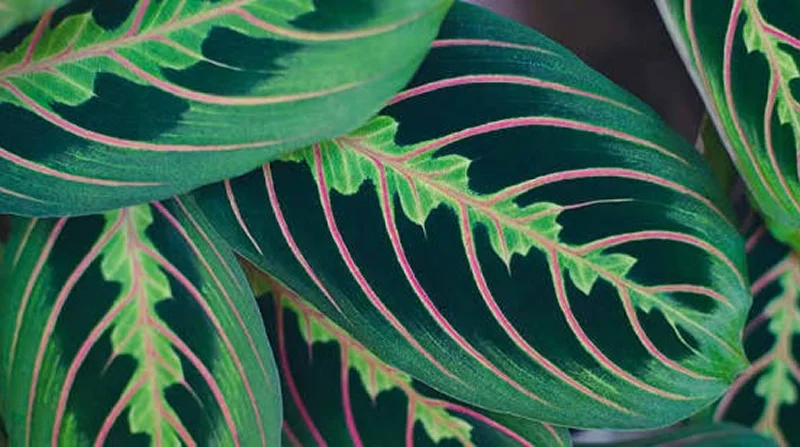
Four different houseplants get sold as prayer plants, and only one is the real thing. Maranta leuconeura is it, named for leaves that lie flat all day and fold upright at night.
Which one you bring home matters, because the care is not the same. Maranta is the forgiving member of the family. Its lookalikes are not.
Below: how to tell them apart, what the plant actually needs, and what the brown tips, yellow leaves, and fading color are telling you. If yours turns out to be a calathea, we have a separate guide for that.
Table of Contents:
What Is A Prayer Plant?
Also known as Maranta leuconeura, a prayer plant is actually native to the rainforests of Brazil, where it grows as an evergreen tree with a perennial nature. They also have a low growth when it comes to its height, and hence, along with its patterned leaves, they make the perfect choice to be grown indoors.
There are different labels that can be attached to this plant, and this is why most people get confused when buying it. Maranta, prayer plant, or just pray plant all have different names, but they all refer to the same plant. The most interesting part about this plant is how the plant actually got its name. This is due to its movements, especially during the nighttime.
The leaves of a prayer plant sit normally throughout the day, but as the night strikes, they fold into an upright position which closely resembles a pair of praying hands and that is why this plant got the name “praying plant”.
The only problem arises when different plants of the same family, which have this very characteristic, get sold under the same name. There are mainly three other genera in the same family that have the same name, and this is why most people actually get the wrong plant despite getting the name right.
Calathea, which has now been renamed to Goeppertia, is the most common variety people mean when they use the term calathea prayer plant. Moreover, while Ctenanthe is the prayer plant that is sold as the fishbone prayer plant, Stromanthe is bought for its tricolour appearance.
One mistake that most people make is that they assume the two are exactly the same plant, but they are actually not. These plants are just relatives of the same family, and that difference is much more practical than it will ever be academic.
This is because while a Maranta plant can grow well under ordinary room conditions, its sister plants like Calathea are far more specific about their growing conditions, including humidity and water. This means that they do not adjust to any schedule of the system that you assign them, which is why so many people conclude they have a black thumb when they really have a different genus.
| Did you know? |
| New leaves arrive rolled up like a tube and unfurl over a few days. The underside is reddish to burgundy, so a plant pushing out new growth shows flashes of purple that vanish once the leaf opens flat. |
Which Variety Do You Have?
There are mainly three kinds of varieties in a prayer plant, which will cover all the cultivars that are sold under different labels.
This is why you should know how to tell all of these apart by the veins because this is a faster method to identify them rather than matching the leaf shapes or sizes, which can take a lot of time.
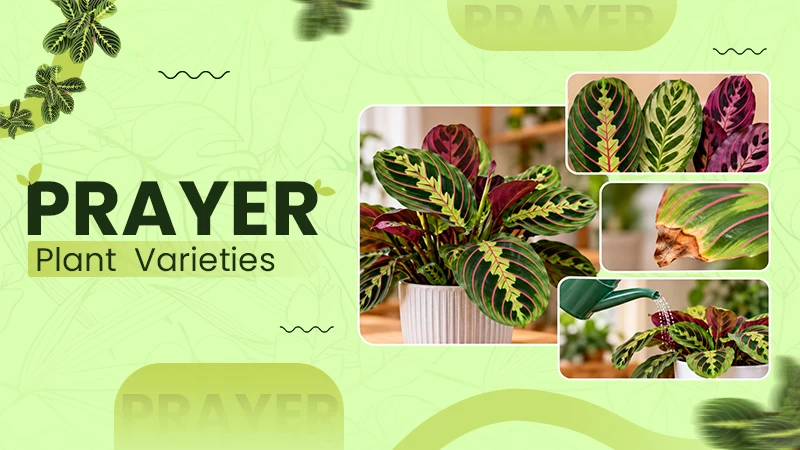
- Red-veined, or herringbone. The most common variety of a red-veined prayer plant, which is also what people usually buy, is called Maranta leuconeura. One more variety that is actually sold both as a pink prayer plant and as a red prayer plant is erythroneura. This plant has bright red veins which move from the middle part of the leaf to its outer, dark green part. This plant is also labelled as the Pink prayer plant in a lot of shops because, under low light, this plant actually showcases veins of a pink shade rather than that of a bright red.
- Rabbit tracks. This variety is actually the easiest to identify because it has a plain green colour with dark blotches on either side of its mid rib, hence giving it an animal footprint-like appearance. This variety is called kerchoveana, and with no red veins at all, this is the cultivar that gets sold under the simple name of a prayer plant because it does not have any other unique feature by which it is explained. One piece of advice is to place it in a dream spot because, here, this plant looks the best, and due to less lighting, the plant will also not lose its colour a lot.
- Black maranta. This is the variety which is much darker in shade than the other two and has a silver marking along its midrib. This variety is popularly known as massangeana, and has fine white veins along either side of its midrib. While most people ask you that this contrast is shown all throughout, that’s actually not true because the shade contrast is only shown under indirect light. This is also one of the hardest species to find, and this is why you may have to consult a specialist to grow it healthily.
- Named cultivars. ‘Fascinator Tricolor’ is the common name of the variety which you can easily find in almost any shop that carries prayer plants. It is also the one you might have seen and already identified with a yellow centre and light green margins. The red ribs present in this variety are actually swapped out for yellow-green striping in ‘Lemon Lime’, and ‘Silver Band’ runs a broad silver patch down the center.
- The lookalikes. The common variety that falls under fishbone prayer plant is Ctenanthe burle-marxii. These species tend to have a much taller growth with a more upright nature. This plant also has a more purple underside, which means that anything sold with the name purple is most likely talking about this variety.
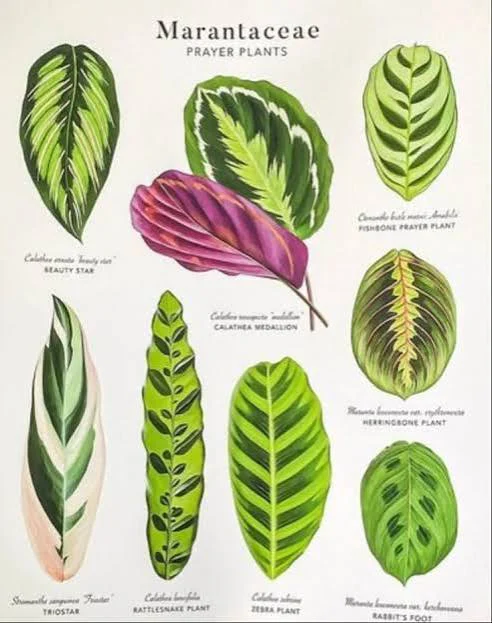
Although there is one thing to note about a prayer plant, which is the reason why most people get it in the first place, is that not every single variety of this plant actually gets big. They usually grow in width rather than height, and can actually spread up to 2 feet across while still staying under a foot high.
Read more: Peperomia Plant: Varieties, Care And Growing Guide
Prayer Plant Taxonomy And Growing Conditions
A prayer plant actually requires the growing conditions of its native habitat so that it can grow healthily. This means that it requires the floor of a Brazilian rainforest to sustain its growth. Hence, filtered light with steady warmth and a soil that never dries out makes the ideal condition for the survival of this plant.
| Botanical name | Maranta leuconeura |
| Common names | Prayer plant, herringbone plant, rabbit tracks, cathedral windows, red-veined maranta |
| Family | Marantaceae (the prayer-plant family) |
| Genus | Maranta |
| Native area | Brazil |
| Hardiness | USDA zones 11a to 11b; a houseplant everywhere else |
| Light requirements | Bright indirect; tolerates low to medium light; no direct sun |
| Type | Evergreen perennial subshrub, clumping and spreading |
| Soil | Well-draining, slightly acidic, peat-based potting mix |
| Water requirements | Evenly moist in growth, drier through winter |
| Humidity | High; intolerant of dry air |
| Mature size | 6 to 12 in tall, 6 in to 2 ft wide |
| Flowers | Small, white to purple, under 1 in; rare indoors |
| Propagation | Division of the rhizome, or root cuttings |
| Toxicity | Non-toxic to dogs, cats, and horses |
How To Care For A Prayer Plant?
The only two things that matter the most when it comes to taking care of a prayer plant are the light and the air. Everything else gets taken care of by the plant itself, and this is also why the plant is called low maintenance.
In fact, these two factors are so important for good growth of this plant that the majority of the causes of stunted growth can be traced back to an issue in one of these two.
- Light. This plant requires bright light but if you put it under direct sunlight then the plant actually acquires more damage. This is why you should keep it in a shaded spot that still receives enough sunlight, preferably near a window that faces east. This is the part that is the trickiest about growing a prayer plant because while the plant grows well in dim spots, it loses its colour in low lighting. This means that the plant will grow healthily, but will lose the exact thing that you purchased it for.
- Water. One thing to make sure of is that you keep the potting mixture of a prayer plant evenly moist, especially during spring season and summer season. This is because one should never overwater the soil, as it would create the problem of waterlogging, so watering only when the top inch has dried is necessary. During winter, one can relax by watering the plant.
- Humidity. This plant requires high humidity, more specifically 50% or more, which is not something a normal room temperature can achieve. This is why it is recommended to get a humidifier or use a pebble tray near this plant so that it can receive the humidity it wants; even a cache pot with pebbles under the nursery pot is the cheap version.
- Temperature. Room temperatures between 65 and 80°F are the ideal temperature settings in which this plant can thrive. One thing worth remembering is to keep this plant away from cold places, like hanging it on a cold glass or keeping it away from ducts and vents.
- Feeding. To grow a balanced prayer plant that can grow healthily, you must feed the plant every few weeks in spring and summer at almost half of its water needs. Continue repeating this process until the growth restarts, after which you should stop feeding it at all because overfeeding it can also damage the growth by burning the leaf edges.
| Quick Tip |
| Misting is the advice everyone gives and the one I would skip. A spray raises humidity around the leaf for a few minutes, and then it is gone, and wet foliage sitting in still air invites fungal spotting instead. Raise the humidity of the whole room instead and leave the leaves dry. |
Prayer Plant Problems And What They Mean
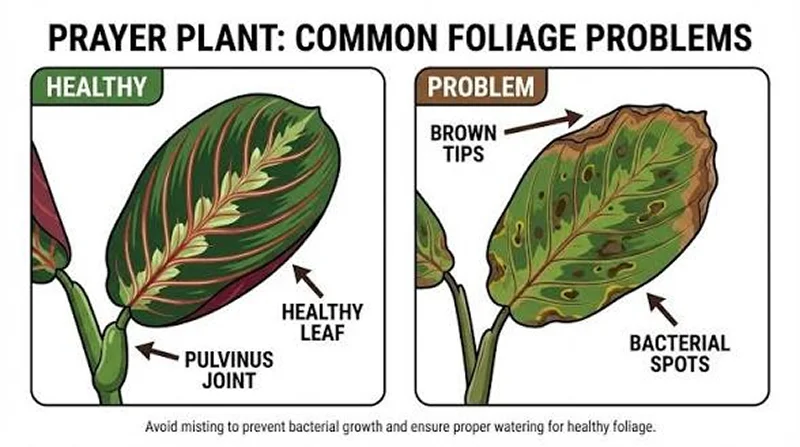
Read the symptom, not the forum.
Prayer Plant Brown Tips
A prayer plant requires dry air and a good watering schedule to sustain its growth, with almost every guide telling you to make the switch to distilled water so that it can grow even better. Iowa State’s extension service lists low humidity as the cause, due to which leaves get a browner tip. In addition to it, inconsistent watering and salt buildup from overfeeding are also signified as the reason due to which the brown leaves occur.
This is why the nature of the water you use for a prayer plant is actually more important than what people assume. This is because a prayer plant is actually listed as one of the plant species that is sensitive to both fluoride and chlorine, and NC State records leaf burn at high fluoride levels. It just takes months to show.
This is why a good approach to solve this situation altogether is to fix the room in terms of its humidity and change the water chemistry that you’re providing to the plant. This can be done by only changing the water cans first, and if the problem is still not resolved, which is that you still find the leaves browning on their tips, then you should change the water. A standard jug filter will not remove fluoride anyway.
Prayer Plant Leaves Turning Yellow
Usually, whenever leaves change shade, most people assume that it is because they have watered it too much, but that is not the case at all, and confusing those symptoms can cost you your plant.
This means that when you start noticing the yellowing on the leaves, always remember that it is a sign of you watering the plant too much rather than too little. Yellowing on leaves actually spreads through the soggy mix or the soft stem, and this is actually the earliest stage of root rot. The best method to fix this is to water the plant less and to actually check if the pot has good drainage. This is one of the things that is often the most overlooked by people, but it is actually more beneficial than anything else.
However, do not take any yellow leaves as a sign of damage, since yellow leaves on the outside of a healthy plant can just be due to its age. So if these leaves go after some time and new leaves replace them, then it means that you have a healthy plant and nothing needs to be changed.
Fading Color
Prayer plant varieties that have red veins and darker markings actually need brighter conditions, like a good amount of food and a good amount of indirect sunlight, and if a plant is left in a dark corner, then it starts losing its colour, making it look faded.
Drooping And Curling
If you observe symptoms of drooping, the best way to start is by checking the soil before you move on to anything else. This is because a dry potting mix actually gives you limp leaves, which recover within a few hours after watering it thoroughly, whereas leaves that curl inwards while the soil is still damp usually have cold drafts or low humidity as their source.
Do They Ever Flower?
Prayer plants do flower, but they only do so in very rare instances when placed inside, and even when they do, the flowers are the least interesting thing about this plant.
The flowers of this plant are actually not that striking in their appearance, as they are small and have colours that range from white to pale purple with darker spots on them. These are two-lipped and are carried on a thin stalk above the foliage.
This plant is therefore rarely grown for its flowers, which is quite different from the reason for which most plants grow. The flowers are actually worth knowing about so that when they bloom on a prayer plant you do not mistake it for a pest or as something wrong in the growth of your plant. Leave it or snip it off, and the foliage carries on either way.
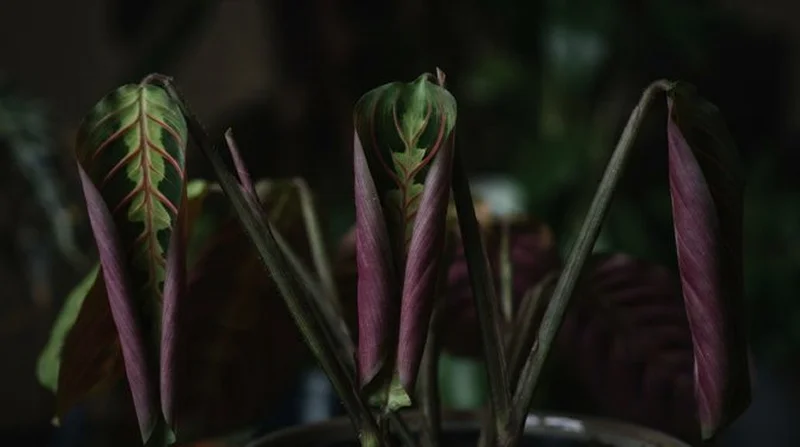
The leaves fold upward after dark and flatten again by morning, which is where the name comes from.
Final Thoughts
While most guides suggest that growing a prayer plant is actually difficult, compared to reality, it actually isn’t true.
However, this is also only true if the variety of the prayer plant you bought at home is a Maranta instead of the fussier cousins of the same plant, which are often sold under the same label and can be mixed up if you do not know how to differentiate them. Growing a prayer plant is actually much easier because all it requires is bright but indirect sunlight, damp air, evenly moist soil, and a light feeding in spring and summer seasons, with cutting back on it during the winter.
And in case something goes wrong, like the leaves have started turning brown at the edges or are showing yellowing, then you should probably check the room for humidity before you ever change the water. This is because dry air and a dark corner explain more brown tips and faded leaves than tap water ever will.
Happy planting!
FAQs
Where Is The Best Place To Put A Prayer Plant?
How Do You Tell If It Is Happy?
It moves. A healthy plant folds its leaves up at night and flattens them by morning, holds strong vein color, and pushes out rolled new leaves through spring and summer.
What Is Special About A Prayer Plant?
The nightly leaf movement, which is driven by changes in water pressure at the base of each leaf stalk rather than by the plant simply wilting. Few houseplants visibly do anything.
Are They Easy To Take Care Of?
Easier than their reputation, and easier than calathea. The two things that catch people out are dry indoor air and a spot that is darker than it looks.
Is It Toxic To Cats And Dogs?
No. It is on the non-toxic list for dogs, cats, and horses, which makes it one of the safer patterned houseplants to keep.
Sources
Maranta leuconeura — NC State Extension Gardener Plant Toolbox — https://plants.ces.ncsu.edu/plants/maranta-leuconeura/
Why does my houseplant have brown leaf tips and edges? — Iowa State University Extension and Outreach — https://yardandgarden.extension.iastate.edu/faq/why-does-my-houseplant-have-brown-leaf-tips-and-edges
Prayer plant leaves turning yellow/brown — Ask Extension, Cooperative Extension — https://ask2.extension.org/kb/faq.php?id=852330
Prayer Plant — ASPCA Toxic and Non-Toxic Plants — https://www.aspca.org/pet-care/animal-poison-control/toxic-and-non-toxic-plants/prayer-plant
Latest Blog