Yes, in zones 5 to 9. It dies back to a woody base each winter and resprouts in spring. Trial plants survived a low of nearly minus 23°F below the snowline.
Russian Sage Plant Care And Growing Guide
Author
Rashika GuptaReviewed By
Cody Allison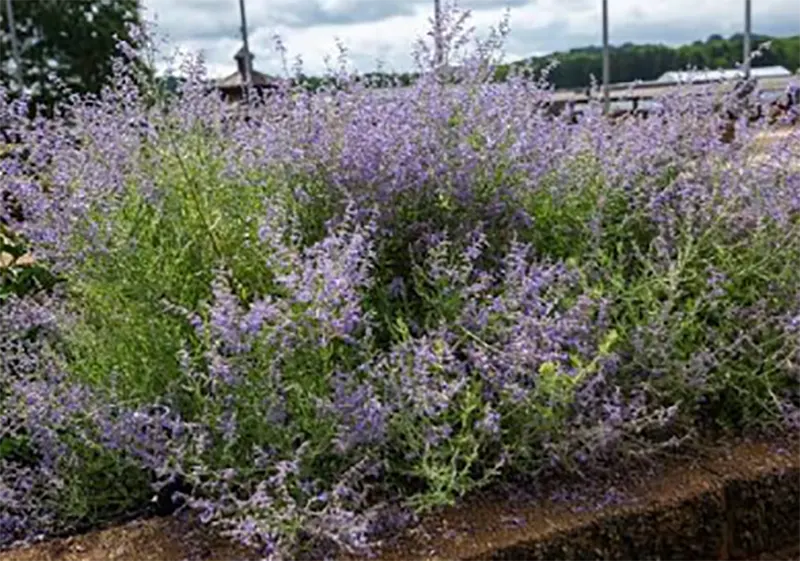
The russian sage plant doesn’t require too much care, not too much little. It can tolerate drought very easily. It is a long-lasting shrub that can grow up to 2 to 4 ft tall. It blooms from June through October; the things that it takes to grow are lean soil and hard sun.
Feed it, water it, and plant it in a rich border, and it will be lying across the path by July. Pair it with our sedum guide instead.
Quick Answer: Russian sage is a drought-tolerant and long-lasting sub-shrub that can grow up to 2 to 4 ft tall and wide. It is lavender-blue in colour and blooms from June through October and comes under USDA zones 5 to 9. Full sun and lean, well-drained soil are the most important factors it needs to grow.
Table of Contents:
What Is Russian Sage?
Russian sage is an upright, long-lasting shrub that has a woody base, silvery aromatic leaves, and small blue flowers that are held in a loose open sprays above the foliage that came form the time of the midsummer onward. It was considered Russian, until recently, a sage. The native range runs through Afghanistan, Pakistan, Tibet and the west Himalayas, a long way from Moscow.
The name on the label depends on when the label was printed. Botanists moved the plant out of its old genus, so the current name is Salvia yangii and the older one is Perovskia atriplicifolia. Nurseries hedge, selling perovskia russian sage, russian sage perovskia, or russian sage atriplicifolia, and advice written as perovskia care applies unchanged.
Being a Salvia now makes it classify as a true sage, which it was not considered before. It is still not the plant that you can cook with. The best trick to know it is to take a stem of the plant and roll it between your fingers and your thumb, and you will know that it is a square. This is the feature that is found in every plant in the mint family. That is the detail I find myself checking on every grey-leaved thing in a nursery.
Did you know?
In parts of Asia, the plant also has a long medicinal history, used for fever, dysentery, and scabies. None of that makes it a kitchen herb.
How Big Does Russian Sage Get?
Two to four feet tall and roughly as wide. The straight species sits at the top of that range, around 3 to 4 ft, while the named varieties most garden centres stock have been bred shorter and stiffer. ‘Little Spire’ stops at 18 to 24 inches. ‘Longin’ goes to about 4 ft tall and wide.
Spacing advice varies wildly, from 18 inches to 6 ft apart. Go by the variety’s mature width and allow the full spread, because a plant squeezed in tight leans on its neighbours.
Russian Sage Bloom Time and Flowers
Russian sage bloom time runs from June through October, which is close to five months of colour and the main argument for growing it. Each russian sage flower is under an inch across, two-lipped and lavender-blue, carried in slender open panicles above the foliage.
The effect at a distance is a haze rather than a block of colour, because the calyxes are hairy catch the light. Bees, butterflies and hummingbirds work it steadily all season.
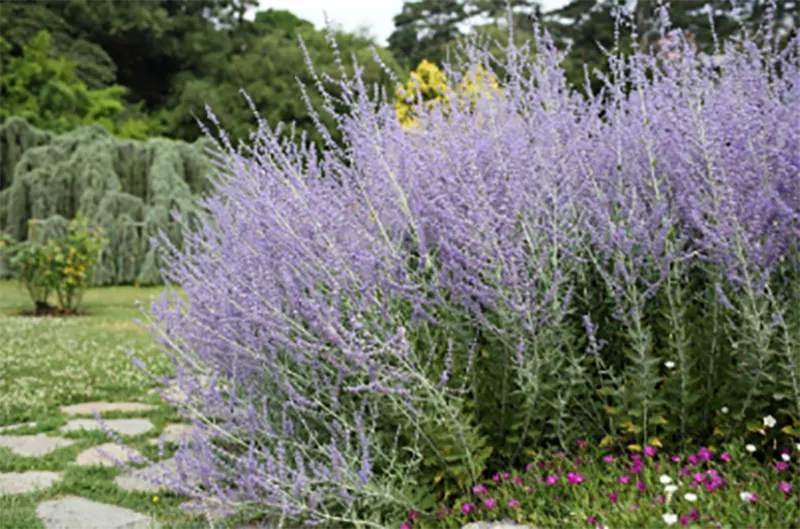
The hairy calyxes stay on after the flowers drop, which is what gives the plant its smoky look into autumn.
Russian Sage Plant Care
Russian sage care is mostly a matter of leaving it alone in the right spot, and the right spot is the one nobody else in the garden wants. These russian sage plants tolerate drought, poor soil, salt, and urban pollution, so I would give it the hot strip by the drive rather than a place in the border.
Sun and Soil
It takes around full sun for at least 6 hours and soil that can easily drain the water. In full sun, it flowers best and is less likely to not bloom when kept in partial shade, as it might get relaxed and stretch. Loam or sand both work perfectly for it, and the pH also matters little. But wet soils should be avoided directly. An eight-year trial that happened lost several plants to excess moisture in one badly drained corner.
Water and Feeding
Water regularly through the first growing season so the plant builds a deep root system, then stop. Once established, it is very drought tolerant, and soil that stays moist will rot it.
Feeding is where opinions part. Some guidance says to fertilise before growth starts in spring, and I would skip it. A plant that tolerates poor soil does not need feeding, and rich ground is one of the reliable causes of a floppy russian sage perennial.
Pruning Russian Sage and Winter Care
The best thing to do is to leave the stems standing through winter, then cut them when they are hard in early spring before new growth starts. They change their colour to silver and hold their shape. This is also the reason why Russian sage earns its place in the border rather than needing care in winter. Take the old growth down to several inches above the ground.
If a plant has gone lanky and dull, the full care of the russian sage fall needs a cut to about 12 inches after the first hard frost and snowfall. The other older references that tell you to trim perovskia mean the same job at the same moment. Expect the odd stem not to resprout.
Tip:
Cut above a visible pair of buds rather than guessing the height that you are about to cut. If the base is woody, then they are easy to see once the old growth is off, and if you cut below one of them, then you will be left with the dead end.
| Russian Sage Plant Stats | Detail |
| Botanical name | Salvia yangii, formerly Perovskia atriplicifolia |
| Plant type | Perennial sub-shrub with a woody base |
| Mature size | 2 to 4 ft tall, 2 to 4 ft wide |
| USDA zone | 5 to 9 |
| Light | Full sun, 6+ hours |
| Soil | Lean, well-drained loam or sand; any pH |
| Water needs | Regular in year one, then little |
| Bloom season | June through October |
| Flower | Lavender-blue, under 1 inch, in open panicles |
| Pests and disease | No serious problems; root rot in wet ground |
| Wildlife | Bees, butterflies, hummingbirds; deer and rabbit resistant |
Read more: How to Grow Rosemary: Planting, Propagation, and Care Tips
Why Russian Sage Flops and Which Varieties Stay Upright
It can flop and not bloom for three reasons, and two of them are due to the planters. The shade that you give produces a relaxed and expanding habit. Also, the rich soil that you see gives it a soft growth, which might not help it grow into a big and grown-up plant and stand upright. The third reason is the variety itself, and in this case it has the real evidence rather than just the copy of a register.
Chicago Botanic Garden ran fourteen Russian sages side by side for eight years, with almost no trimming, no fertiliser, and no soil cover at all. Out of all the varieties, the five that earned the top ratings were: ‘Blue Jean Baby’, Blue Spritzer, ‘Blue Steel’, ‘Denim ‘n Lace’ and Little Lace. Only one of them was rated poor, which was Lacey Blue, purely for staying floppy, with crowns splayed and stems down by mid-July.
Bonus: Russian sage seeds germinate slowly and unevenly and take nearly one to four months at 60 to 65°F; also, the seedling varies in height, flower, colour, and the shape of its leaves. Named cultivars beat seed-grown plants when habit matters the most in the growing conditions.
Does Russian Sage Spread?
It forms a bunch that grows up to 2 to 4 ft wide and stays there in most of the gardens for a longer period of time. No extension services have a record of it being an aggressive self-seeder. The eight-year trial and research on this plant mentioned that the rhizomatous stems it carries are only one possible reason two older varieties broke into separate plantlets.
Plants That Look Like Russian Sage
Two plants get mistaken for it constantly, and both are close relatives in the mint family with the same grey aromatic leaves and the same blue-violet flower spikes.
- Lavender. One to two feet tall, broadly mounded and evergreen, flowering in summer, and the only one of the three you cook with. Russian sage versus lavender comes down to height and season, because this plant is still flowering in October when lavender has long finished. A search for russian lavender almost always means one of these two.
- Catmint. Eighteen to twenty-four inches, cascading and spreading as wide as three feet, flowering spring into summer. Shear it after the first flush and it flowers again. It also takes partial shade. Russian sage will not.
That height ladder decides the planting order: catmint at the front, lavender in the middle, Russian sage behind. For planting russian sage near either one, allow its full spread. Browsing russian sage plants for sale makes that harder than it should be, because listings rarely give a mature height.
Takeaways
The russian sage plant is a 2 to 4 ft long-lasting sub-shrub for USDA zones 5 to 9, that flowers and is blue in colour from June to October with the help of full sun and lean, well-drained soil.
You only need to water it in the first year and then rarely after that.
The best thing is also that you can skip putting in the fertiliser, cut it back hard in early spring, and choose a trial-rated variety if you want it upright without staking.
FAQs
Will russian sage come back every year?
Is Perovskia atriplicifolia russian sage the same plant?
The same plant. Russian sage, Perovskia atriplicifolia, is the old botanical name, now replaced by Salvia yangii. Nothing about its care changed.
Does russian sage like shade or sun?
Sun, and no compromise on it. Six hours of direct sun is the minimum. Anything less gives a lax, sprawling plant with fewer flowers.
Where is the best place to plant it?
The hottest, driest, poorest spot you have that drains freely. A south-facing strip by paving suits it better than a watered border.
What is the russian blue sage plant sold as?
Usually a named variety picked for flower colour, such as ‘Blue Steel’ or ‘Denim ‘n Lace’. Blue is the normal colour for the species, so the word adds nothing botanically.
What are the pros and cons?
Five months of flower, no pests, and deer and rabbits leave it alone. Against that: it flops in shade or rich soil, rots in wet ground, and is not edible.
Sources
Salvia yangii (Russian Sage): NC State Extension Gardener Plant Toolbox: https://plants.ces.ncsu.edu/plants/salvia-yangii/
Russian sage, Salvia yangii: Wisconsin Horticulture, Division of Extension: https://hort.extension.wisc.edu/articles/russian-sage-perovskia-atriplicifolia/
An Evaluation Study of Russian Sage Cultivars: Chicago Botanic Garden: https://www.chicagobotanic.org/plant-evaluation/russian-sage-cultivars
Latest Blog