Watermelon must be planted outdoors under bright sunlight for at least 6 to 8 hours a day and with rich, loose, well-drained soil.
Watermelon Plant Guide: Care Tips, Growing Steps, Health Benefits, & Much More
Author
Rashika GuptaReviewed By
Cody Allison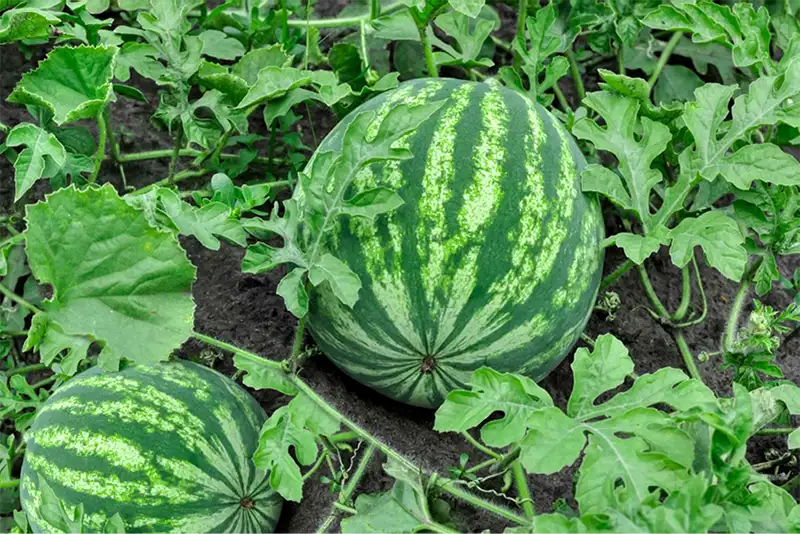
Watermelon plants are annual, low-maintenance and thrive best in warm climates. The fruit is many people’s favourite and is widely cultivated. The plant is also pollinator-friendly and attracts pollinators like bees, butterflies, and hummingbirds. These pollinators help in carrying sticky pollen from male to female watermelon flowers. Without this essential step, flowers drop off and fruit cannot be grown.
So, before planting watermelon, read the article to learn about its taxonomy, care tips, growing steps, pests and diseases associated with the plant, and much more.
Table of Contents:
Taxonomy and Ideal Growing Conditions for Watermelon Plant
The watermelon plant grows best in hot climates and is native to tropical Africa and cultivated all around the globe. This fruit is considered to be a kind of berry that is botanically known as a pepo.
For a quick taxonomic overview and ideal growing conditions, have a glance at the table given below:
| Botanical name | Citrullus lanatus |
| Kingdom | Plantae |
| Order | Cucurbitales |
| Family | Cucurbitaceae |
| Genus | Citrullus |
| Native area | Tropical Africa |
| Hardiness | 3 to 11 USDA Zones |
| Light Requirements | Full sun for at least 6 to 8 hours a day |
| Maintenance | Low to average |
| Plant type | Annual |
| Soil | Fertile, loose, well-drained, moist soil with slightly acidic to neutral pH levels between 6.0 and 7.5 |
| Water Requirements | Average to moderate |
| Mature size | The mature fruit ranges between 5 and 30 pounds and is around 6 to 24 inches long. |
| Fertilizers | Use seaweed-based fertilisers |
| Toxicity | Safe for both humans and pets |
Did you know?
- Watermelons are approx. 90 per cent water.
- In the United States, August 3 is widely celebrated as National Watermelon Day.
Read more: Peperomia Plant: Care Tips For A Healthy Radiator Plant
Watermelon Plant Care
While growing watermelons, most people are aware of the location that the fruit prefers for growing, but there is much more. The watermelon plant prefers full, direct sunlight for at least around 8 hours a day with rich, well-drained sandy soil. It also prefers to be watered deeply and consistently. Here are some of the watermelon plant care tips that I followed for a healthy plant:
- Amend soil with manure, seaweed, or compost before planting.
- Water your vines regularly to keep the soil moist.
- Watermelons are known to be heavy feeders. Therefore, use fertilizer during the growing season for healthy fruit.
- Make sure that the location you chose to plant watermelon is wide enough, as watermelons require a lot of space to spread.
- The location must receive direct sunlight for at least 6 to 8 hours a day.
- Mulch around the plant base to suppress weeds and maintain soil temperature.
- Blossoms require pollination to set fruit. It is important to be kind to bees, hummingbirds, and butterflies.
- Always check for pests on the underside of the leaves. If you find any, use organic pesticides to remove them.
Read more: How to Grow Dragon Fruit? Learn to Grow this Unique Tropical Fruit
How to Grow Watermelon?
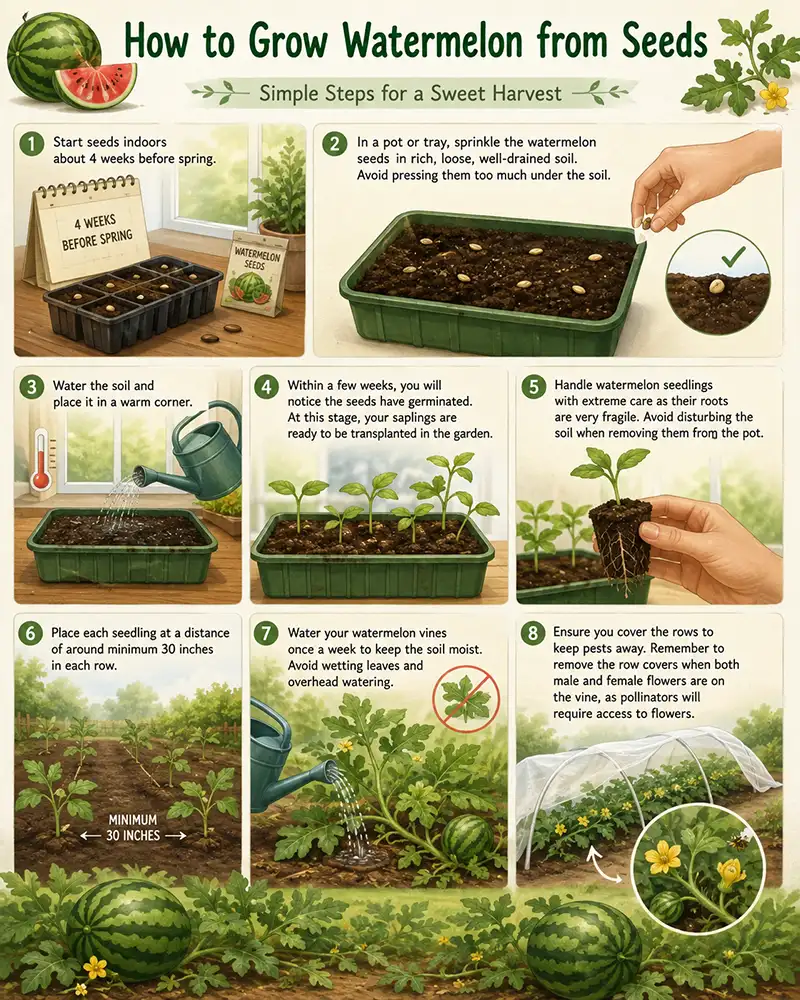
Ever wondered how watermelon is grown? Well, watermelon is grown using seeds. It includes some very simple steps that are listed below:
- Start seeds indoors about 4 weeks before spring.
- In a pot or tray, sprinkle the watermelon seeds in rich, loose, well-drained soil. Avoid pressing them too much under the soil.
- Water the soil and place it in a warm corner.
- Within a few weeks, you will notice the seeds have germinated. At this stage, your saplings are ready to be transplanted in the garden.
- Handle watermelon seedlings with extreme care, as their roots are very fragile. Avoid disturbing the soil when removing it from the pot.
- Place each seedling at a distance of around a minimum of 30 inches in each row.
- Water your watermelon vines once a week to keep the soil moist. Avoid wetting leaves and overhead watering.
- Ensure you cover the rows to keep pests away. Remember to remove the row covers when both male and female flowers are on the vine, as pollinators will require access to flowers.
Tips
- Reduce watering once fruit is growing because dry weather produces the sweetest melon.
- Consider using compostable pots that can be easily removed or planted directly. This will keep the roots intact and unaffected, leading to a healthy plant.
- If you are planning to sow the seeds directly outdoors, sow 5 to 7 seeds per hill.
Read more: Mulberry Tree: Taxonomy, How to Grow, Propagate, and Care Tips I Followed
Health Benefits of Watermelon
Lately, people have become much more health-conscious. This has also led to counting calories and choosing food options that are both healthy and low in calories. Watermelon is among such fruits that fulfil both aspects and have few calories and so much water that it keeps you hydrated and promotes many health benefits. Here are some of the health benefits of consuming watermelon:
- Staying hydrated is important for the body to function efficiently and effectively. Since watermelon is around 90 percent water, it helps you to stay hydrated for a longer period.
- According to NIH, watermelon has several nutrients that may support heart health. Lycopene helps lower cholesterol levels and blood pressure.
- A study by NIH on animals suggests that watermelon also helps in reducing inflammation and oxidative stress. But there are no studies in humans yet to verify the same.
- Watermelon is rich in Vitamin A and C, which are important and beneficial for skin health. While vitamin C can help in preventing wrinkles, vitamin A repairs skin cells.
Nutritional Value of Watermelon
Watermelon contains various nutrients like potassium, magnesium, and vitamins A and C. It is also relatively low in calories, which makes it perfect for a weight management journey.
Here is the list of nutrients in 152 gm of diced watermelon:
| Nutrient | Value |
| Calories | 46 |
| Carbohydrates | 11.5 gm |
| Fibre | 0.6 gm |
| Natural sugar | 9.4 gm |
| Protein | 0.9 gm |
| Fats | 0.2 gm |
| Vitamin A | 5% of the daily value |
| Vitamin C | 14% of the daily value |
| Potassium | 4% of the daily value |
| Magnesium | 4% of the daily value |
Quick tip
The best way to store watermelon is in a large plastic zipper bag or food containers. This keeps the fruit fresh for longer, and containers help with mess-free handling.
Read more: Campanula Plant: Varieties, Growing Process and Caring Tips
Common Pests and Diseases Associated with Watermelon Plant
There are certain pests and diseases that can attack your watermelon plant that might further lead to plant death or no fruit. Here is the list of pests and diseases with their solutions:
| Pests and diseases | Solutions |
| Alternaria leaf blight | It can cause a fungus that might appear as small, yellow-brown spots on leaves. To avoid Alternaria leaf blight, rotate cucurbits with another crop every 2 years. |
| Cucumber beetle | They are the biggest watermelon pests that lay eggs on the plant base and leaves. To prevent them from attacking your plant, use row covers. |
| Aphids and mites | Aphids and mites generally attack every plant. They can be prevented with a strong water spray and the use of neem oil or other organic pesticidal soaps. |
| Anthracnose | They appear as brownish-yellow and black spots on watermelon leaves, fruit, and stem. Anthracnose can be spread by wind and rain. To avoid this fungal disease, use disease-free, treated seed when planting watermelon plants. |
Read more: Pink Paradise: 30 Beautiful Flowers to Embellish Every Garden
Takeaways
Watermelon is a juicy fruit that is enjoyed by many on hot summer days. It has high water content and is packed with nutrients like potassium, magnesium, vitamins, and lycopene, which are beneficial for your health.
This annual plant is also easy to grow and can be planted in mid-summer. Next time you go out to buy watermelon, save its seeds and plant them next spring for organically grown watermelon fruit.
Happy planting!
FAQs
Where to plant watermelon?
When to plant watermelon?
The best time to plant watermelon is in late spring, after the frost has completely passed. You can also start seeds indoors around 3 to 4 weeks before planting them outdoors.
How to cultivate watermelon?
Grow watermelons in full sun for around 8 hours a day in rich, well-drained sandy soil. Water the soil deeply and consistently, and harvest the watermelon in around 70 to 80 days.
Can I eat watermelon at night?
Yes, you can eat watermelon at night. It has a high water content that keeps you hydrated.
Sources
Watermelon: Britannica