Spring or early fall. Fall planting works as long as you keep watering until the ground freezes.
Arborvitae: Taxonomy, Care Tips, Varieties, and the Mistakes You Can't Undo
Author
Annette Hird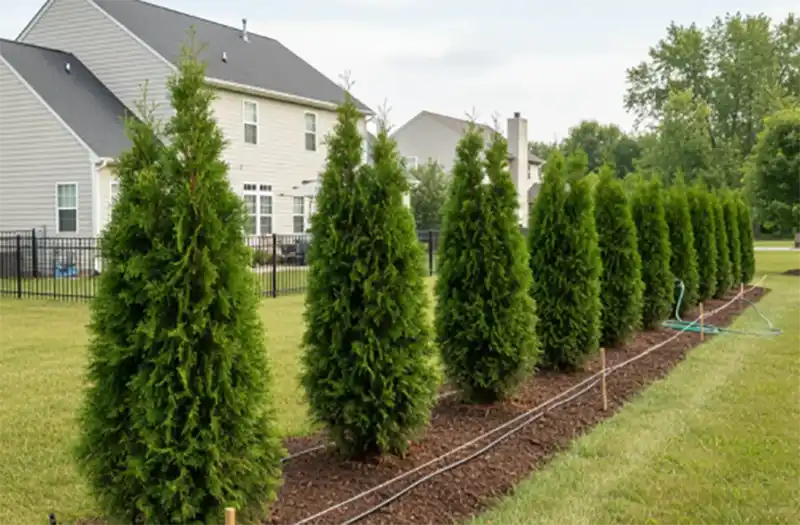
Arborvitae has a reputation as the easy evergreen. The reputation is deserved. It is also, quietly, one of the least forgiving plants you can put in a garden.
Most shrubs give you a second chance. Cut one back too hard, and it sulks for a year, then recovers. This one doesn’t work that way. Damage tends to stay exactly where it happened.
That trait should shape which one you buy, how far apart you space them, and how seriously you take a few weeks in June.
Read on for a full arborvitae growing guide: taxonomy, the types worth planting, ideal growing conditions, care, pests, and the one pruning rule that makes everything else permanent.
Table of Contents:
- What Arborvitae Actually Is, and Which Species You're Buying
- Which Arborvitae Should You Plant?
- How to Grow Arborvitae?
- Arborvitae Care Tips Through the Year
- The One Pruning Rule That Makes Every Other Mistake Permanent
- Pests and Problems Associated with Arborvitae
- Dwarf and Globe Arborvitae for Small Gardens
- Takeaways
- FAQs
- Sources
What Arborvitae Actually Is, and Which Species You’re Buying
Arborvitae is the common name for a small group of evergreen conifers which are bunched together and sold in such a way that most people get different species of the same plant and rarely ever realise it. And it is genuinely worth knowing the difference because both the conifers belong to different species and thus actually have very different habitat habits, so without knowing the difference one would not be able to help grow it suitably.
The first one, which is found in more native regions, is called Thuja occidentalis, the American arborvitae, also sold as northern white cedar. Its height also differs depending on the place it is growing in; for example, it grows up to 40 to 60 feet in wild areas but only grows about 20 to 30 feet in a garden.
While the American version of Arborvitae grows slowly, this version of the evergreen conifer has bigger and faster growth, which can be seen a lot more. It is called Thuja ‘Green Giant’, and while it is not a variety of the American species, it comes as a hybrid between the western red cedar and Japanese arborvitae bred in Denmark in the 1930s.
Both are sold as an arborvitae tree in some catalogues. In others, the same plant is an arborvitae shrub. Rounder forms become an arborvitae bush. You’ll see arbor vitae too, or it misspelled arborvite or aborvitae.
Taxonomy and growing conditions for the native species:
| Botanical name | Thuja occidentalis |
| Common names | Arborvitae, American arborvitae, northern white cedar |
| Family | Cupressaceae (Cypress family) |
| Genus | Thuja |
| Native area | Eastern and central Canada, eastern United States |
| Hardiness | 2 to 7 USDA Zones |
| Light requirements | Full sun; tolerates part shade |
| Type | Evergreen conifer; tree or shrub by cultivar |
| Soil | Medium-moisture, well-drained; neutral to alkaline loam |
| Water requirements | Moderate and consistent; poor drought tolerance |
| Mature size | 20 to 30 ft tall, 10 to 15 ft wide in cultivation |
| Tolerant | Clay, wet sites, air pollution, black walnut |
| Not tolerant | Dry soil, exposed windy sites, deer |
Most people don’t know this about evergreen conifers, and it is genuinely one of those things that deserves more attention than it gets, and it is about Black walnuts. Most plants die as soon as they reach within the conifer’s roots; however, black walnut is the only one that survives the root, so if you have a walnut and a patch of dead ground under it this is one of those low-cost and low-effort techniques that you should definitely try out.
Did you know?
The same species sold in three-gallon pots includes some of the oldest trees in eastern North America. On the limestone cliffs of the Niagara Escarpment, researchers dated a living eastern white cedar that germinated around 952 AD, and a dead one carrying 1,653 rings. They stay small and gnarled because nothing grows fast on a rock face, which appears to be why they last so long.
Read more: Best 15+ Small Evergreen Garden Plants Perfect for Compact Spaces
Which Arborvitae Should You Plant?
Most of the time, people plant the wrong type of species and then wonder why their plant does not grow as healthily as it should. This is generally one of the most common mistakes that people make, and the best way to avoid this mistake is to consider all the factors of planting, including space, light, and more, before you ever start planting.
According to the Penn State Extension lists, Thuja occidentalis is stated as a highly susceptible plant. Hence, it is advised to start with the easy species of this conifer, like the deer.
Typically, Thuja occidentalis has a signature damage that you can spot from far away, and it leaves plants so much so that you might feel a trimmer was run along it. While most guides bury this near the bottom, it should actually be mentioned at the top because this decides everything else. The damage includes a brown band that spreads across the hedge and is tall enough so that a deer can reach.
Thuja ‘Green Giant’ resists browsing. Plant green arborvitae like ‘Emerald Green’ where deer pass through, and you have planted deer food at nursery prices.
The second question that comes about growing this species is regarding space, and many people actually think that the ‘Green Giant’ is a good option for people who do not have a big space for the usual Thuja species. This is so as ‘Green Giant’ matures at 12 to 18 feet wide. That is a driveway. On a narrow strip, the fast grower is wrong; however, appealing three to four feet a year sounds.
The types of arborvitae worth considering:
| Type and image | Mature size | Deer | Best for |
Thuja ‘Green Giant’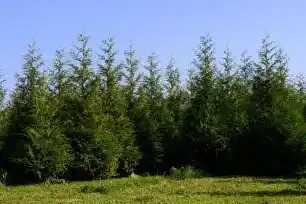 Green Giant arborvitae grown as a windbreak. | 40–60 ft tall, 12–18 ft wide; 3–4 ft a year | Resistant | Windbreaks and fast screening. Needs room. No salt. |
‘Emerald Green’ (Smaragd)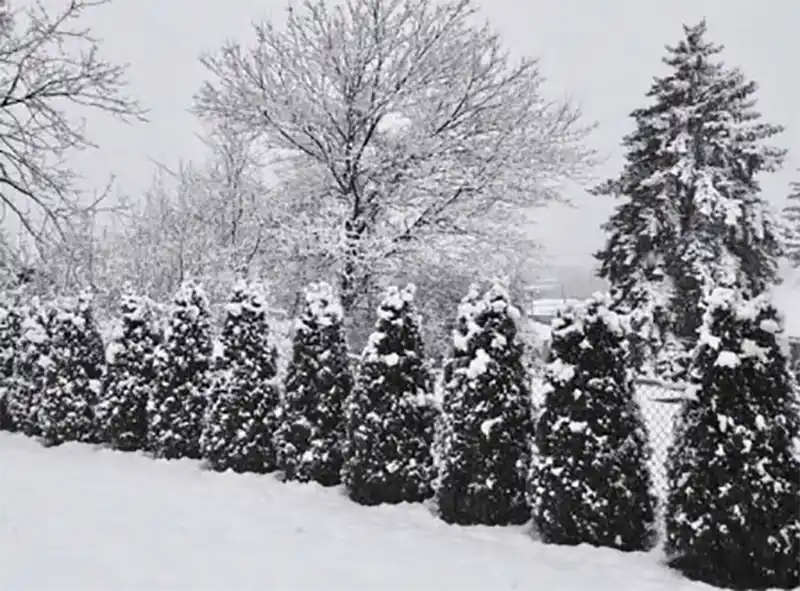 Emerald Green arborvitae in winter colour. | Compact, roughly 3–4 ft across | Vulnerable | Tight spaces. Holds colour through winter. |
‘Techny’ (Mission)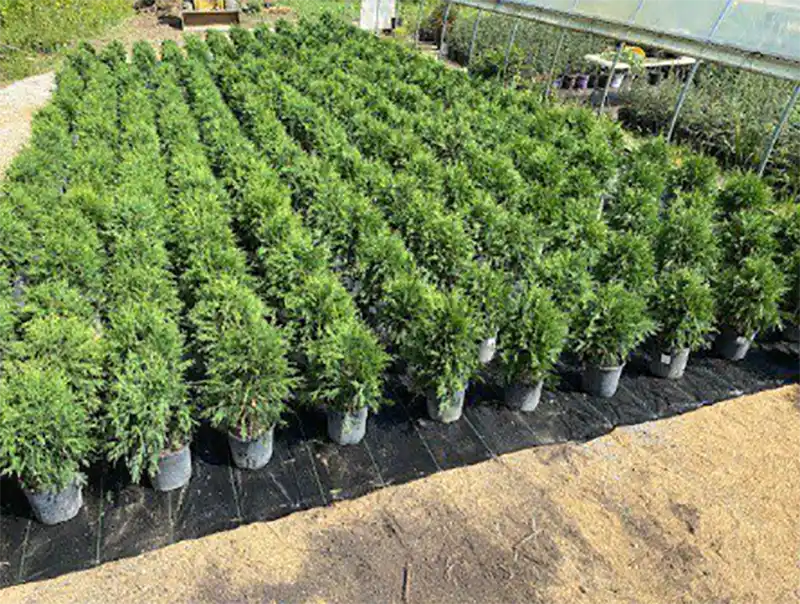 Techny arborvitae as a clipped hedge. | Broad pyramid, mid-sized | Vulnerable | Hedging for density over height. Slower. |
Globe and dwarf forms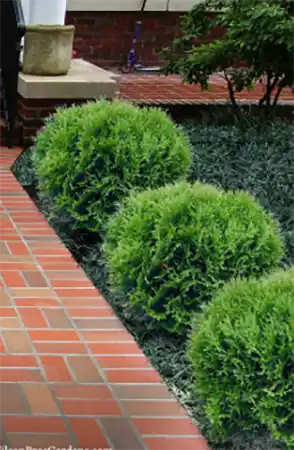 Dwarf globe arborvitae along a path. | Typically 2–5 ft, rounded | Vulnerable | Containers and low borders. No screening. |
Quick tip
I don’t bother with deer spray in summer. The browsing that ruins a hedge happens in late winter, when everything else has been eaten, and an evergreen is the only green thing left. Protect them from January, and net high enough to cover the top.
How to Grow Arborvitae?
Typically, people spend more time thinking about what is a good time to grow Arborvitae. However, the question that they should ask is what to do after they plant the species.
Spring and early fall are both good options to cultivate Arborvitae, but this season’s choice of growing matters far less than what you do in the summer that follows after you plant it.
For Thuja occidentalis planting, the sequence is short:
- You need a good amount of light and a reliable drainage system to grow this species, so full sun is recommended, and a dry, windy corner is not. Part shade is also survivable.
- After you figure out which part of the ground has a good amount of sunlight hitting it, calculate the width of the ground from there instead of from the pot and the front of you.
- Then dig a hole that is twice times wider than the root ball, and it should not be deeper than the height of the species. Once that is done, tease the roots apart if the plant is pot-bound.
- Set the root ball level with the soil and backfill with what you dug out, firming gently.
- Almost all failures in the first year of growing a plant are water failures, so remember to water in thoroughly, then mulch a few inches deep, off the trunk.
- Keep watering all first season deeply, and don’t stop in autumn.
The step that most people give as the aftercare while growing a plant gives way for that young plant to go into winter with dry roots and have poor drought tolerance, which leads the way for a classic setup of February browning.
How Far Apart to Plant Arborvitae
Arborvitae plants are one of those species which tend to grow wider and bigger than what is expected.
So the most honest advice to make sure your garden looks clean is not to place the plants at larger distances but to plant fewer plants. A screen of ‘Green Giant’ set eight feet apart looks generous for three years and becomes a wall of overlapping, shaded, thinning growth by year ten.
Now, wider spacing can cost money when you are just starting out the planting of species, and it may look unnecessary, but over time it will convert into a hedge that still looks good when the arborvitae trees are mature.
Arborvitae Care Tips Through the Year
The most common mistake that people make while caring for this species is that they do not take into account the plant’s water needs. And so water automatically becomes the one thing that is the reason for most first-year failures.
Usually, the established plants are low maintenance and do not require much of your effort, but establishing those plants in a well-maintained environment is the hard part of the job.
This means that until the roots of your plant begin to reach out in the surrounding soil, the plant requires extensive care in the form of a watering schedule.
- Typically, people only water the plant lightly, and they do so daily, but this kind of shallow watering gives way for shallow roots. And that is something which hinders the growth of your plant in a dry August; hence watering deeply and less often is the way to go.
- Keep watering the plant into late autumn because evergreen conifers like these tend to lose moisture through their foliage all winter, and this replaces the water with what the soil held when it’s frozen.
- Avoid overuse of fertilizers unless a soil test actually suggests using them because feeding a stressed plant makes it worse.
- When the stem of a plant is bent, it really never stands back upright again. The reasons for this can be heavy wind, rain, or snowfall. That’s why it is a good option to regularly brush heavy snow off.
- Expect interior browning every autumn. Older foliage yellows and drops on a natural cycle. It looks alarming and means nothing.
Not a lot of attention is paid to this one factor, which makes up one of the most interesting and worth-noting arguments of all time: the interior.
The dense interior that makes a plant look good or have a good screening is also the reason why most songbirds use it as a nesting cover. That’s why it’s probably better to leave the inside of the plant alone and not modify it.
The One Pruning Rule That Makes Every Other Mistake Permanent
The most common thing to understand about this species that many people don’t realise until after it’s too late is that every plant that belongs to this family lineage has almost the same structural limitation. Arborvitae doesn’t grow from old wood, and once you understand this, the word load stops being about routine maintenance, and it actually starts being consequential.
According to the University of Maryland Extension, most conifers do not produce new growth from old wood, including this variety. Also, such conifers remain leafless if you create it to stay that way. This happens not just for a season, but occurs more permanently. This means that if you cut into the bare brown interior, nothing will come back.
So you can shape the green and nothing else. Light shearing of the current year’s growth keeps a hedge tidy. Cutting back to bare stems to reduce an overgrown plant doesn’t reduce it; it disfigures it. When one gets genuinely too big, the extension advice is to replace it.
Which is why the spacing decision earlier was never really about spacing. Plants set too close to shade each other’s interiors; that foliage dies back, and cutting won’t return it. The hedge you plant in year one is broadly the hedge you keep.
Pests and Problems Associated with Arborvitae
Four things do most of the damage here. One can kill a mature hedge in a season if nobody spots it in June.
| Pest or problem | Solution |
| Bagworms | The serious one. Larvae emerge late May to mid-June, and Bt spray works only while they are small, because the larva soon seals itself in its bag. Handpicking is the cheapest control on a small hedge, and winter is the easiest time to see them. |
| Deer | Netting or fencing through late winter, or plant a resistant hybrid. Repellents need reapplying and fail in the hard weather when browsing peaks. |
| Leafminer, mites, scales | Leafminer turns tips tan and hollow; shear them off in spring. Mites and scales leave foliage dull or sticky, and horticultural oil handles light infestations. Mites build up on drought-stressed plants, so fixing the watering fixes most of it. |
| Winter burn | Yellow-brown foliage on the windward side in late winter, from water lost faster than frozen ground replaces it. Autumn watering and wind shelter prevent it. |
| Blight, canker and root rot | Spotting, dead branches, or decline in waterlogged ground. Prune into healthy wood, improve airflow, fix drainage. Root rot has no cure. |
Usually people do not understand the importance of the pruning rule while cultivating Arborvitae plants, but if you imagine the bagworm timeline next to the pruning rule, you will understand why these rules matter more here than elsewhere.
See, complete defoliation when an infestation is missed is completely common, but a stripped conifer cannot grow its foliage back from bare wood. That is not a setback that can be compensated for during the aftercare. That destroys your whole hedge and everything you worked so hard for.
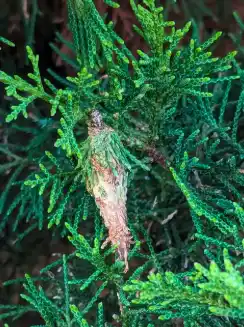
Close-up of bagworm cases hanging among green arborvitae foliage.
Did you know?
A bagworm builds its case from fragments of whatever it is eating. On this plant, that means a bag covered in its own foliage, which is why they are so easy to walk past. By mid-August, it is close to two inches long. Most people notice only when they reach in to prune and find the little cone attached to nothing.
Read more: Spirea: Taxonomy, Care Tips, Ideal Growing Conditions, & Much More
Dwarf and Globe Arborvitae for Small Gardens
The pruning rule is one of the reasons why small species of such plants are a good option for growing in most gardens. Not only are they easy to plant, but they are also cheap to replace.
So dwarf arborvitae and globe forms are a good option if you want low-effort plants that take up less space in your garden because these varieties of the Arborvitae family typically hold their shape at two to five feet without shearing, so the pruning trap never opens.
They screen nothing. Plant them for an evergreen shape in a border or container, and plant something else if you want privacy.
Takeaways
Arborvitae deserves its reputation as a low-maintenance evergreen, and nearly everything here is about protecting that reputation from a few decisions made in the first month. Choose for deer pressure before looks. Space for the mature width. Water through the first autumn.
None of which applies at the warm end of its range. Thuja occidentalis is a cold-climate plant, hardy from zone 2, and struggles in hot, dry summers. Below zone 7, this advice holds. Above it, ask what else will do the job.
What makes this plant unusual isn’t that it’s difficult. It’s that the feedback arrives so late. A hedge planted too close, in too much wind, in deer country looks fine for four years. By the time it tells you what you got wrong, the pruners can’t fix it and the plant can’t outgrow it.
Happy planting!
FAQs
When to plant arborvitae?
Is arborvitae care different for hedges than for single plants?
Watering and feeding are the same. Spacing and airflow matter far more in a hedge, where crowded plants shade out their own interiors.
What are the main types of arborvitae?
The native Thuja occidentalis and cultivars such as ‘Emerald Green’ and ‘Techny’, plus the hybrid Thuja ‘Green Giant’, which is far larger and more deer-resistant.
My arborvitae has turned brown. Is it dead?
Depends where. Browning inside in autumn is normal shedding. Browning on the windward face in late winter is winter burn and usually recovers. Browning from the top down, or bare patches at deer height, needs a proper look.
Sources
The Mighty Arborvitae: Penn State Extension
Thuja occidentalis: Missouri Botanical Garden Plant Finder
Thuja occidentalis: North Carolina Extension Gardener Plant Toolbox
Thuja ‘Green Giant’: North Carolina Extension Gardener Plant Toolbox
Cutting back arborvitae: University of Maryland Extension, Ask Extension
Bagworms (G7250): University of Missouri Extension
Thuja occidentalis: The Gymnosperm Database