Fewer than most plans specify. Start from where you actually need light on a surface and work outward, rather than spacing a grid evenly across the ceiling.
Mastering the Glow: How to Layer Ambient, Task, and Accent Lighting in Open-Concept Homes
Author
Swati MishraLast Update
September 22, 2026
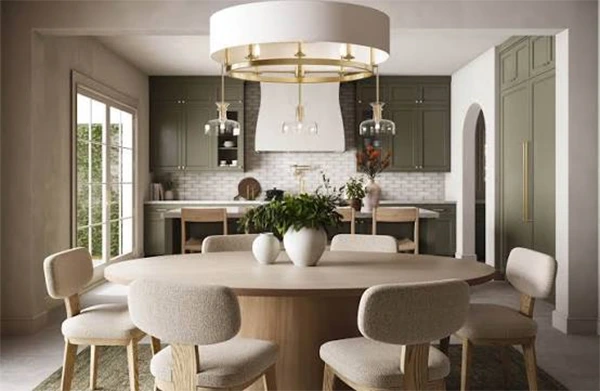
Whenever it comes to an open-plan lighting conversation, make sure the conversation is happening between you and a professional, not someone who used to fit lights in normal houses and now is wondering what you’re talking about.
Only bright is not what you want; you want a house that is lit on purpose, has character, and serves both functional and aesthetic properties.
The three layers of lighting that make the home perfect to both look and live in, the considerations, best approaches, and exactly what you should do to achieve lighting the way you want are what we are covering in this article.
Table of Contents:
Why Open Plan Breaks the Usual Rules
In a house with walls, each room has its own lighting problem, which is solved on its own terms and switched independently. This is easy to understand only till it happens actually.
The kitchen has to be bright and functional. The living room can be low and warm. In normal homes, only walls can separate them, with no other noticeable changes.
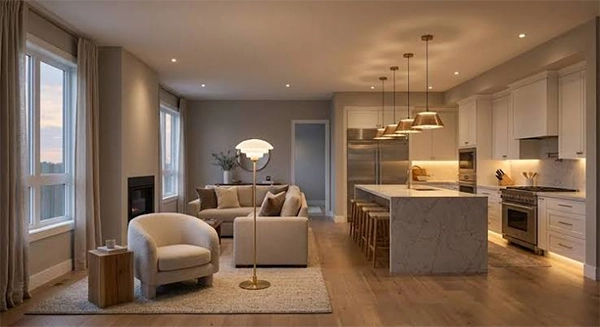
Take the walls out and every place is similar, but the right lights can fix that. Your kitchen lighting is now also your dining lighting, and it is visible from the sofa at ten at night.
Light is the only thing left that can tell someone where one zone ends and the next begins, and that’s the beauty of an open house.
The Three Layers, Side by Side
The three types of lights you need for perfect layering are: Ambient, Task, and Accent.
Understand these better with this table:-
| Layer | What it actually does | Typical fittings | How it fails |
|---|---|---|---|
| Ambient | Fills the space so you can move around safely | Downlights, ceiling pendants, wall washers | Used alone, at full output, as the entire scheme |
| Task | Puts usable light on a specific surface | Under-cabinet strips, pendants over an island, reading lamps | Positioned so you stand in your own shadow |
| Accent | Gives the eye something to land on | Picture lights, shelf strips, uplighting a plant | Skipped entirely, which is why a room reads flat |
Most homes have the first layer but do not have the second or third. Accent light is optional for most of the homeowners. In practice, it is the layer doing the most work on how a room actually feels after dark, and the ceiling lights are the only source of lighting.
Keep One Color Temperature Across the Whole Floor
Mixed color temperature is the most common reason an open-plan space looks like there is something wrong in photographs and in person.
One zone looks warm and yellowish, the next feels cold and blue, and the eye registers the mismatch very easily, and that is what separates one zone from another.
Did You Know?
Color temperature is measured in Kelvin, and this number is printed on every bulb box. Lower numbers are warmer and more orange, and the higher numbers are colder and closer to daylight.
One value can be used everywhere on that floor, including the under-cabinet strips and the lamp in the corner that is playing an important role and still not getting attention.
The most important change that you should make is to place task lighting over a countertop, where slightly cooler light genuinely helps you see what you are chopping. But keep the gap small.
Zone With Circuits, Not With Fittings
Good lighting is decided before anyone chooses a fitting, at the boring stage where someone asks how many circuits you want. Don’t be the one who looks for the cheapest; look for the best deal at a reasonable price.
That will determine the answer and results. If the kitchen and the sitting area share a circuit, they share the same level of brightness regardless of how nice the pendants are. They will still look like a mistake that may bother you for life.
Ask for more circuits than feels necessary and put dimmers on all of them. It is cheap only when the walls are open, and there is a chance, but very expensive once they are closed.
And since LEDs now use up to 90% less energy than incandescent bulbs and last up to 25 times longer.
According to the US Department of Energy, the running cost of having more light sources seems like a useless argument that is not valid.
Lighting for People Who Did Not Choose It
Rooms get used by people who were not there when the decisions were made. Guests, tenants, whoever buys the place in nine years, avoid these mistakes; your home should be the you you want it.
Short-term rental operators hit this constantly. Stay Portland, which manages rental homes across Portland directly rather than through a booking platform.
This includes furnishing spaces for people who reach home after dark, find the switch that is nearest, and touch a dimmer will just add to the problems.
Design for that person. If the scheme only works when someone adjusts four separate controls in the right order, it is suggested to keep the controls minimal and easy to use.
One switch by the entrance should produce a room that looks good and bright enough.
The Thing Nobody Warns You About
Open-plan rooms get darker as they get deeper, and the middle of a long space is always the concern area, instead of the corners that have a bad image for minimal reasons.
Stand there at night before you sign anything off, and look at what is good and what can hurt someone or create any difficulty.
Glow Is a Verb Here
Good lighting is noticed by very few people, because nobody knows it in brief; selling this is also a difficulty for the market.
People notice bad lighting, but can not tell exactly what is wrong.
So light the space in layers, keep the color consistent, and give yourself enough separate controls to change your mind later to maintain the perfect balance or visual harmony and usability.
Then turn everything on at once, just to confirm how bad it looks. Change whatever looks bad, and it’s all good; then you’ve done it right.
Frequently Asked Questions
How many downlights does an open-plan room need?
Can I mix warm and cool bulbs in the same open space?
Not comfortably. Keep one color temperature across the shared floor, with at most a slight shift for countertop task lighting.
Are smart bulbs worth it for layered lighting?
They are useful where rewiring is not an option, since they give you control without new circuits. Where you can add circuits and dimmers instead, do that.
What is the cheapest change that makes the biggest difference?
Adding accent light. A pair of lamps or a shelf strip changes how a room reads far more than swapping ceiling fittings does.
Sources
- US Department of Energy, Energy Saver — LED efficiency and lifespan compared with incandescent bulbs.s
Latest Blog