White perennials that bloom all summer include lobelia, cosmos, jasmine, begonia, and calla lily.
List of 15 Beautiful White Plants For Your Garden and Indoors
Author
Cerina TriglavcaninReviewed By
Cody Allison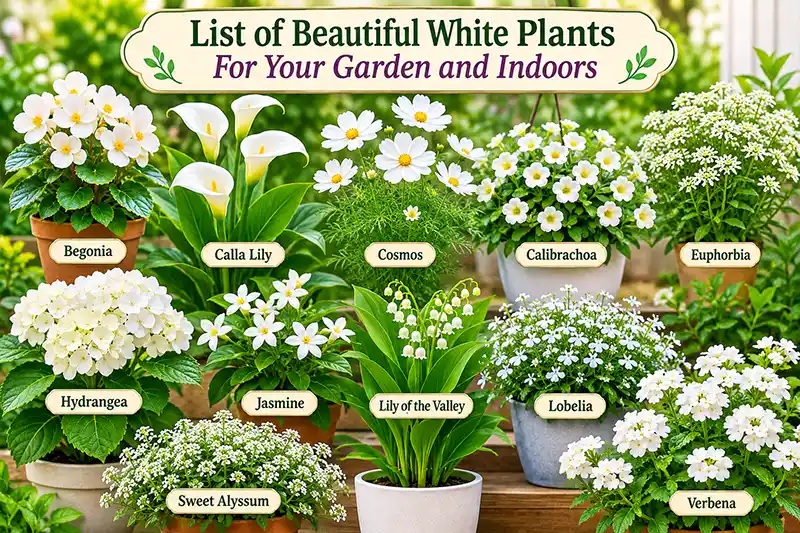
White flowers aren’t just elegant and beautiful, but they carry timeless meaning. Just as the colour white is associated with peace, purity, and innocence, so are white flowers.
Plants with white flowers are commonly used in formal or English-style gardens. They not only enhance the garden’s aesthetic appeal but also help attract local pollinators. These flowers pair well with every other coloured flower, like blue, purple, red, orange, and many more.
Read the article to learn about 15 stunning white plants, their descriptions, taxonomy, and ideal growing conditions for your garden and indoors.
Table of Contents:
10 White Blooming Perennials: Name, Image, and Description
White flowering plants can be used throughout the season to brighten darker areas, unify the landscape, and sizzle summer borders. Here are the top 10 white flowering perennials:
1. Begonia (Begonia spp.)
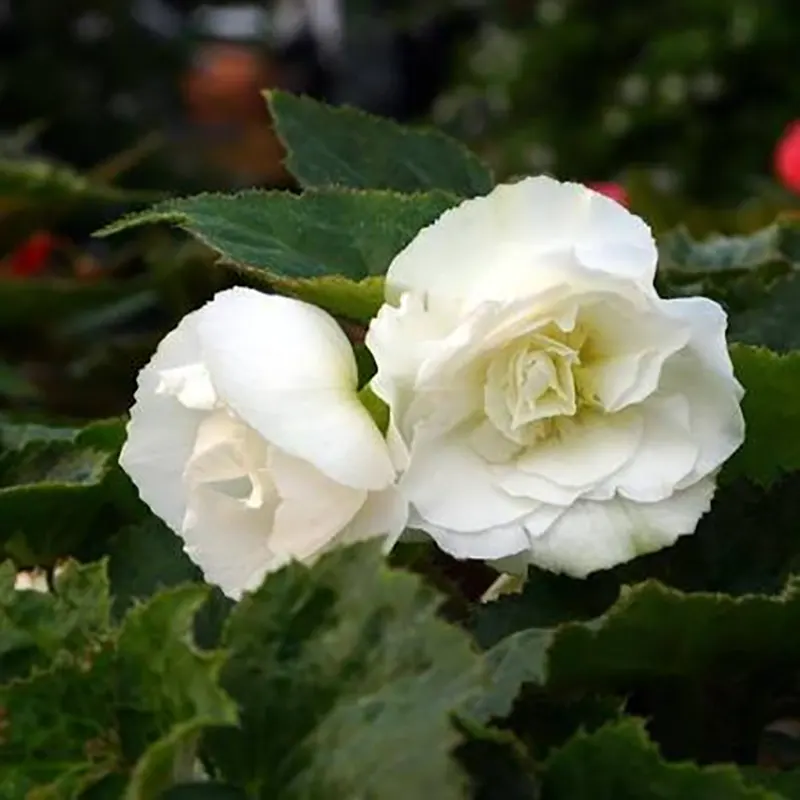
The Begonia genus has more than 2000 species that bloom in hues of white, pink, yellow, and red. Most varieties are succulent plants in this family that can be easily grown indoors and in the garden. Begonia flowers usually have 4 petals and sepals in different sizes.
Look at the table below to know more about the plant’s taxonomy and ideal growing conditions:
| Botanical name | Fibrous begonias |
| Common name | Wax begonias, bedding begonias |
| Kingdom | Plantae |
| Order | Cucurbitales |
| Family | Begoniaceae (Begonia family) |
| Genus | Begonia |
| Native area | Subtropical and tropical regions of Central and South America, Africa, and Asia |
| Season of interest | Summer through fall |
| Hardiness | 9 to 11 USDA Zones |
| Light Requirements | Sunlight to shade |
| Maintenance | Low |
| Type | Annual, perennial, showy |
| Flower colour | White, pink, red |
| Soil | Evenly moist, well-draining |
| Water Requirements | Regular |
| Mature size | 6 inches tall and wide, depending on the variety |
| Fertilizers | Balanced water-soluble fertiliser once a month |
2. Calibrachoa (Calibrachoa spp.)
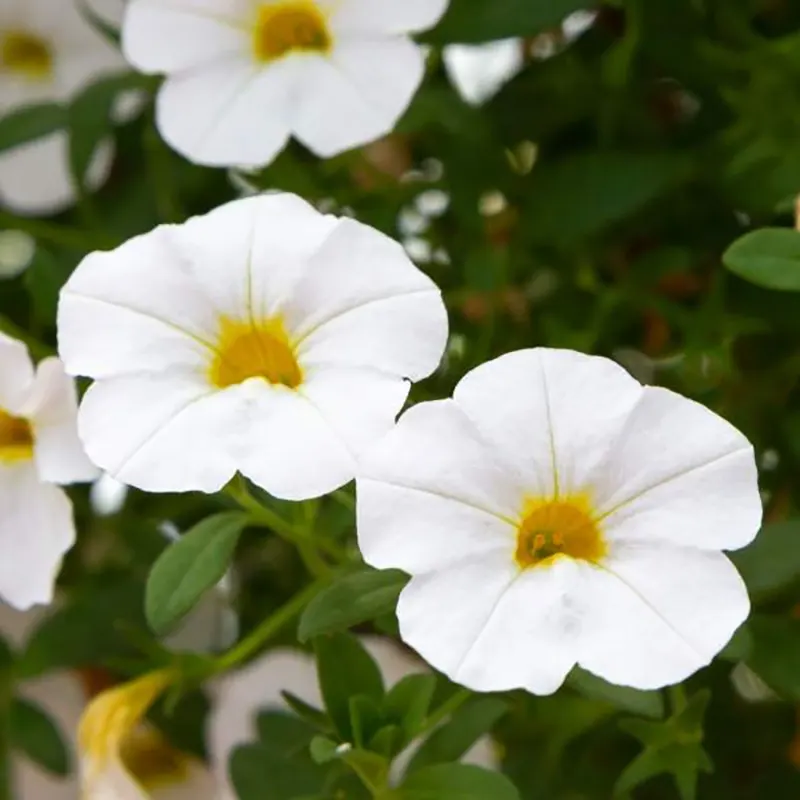
Calibrachoa, also known as million bells or superbells, is a short-lived perennial that blooms in warm climates but is grown as an annual plant. This plant is low-maintenance and easy to care for and blooms in multiple colours with compact leaves that are oval in shape and are a bit sticky.
Look at the table below to know more about the plant’s taxonomy and ideal growing conditions:
| Botanical name | Calibrachoa spp. |
| Common name | Superbell white, calibrachoa, conga white, million bells |
| Kingdom | Plantae |
| Order | Solanales |
| Family | Solanaceae (Nightshade family) |
| Genus | Calibrachoa Cerv. |
| Native area | South America |
| Season of interest | Spring, summer, fall |
| Hardiness | 9 to 11 USDA Zones |
| Light Requirements | Full sun with partial shade |
| Maintenance | Low |
| Type | Herbaceous perennial flowering plant |
| Flower colour | White |
| Soil | Rich, well-draining soil with acidic pH levels between 5 and 6.5 |
| Water Requirements | Consistently moist |
| Fertilizers | Heavy feeders: feed every two weeks with balanced liquid fertiliser. |
3. Calla Lily (Zantedeschia spp.)
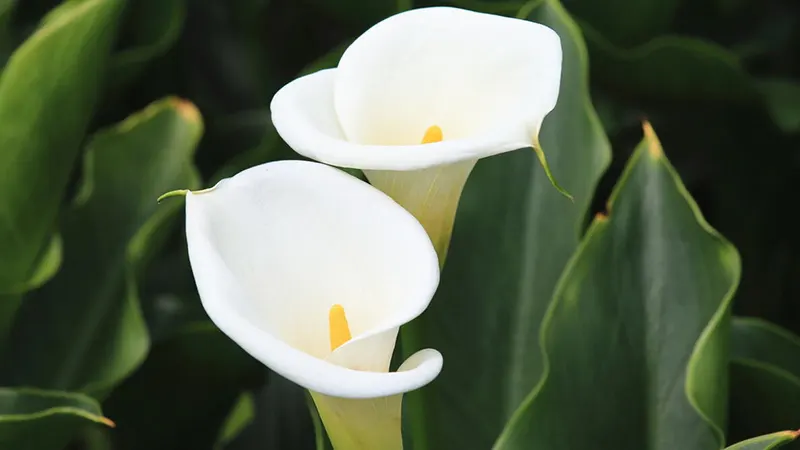
Calla lily is a summer-blooming plant that is used in enhancing landscapes. The plant has attractive lance-shaped foliage and funnel-shaped flowers that are known as spathes. It can be easily grown in gardens with full sunlight and partial shade.
This flowering plant has various varieties, including ‘Be My Sunshine’, ‘Be My First Love’, ‘Be My Heart’, ‘Be My Main Squeeze’, and ‘Be My Destiny ‘, that bloom in yellow, pink, deep-burgundy, orangish-peach, and purple colours, respectively.
Look at the table below to know more about the plant’s taxonomy and ideal growing conditions
| Botanical name | Zantedeschia spp. |
| Common name | Calla lily |
| Kingdom | Plantae |
| Order | Alismatales |
| Family | Araceae (Arum family) |
| Genus | Zantedeschia |
| Native area | Southern Africa |
| Hardiness | 8 to 10 USDA Zones |
| Light Requirements | Full sunlight with partial shade |
| Maintenance | Low |
| Type | Perennial, showy |
| Flower colour | White, pink, orange, purple, yellow, burgundy |
| Soil | Loose, well-draining soil |
| Water Requirements | Regular |
| Fertilizers | Apply slow-release fertiliser in spring |
4. Cosmos (Cosmos spp.)
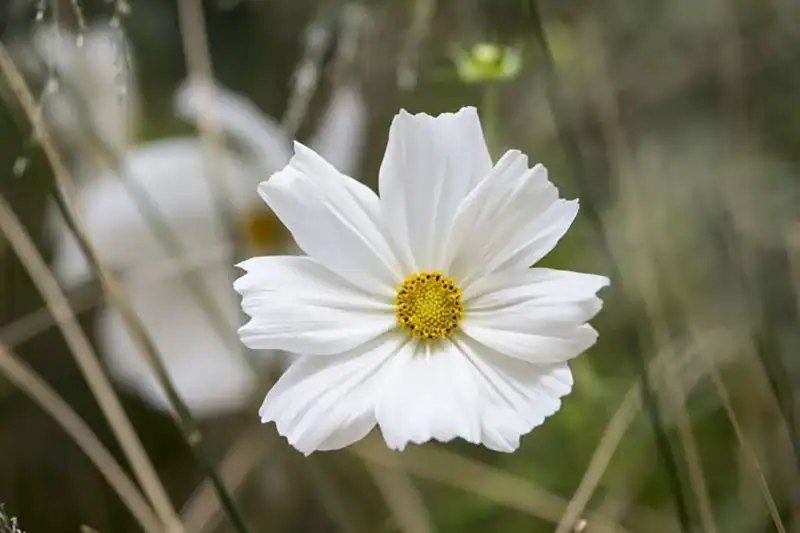
Cosmos is one of the gardeners’ favourite flowering plant varieties because of its versatility. The plant is easy to grow and low-maintenance and blooms in various hues if white, purple, red, orange, and yellow. It thrives in warm seasons but is usually planted as an annual. The cosmos flower mainly symbolises order, harmony, peace, and balance, which best resonates with its name, “cosmos,” meaning the well-ordered universe.
Look at the table below to know more about the cosmos plant’s taxonomy and ideal growing conditions:
| Botanical name | Cosmos spp. |
| Common name | Cosmos, Mexican aster, cut-leaf cosmos |
| Kingdom | Plantae |
| Order | Asterales |
| Family | Asteraceae (Aster daisy, or sunflower family) |
| Genus | Cosmos Cav. |
| Native area | South America, Central America, North America |
| Season of interest | Summer, fall |
| Hardiness | 2 to 11 USDA Zones |
| Light Requirements | Direct sunlight for 6 hours a day |
| Maintenance | Low |
| Type | Perennial |
| Flower colour | White, yellow, pink, red, orange |
| Soil | Well-draining soil with acidic pH levels |
| Water Requirements | Regular watering in establishing years. Once established, the plant can tolerate dryness for a few weeks. |
| Mature size | 1 to 6 ft. tall and 1 to 3 ft. wide |
| Fertilizers | Not required |
5. Candytuft (Iberis sempervirens)
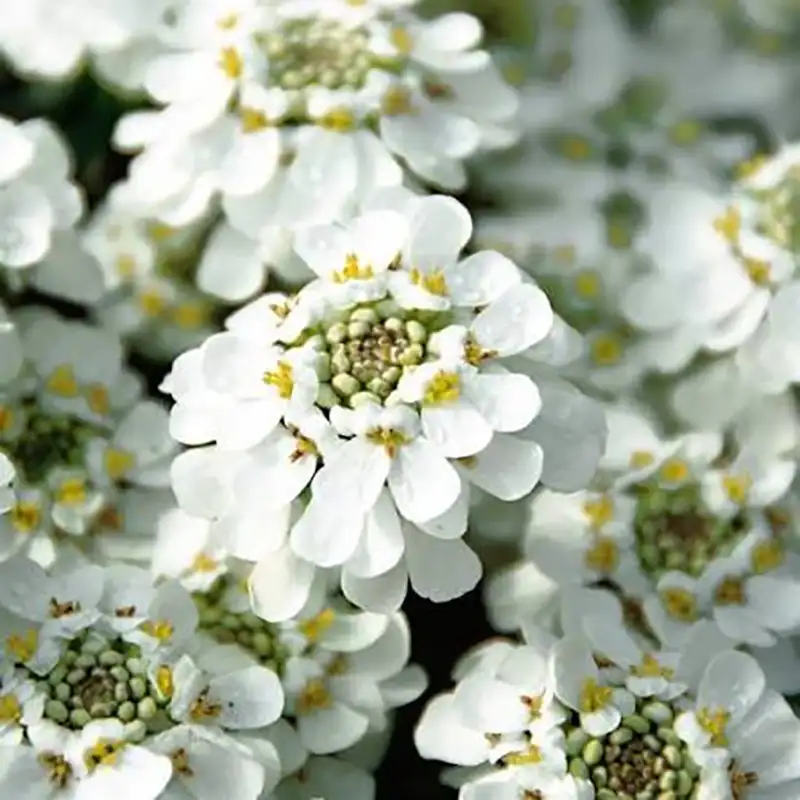
Candytuft is a low-growing shrub that spreads widely and is mainly grown for its dense clusters of small, four-petaled flowers that bloom from spring till fall. The plant thrives in full sunlight with partial shade and does not require too humid weather conditions.
Look at the table below to know more about the candytuft plant’s taxonomy and ideal growing conditions:
| Botanical name | Iberis sempervines |
| Common name | Candytuft |
| Kingdom | Plantae |
| Order | Brassicales |
| Family | Brassicaceae (Mustard family) |
| Genus | Iberis Dill. ex L. |
| Native area | Europe, Mediterranean |
| Season of interest | Spring |
| Hardiness | 3 to 9 USDA Zones |
| Light Requirements | Full sunlight with partial shade |
| Maintenance | Low |
| Type | Shrub, perennial |
| Flower colour | White, red, pink, purple |
| Soil | Well-draining soil with acidic, neutral, or alkaline pH levels |
| Water Requirements | Does not require regular watering |
| Mature size | 12 to 28 in. tall and 10 to 19 in. wide |
| Fertilizers | Slow-release fertiliser in early spring |
| Toxicity | Toxic to humans |
6. Euphorbia (Euphorbia hybrid)
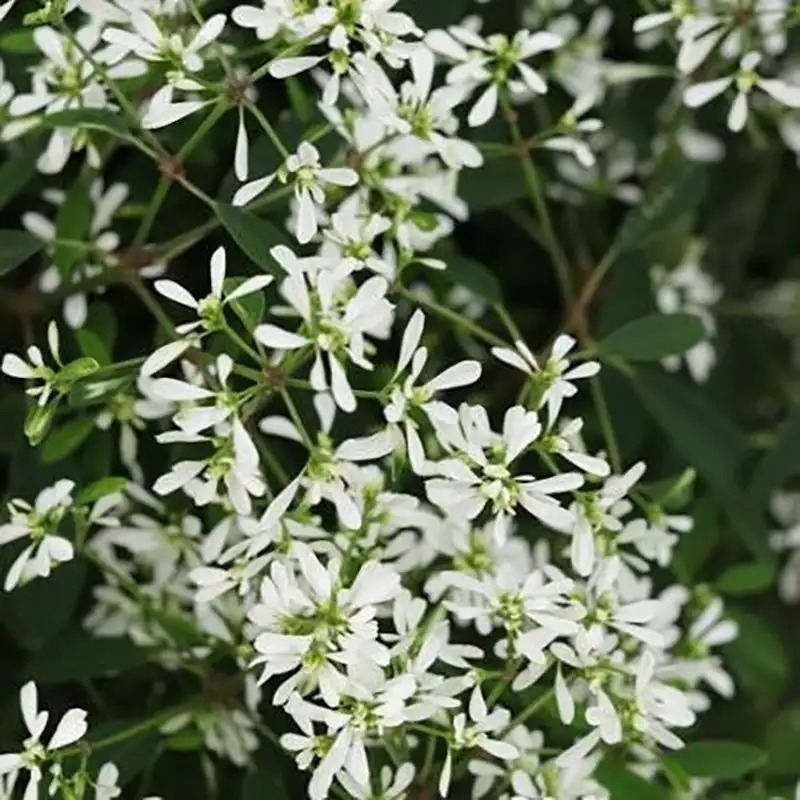
Euphorbia, also known as spurge, is a diverse genus of flowering plants that have unique floral structures. It has poisonous features; therefore, people who have kids and pets at home must be aware of this. One of the special features of this plant is that you can neglect it for a few weeks, but overwatering kills the plant. This makes it best for first-time planters.
Look at the table below to know more about the plant’s taxonomy and ideal growing conditions:
| Botanical name | Euphorbia hybrid |
| Common name | Euphorbia |
| Kingdom | Plantae |
| Order | Malpighiales |
| Family | Euphorbiaceae (Spurge family) |
| Genus | Euphorbia |
| Native area | Asia, Africa, North America, South America |
| Season of interest | Spring, summer |
| Hardiness | 5 to 11 USDA Zones |
| Light Requirements | Full sunlight |
| Maintenance | Low |
| Type | Succulent, perennial |
| Flower colour | White, yellow, pink, red |
| Soil | Sandy, well-draining soil with neutral or acidic pH levels |
| Water Requirements | Water when the soil is dry a few inches deep |
| Fertilizers | Balanced fertiliser during growth season |
| Toxicity | Toxic to pets and humans |
7. Hydrangea (Hydrangea spp.)
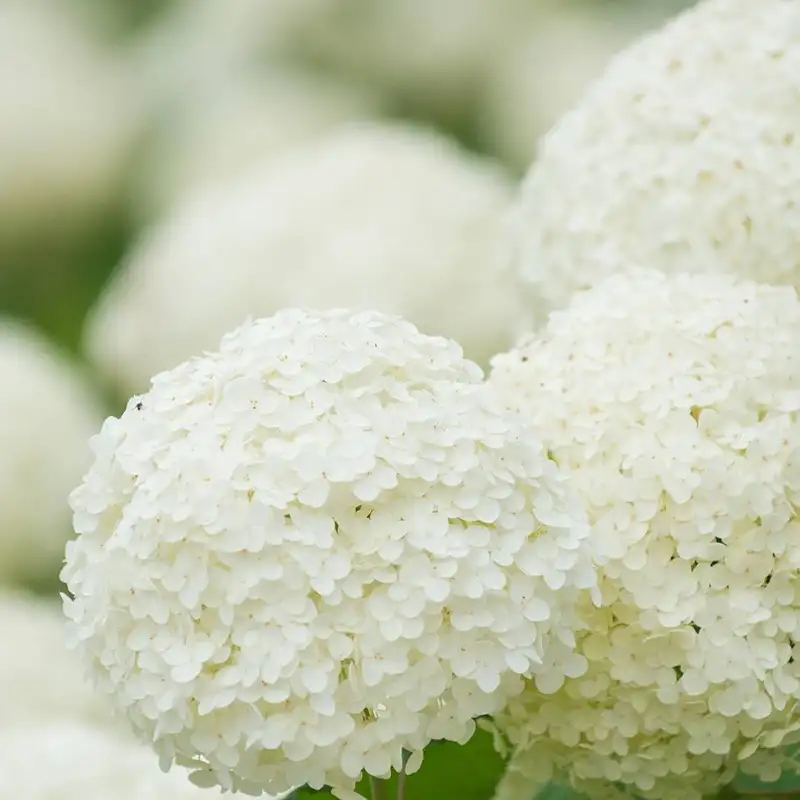
Hydrangeas are one of my favourite flowering plants. They not only have aesthetic appeal but also bring peace and harmony when looked at. The plant is pollinator-friendly and attracts bees and butterflies. The best season to plant popular varieties like oakleaf hydrangea is in the fall using the softwood cuttings method.
Look at the table below to know more about the hydrangea plant’s taxonomy and ideal growing conditions:
| Botanical name | Hydrangea arborescens |
| Common name | Hydrangea, smooth hydrangea |
| Kingdom | Plantae |
| Order | Cornales |
| Family | Hydrangeaceae |
| Genus | Hydrangea L. |
| Native area | Cultivated in Japan, China, and Korea. |
| Season of interest | Summer, fall |
| Hardiness | 3 to 9 USDA Zones |
| Light Requirements | Partial sunlight |
| Maintenance | Low |
| Type | Shrub, cut flower, showy |
| Flower colour | White, blue, pink |
| Soil | Well-draining soil with acidic, neutral, or alkaline pH levels |
| Water Requirements | Moderate |
| Mature size | 3 to 10 ft tall and 3 to 8 ft wide |
| Fertilizers | Low to heavy feeders, depending on the variety |
| Toxicity | Toxic to pets |
8. Jasmine (Jasminum spp.)
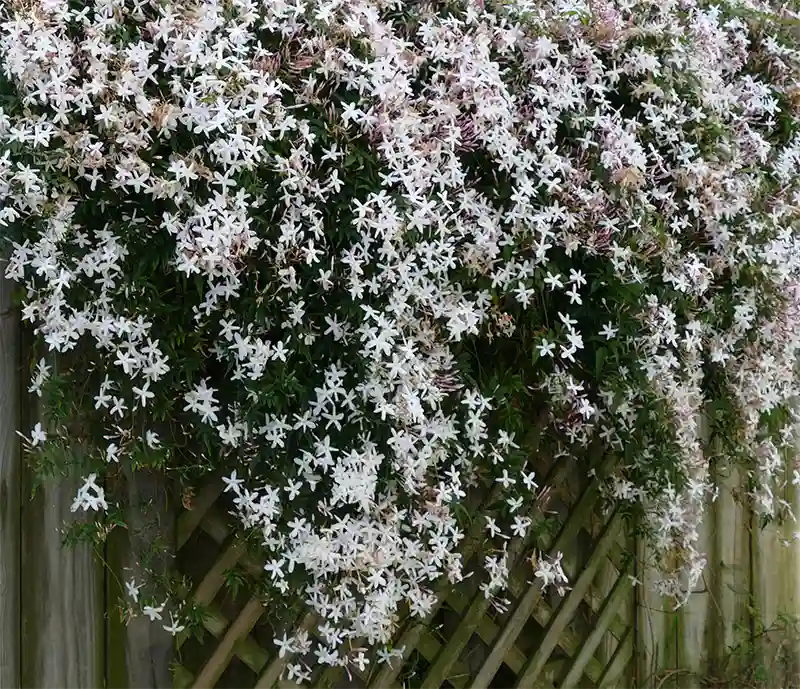
Jasmine is an all-summer flowering plant that prefers full sun with partial shade. It blooms from June till November in beautiful hues of white and yellow. This fragrant flower has about 200 species that are cultivated as ornamentals. Some of the popular species include common jasmine or poet’s jasmine; star or confederate jasmine; cape jasmine; and California or allspice jasmine.
Look at the table below to know more about the plant’s taxonomy and ideal growing conditions:
| Botanical name | Jasminum spp. |
| Common name | Jasmine |
| Kingdom | Plantae |
| Order | Lamiales |
| Family | Oleaceae (olive family) |
| Genus | Jasminum |
| Native area | Australia, Africa, Asia |
| Season of interest | Spring |
| Hardiness | 7 to 10 USDA Zones |
| Light Requirements | Full sunlight with partial shade |
| Maintenance | Low |
| Type | Shrub, vine, perennial |
| Flower colour | White, pink, yellow |
| Soil | Rich, well-draining loam soil with neutral pH levels |
| Water Requirements | Moderate to regular, depending on the weather |
| Mature size | Shrubs are 2 to 5 ft wide; vines can grow up to 20 ft tall |
| Fertilizers | Use compost instead of fertiliser |
9. Lily of the Valley (Convallaria majalis spp.)
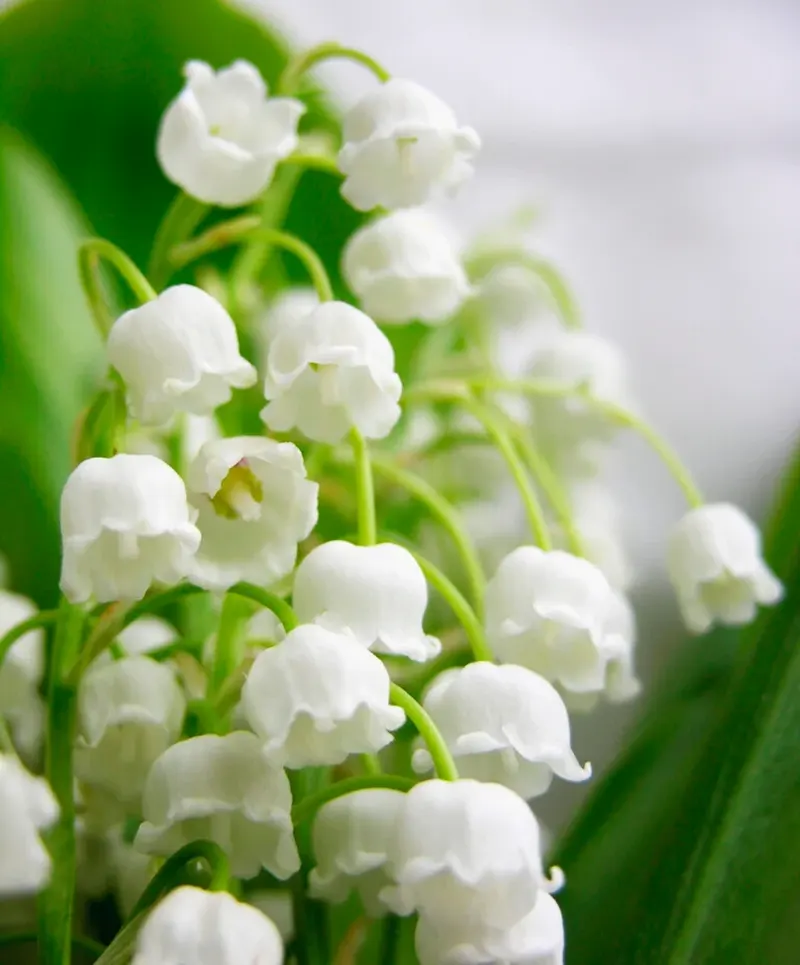
Lily of the Valley is a shrub that grows around 6 to 14 inches tall and has spreading traits. It blooms in bell-shaped flowers that appear in clusters on leafless stalks and last up to 3 weeks. The plant is considered to be poisonous, including its berries, for both pets and humans. If consumed, one must go to the hospital.
Look at the table below to know more about the plant’s taxonomy and ideal growing conditions:
| Botanical name | Convallaria majalis |
| Common name | Lily of the valley, May bells, Mary’s Tears, Our Lady’s Tears |
| Kingdom | Plantae |
| Order | Asparagales |
| Family | Asparagaceae |
| Genus | Convallaria L. |
| Native area | Europe |
| Season of interest | Spring |
| Hardiness | 3 to 8 USDA Zones |
| Light Requirements | Partial sunlight with shade |
| Maintenance | Low |
| Type | Perennial, herbaceous |
| Flower colour | White |
| Soil | Well-drained soil with acidic or neutral pH levels |
| Water Requirements | Regular |
| Mature size | 5 to 13 inches tall and 9 to 12 inches wide |
| Fertilizers | Only requires fertilisation when soil is poor |
| Toxicity | Toxic for humans and pets |
10. Lobelia (Lobelia erinus)
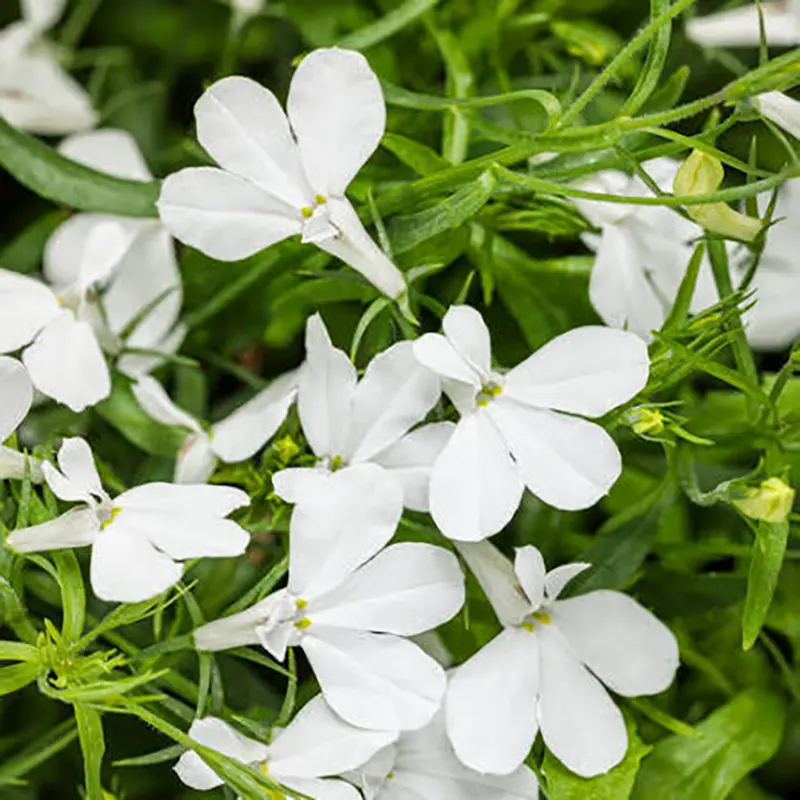
Lobelia is an annual flower that is grown in garden beds, hanging baskets, and containers. The plant usually blooms in the hues of white and blue and prefers moist soil. It is a pollinator-friendly plant that has around 400 species.
Look at the table below to know more about the lobelia plant’s taxonomy and ideal growing conditions:
| Botanical name | Lobelia erinus |
| Common name | Lobelia, annual lobelia, edging lobelia, laguna flower |
| Kingdom | Plantae |
| Order | Asterles |
| Family | Campanulaceae |
| Genus | Lobelia L. |
| Native area | Africa |
| Season of interest | Summer, fall |
| Hardiness | 10 to 11 USDA Zones |
| Light Requirements | Full sunlight with partial shade |
| Maintenance | Low |
| Type | Annual, perennial |
| Flower colour | White, red, pink, blue, purple |
| Soil | Moist, well-draining soil with slightly acidic pH levels between 6 and 7 |
| Water Requirements | Regular |
| Mature size | 6 to 9 inches tall and 9 to 11 inches wide |
| Fertilizers | Fertilise every two to three weeks for fuller blooms |
| Toxicity | Toxic for pets and humans |
Read more: 50 Fall Flowers: African Daisy, Calibrachoa, Petunia, Nemesia, and More!
5 Additional White Flowering Plants
Here is a list of 5 additional white flowering plants that you might consider adding to your garden spaces or indoors:
| Flower name and image | Description |
Sweet Alyssum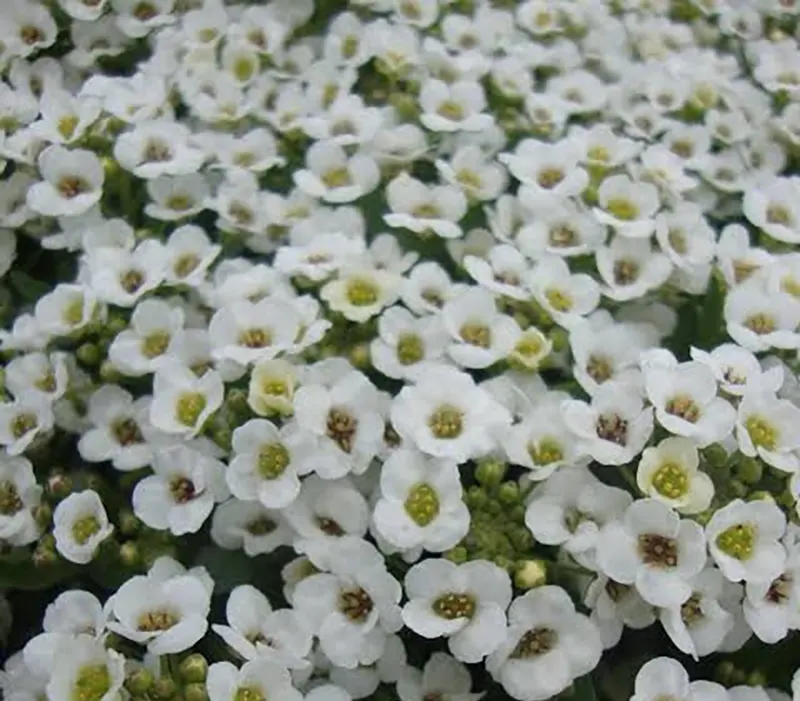 |
|
Verbena 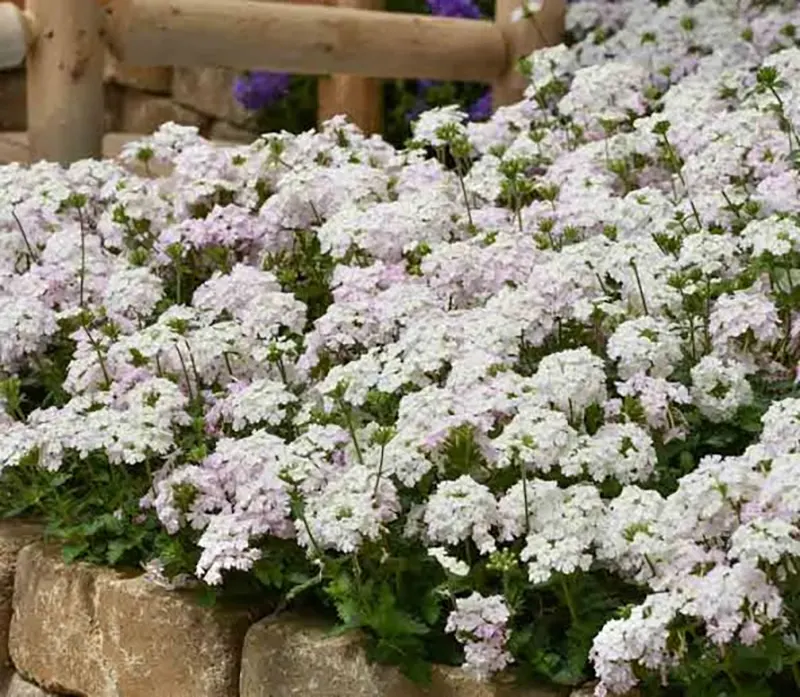 |
|
Rose 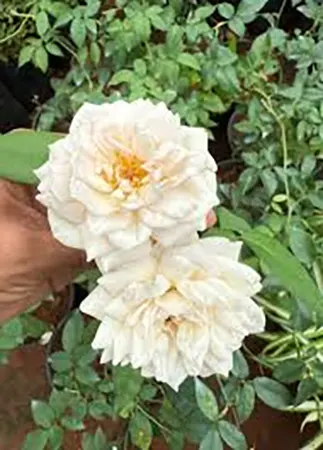 |
|
Shasta Daisy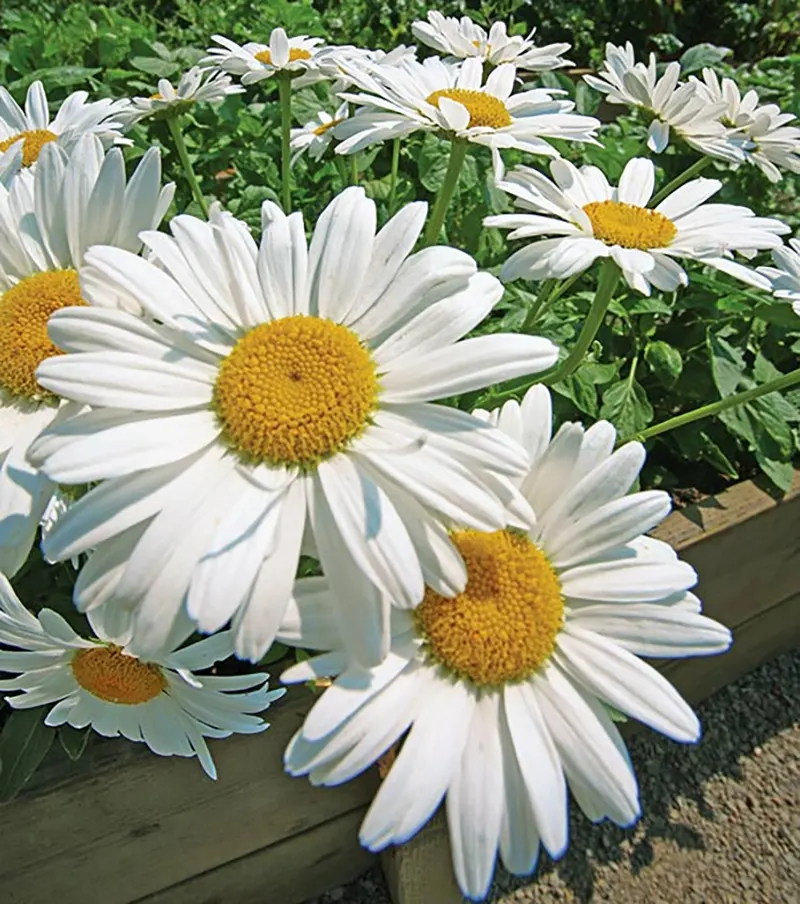 |
|
Gardenia 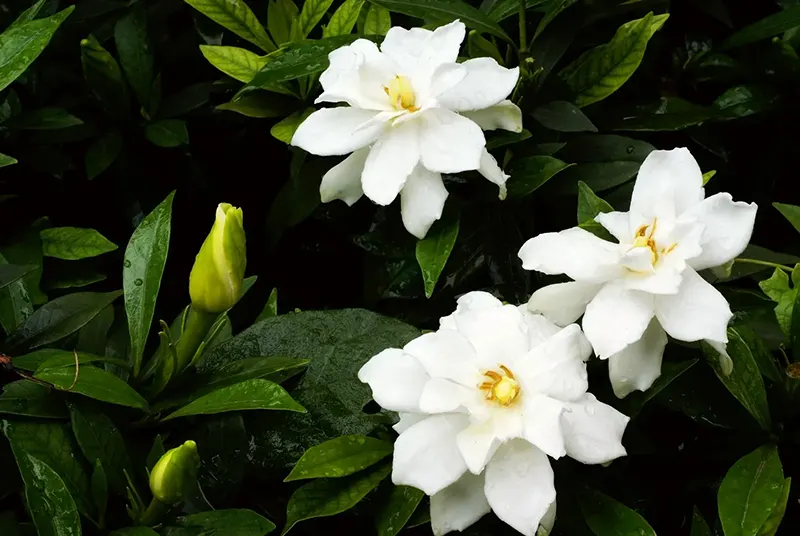 |
|
Read more: 20+ Mexican Flowers: Explore the Culture and Floral Heritage of Mexico
Takeaways
White plants are elegant and add peace and harmony to your space. While most of them are cultivated for their ornamental value, many of them are a great addition to your space if you want to attract pollinators. Some of them include cosmos, lobelia, jasmine, candytuft, euphorbia, and hydrangea.
These plants can be grown as both annuals and perennials and bloom throughout the year, depending on their traits. If you are someone who wants to add harmony to your space, these white flowering plants can be a great addition.
Happy planting!
FAQs
Name some of the white perennials that bloom all summer.
Are there any poisonous white plants that can cause harm to humans and pets?
Yes, Lily of the Valley and Euphorbia are two white plants that are poisonous and can cause trouble to pets and humans if swallowed. In such a case, one must visit the doctor and get proper treatment.
What are the best indoor white plants?
The best indoor white plants are begonia, calla lily, jasmine, gardenia, and euphorbia. Make sure that you place them near the window for the required sunlight and water them according to their needs.
Latest Blog