Yes, peonies thrive under direct sunlight for at least 6 to 7 hours a day.
Peony Flower Guide: Taxonomy, Ideal Growing Conditions, Growing Process, Care Tips
Author
Annette Hird
The peony genus Paeonia includes about 30 flowering plant species in the Paeoniaceae family. People cultivate the plant for its beautiful flowers, which are often used for ornamentation and the floral industry.
Peonies are divided into three distinct groups: herbaceous Eurasian peonies, Asian trees, and North American peonies. Herbaceous peonies are the perennials that grow around 3 ft tall and have large, glossy leaves. They produce large single and double flowers in late spring and early summer. The tree peonies are shrubby plants with permanent woody stems that grow around 4 to 6 ft. tall and begin blooming in late spring, and the North American peony species are P. brownii and P. californica, which range from California to Montana and the Pacific coastal mountains of California and Mexico, respectively.
Read the article to learn about the peony flower growing process, its care tips, taxonomy, ideal growing conditions, and much more.
Table of Contents:
How to Grow a Peony Plant?

The best time to plant peonies is in fall when the plants are dormant. You can either plant peonies from a bare-root peony or simply transplant the store-bought plant. Here are some essential steps to grow peonies from a bare-root peony plant:
- Choose a location that receives direct sunlight for at least 6 to 7 hours a day.
- Using gardening equipment, dig a hole around 12 to 18 inches deep.
- Now, use a garden fork to loosen the sides of the planting hole as well.
- Add compost and organic fertiliser to the bottom of the hole, then add a shovel-full of soil. Fill it to the point where you can place the plant roots near the base. Try to place them only about 2 ft below the soil.
- Now, using a spray nozzle, moisten the soil. Repeat this whenever the soil starts to dry.
- Add a layer of mulch around the plant base to keep the soil moist for a longer period.
- Soon your plant will start blooming flowers in spring or late summer, depending on the variety.
How to Replant a Nursery-Grown Peony?
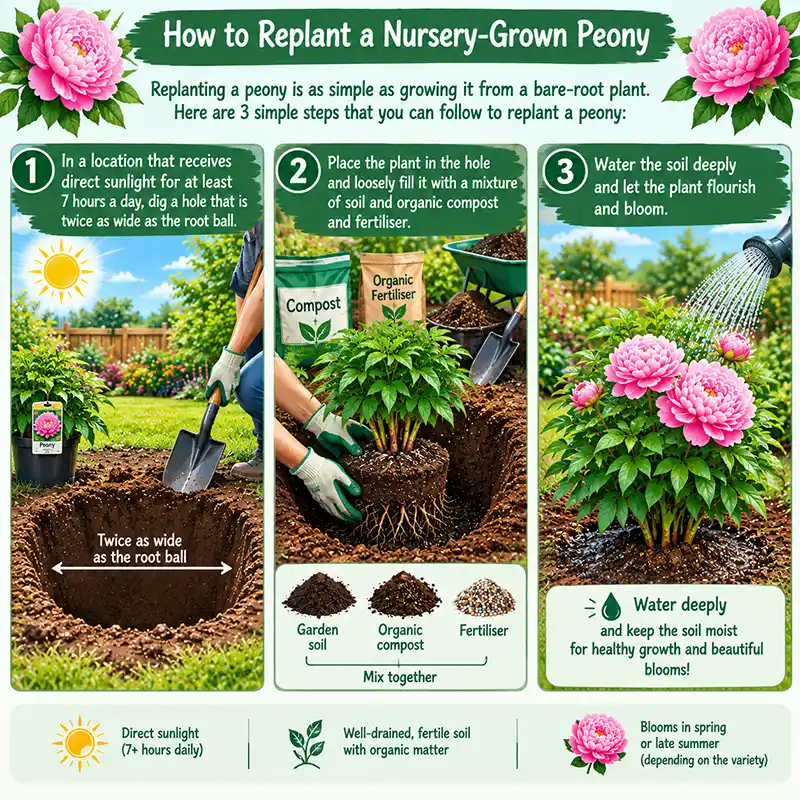
Replanting a peony is as simple as growing it from a bare-root plant. Here are 3 simple steps that you can follow to replant a peony:
- In a location that receives direct sunlight for at least 7 hours a day, dig a hole that is twice as wide as the root ball.
- Place the plant in the hole and loosely fill it with a mixture of soil and organic compost and fertiliser.
- Water the soil deeply and let the plant flourish and bloom.
Did you know?
Peony is one of the two November Birth Flowers.
Read more: Growing Chives Plants: Care Tips, Ideal Growing Conditions, Taxonomy, Harvesting Tips & Much More
Essential Peony Flower Care Tips
Peonies are very low-maintenance and easy-to-grow perennials that live up to 100 years. They can thrive much longer and produce big, fragrant flowers in a wide range of colours, sizes, and forms if properly cared for. Here are some essential Peony flower care tips that help my plant to produce beautiful and aesthetic flowers even after 35 years:
- When planting a peony, choose a location that receives direct sunlight for at least 7 to 8 hours a day. The peony plant can survive in shade, but in such a situation, the plant does not produce flowers.
- Only water peonies when the soil dries out evenly. This can help the plant to grow without any fungal disease or root rot because peonies are not overly thirsty plants.
- Prune your plant only when it is attacked by some disease or damage. This can be done differently for three varieties:
- Herbaceous Peonies: At the end of the growing season, cut your plant all the way to the ground.
- Intersectional Peonies: Leaving 4 to 8 inches of stem, cut back the plant at the end of the growing season.
- Tree Peonies: Tree peonies are comparatively slow growers. Avoid pruning them for the first 2 to 3 years. Later, after every five years, remove suckers from the center of the shrub to thin out growth and promote air circulation. Avoid cutting the woody stems because they bloom on old wood.
- Herbaceous Peonies: At the end of the growing season, cut your plant all the way to the ground.
- Removing side buds that develop near the base of the terminal bud helps in producing large flowers.
- Peony flowers love well-drained soil. It is the key to keeping your plant healthy.
- In cold climates, mulching around the plant base helps in keeping the plant alive. This is because it helps in maintaining the soil temperature. Do not forget to remove the mulch in spring to promote new growth at the soil surface.
Tip
If your peony plant has ants around or on it, it is because of the sweet nectar that is released from peony buds. Do not remove ants because they protect the plant from pests that might attack your plant.
Read more: French Tarragon: Taxonomy, Ideal Growing Conditions, Care Tips, Pests & Problems
Peony Taxonomy and Ideal Growing Conditions
Peonies are low-maintenance plants that thrive in direct sunlight, require less watering, and need well-drained soil. The plant is native to temperate regions of the Northern Hemisphere across Asia, Europe, and Western North America. It blooms in various hues of pink, white, yellow, purple, and coral from late spring to summer.
Look at the table below for more details on peony plant taxonomy and ideal growing conditions:
| Botanical name | Paeonia |
| Common name | Peony |
| Kingdom | Plantae |
| Order | Saxifragales |
| Family | Paeoniaceae |
| Genus | Paeonia |
| Native area | Temperate regions of the Northern Hemisphere across Asia, Europe, and Western North America |
| Season of interest | Late spring and summer |
| Hardiness | 3 to 8 USDA Zones |
| Light Requirements | Direct, full sunlight for at least 6 to 7 hours a day |
| Maintenance | Low |
| Type | Perennial, showy plant |
| Flower colour | Pink, white, yellow, coral, and purple |
| Soil | Rich, well-drained soil |
| Water Requirements | Low |
| Fertilizers | Medium |
| Tolerant | Drought tolerant |
Read more: 20 Stunning Flowers That Start With the Letter P (With Pictures & Facts)
Pests and Problems Associated With Peony Plants
Peonies are generally hardy; however, they are susceptible to pests and problems like aphids, stem rot, and tip blight. Below is a list of pests and problems that can cause trouble for your plant, with their solution:
| Pests and problems | Solution |
| Stem rot | Stem rot can be caused by overwatering the plant. To avoid this, only water the plant when the top layer of soil starts to dry out. |
| Botrytis blight | Botrytis blight can appear as gray mold and is a fungal disease. It usually attacks the leaves, flowers, and stems of the plant and can be cured by pruning the affected area, improving airflow, and reducing humidity. You can also use fungicidal treatments like copper spray or neem oil to get rid of botrytis blight. |
| Aphids and thrips | They are tiny pests that usually attack tender shoots and buds, distorting leaves. You can remove them using a strong spray of water or using pesticides like neem oil every once in a while. If there are ants on your peony plant, they work as natural pesticides and do not allow pests to attack your plant. |
Read more: Heuchera: Taxonomy, Care Tips, Ideal Growing Conditions, Pests and Diseases & Much More
Takeaways
Peony plants are easily grown and low-maintenance plants, which makes them gardeners favourite. The plant thrives for hundreds of years if properly cared for. They require well-draining soil, irregular watering, and direct sunlight to grow healthily.
The plant is a great addition to your garden space as it attracts pollinators and is often cultivated for its ornamental values. Next season, you can plant a peony and pass it down to future generations for the next hundred years.
Happy planting!
FAQs
Do peonies need full sun?
How to care for peonies?
Peonies do not require much attention and time. Only make sure to plant them in direct sunlight, in well-draining soil, and water them deeply every once in a while.
Is it okay if my peony plant has ants on it?
Yes, it is completely okay for a peony plant to attract ants because of its sweet nectar. Do not remove them from the plant, as they help remove pests from the plant.
Sources
Peony: Britannica
Latest Blog