Plant clematis in an area that has cool soil so that the roots remain cool throughout and the vine receives sunlight for at least 6 hours a day. Also, ensure you water the vine deeply once a week.
Clematis Guide: Taxonomy, Care Tips, Growing Process, Pests, and Diseases Associated
Author
Annette Hird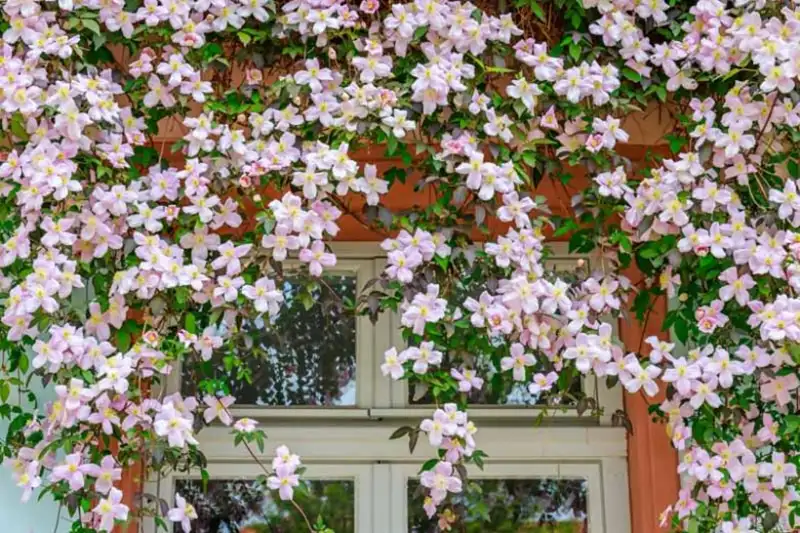
Clematis are usually cultivated for their flowers around the world, especially in Asia and North America. The flowers bloom either in clusters or solitary, in hues of pink, white, red, blue, and purple, and the leaves are individually stalked and compound.
They are versatile and can be used in numerous settings, including fencing, walls, arbors, and pergolas. It is also a pollinator-friendly plant and attracts pollinators like bees, butterflies, and hummingbirds.
This perennial vine has around 370 species; some of the most popular ones include woodbine (Clematis virginiana), traveler’s joy or old-man’s-beard (Clematis vitalba), and vine bower (Clematis viticella).
Read the article to learn about clematis taxonomy, care tips, ideal growing conditions, the growing process, and much more.
Table of Contents:
Clematis Taxonomy and Ideal Growing Conditions
Clematis belongs to the Ranunculaceae family and has around 300 species that bloom throughout the year, depending on the variety. The vine is native to Asia and North America and grows well in loamy soil, with vines in direct sunlight and roots in shade, and requires regular watering.
The clematis vine is considered to be toxic to humans, dogs, cats, and horses because it contains a natural chemical called ranunculin that turns into a blistering irritant when the plant is chewed, crushed, or damaged. In case someone swallows any part of the plant, see a doctor for further assistance.
Look at the table below to know more about clematis taxonomy and ideal growing conditions:
| Botanical name | Clematis spp. |
| Common name | Leather flower, virgin’s bower, clematis |
| Kingdom | Plantae |
| Family | Ranunculaceae (buttercup family) |
| Native area | North America, Asia |
| Season of interest | Winter, spring, summer, and fall |
| Hardiness | 4 to 8 USDA Zones |
| Light Requirements | Direct sunlight for vines for at least 6 hours a day, and shade and cool temperatures for roots. |
| Maintenance | Low |
| Type | Perennial shrub vine |
| Flower colour | Pink, purple, white, red, blue, and bicolours |
| Soil | Loamy, well-drained soil with neutral pH levels. |
| Water Requirements | Regular |
| Mature size | Vigorous growers: can grow up to 20 to 30 ft. tall in a single season Large-flowered hybrids grow around 8 to 14 ft. tall once mature Small/herbaceous species: compact; grow only 2 to 5 ft. tall. |
| Fertilizers | Thrice during the growing season with organic compost or a low-nitrogen fertiliser in combination with 5:10:10. |
| Toxicity | Toxic to humans, dogs, cats, and horses |
| Tolerant | Cold weather conditions |
Tips for Planting and Care of Clematis
Clematis are climbing plants that bloom with fragrant flowers, adding a delightful scent to your garden. This easy-to-grow plant requires certain care, like pruning support, watering, and a specific location. As a first-time gardener, here are some of the care tips that can help your plant to bloom healthily:
- The best place to plant clematis is one that gets at least six hours of direct sunlight. However, make sure you plant your vine where it won’t get direct sunlight on the ground. This helps the plant’s roots to stay at a cool temperature, which is essential for clematis to grow healthily.
- Grow the plant in well-drained soil with a neutral to slightly alkaline pH level between 6.5 and 7.5.
- Water your plant deeply once a week. This helps the soil to stay moist.
- Ensure the planting site has a proper support structure to support the vine.
- Apply a layer of mulch around the base. This will help maintain soil temperature, suppress weeds, and retain moisture.
- Use balanced fertilisers in early spring to promote plant growth. Avoid fertilisers that have high nitrogen, as they promote excess foliage growth and fewer blooms.
- Prune clematis vine to maintain the plant’s health and encourage flowering.
Read more: 15 Best Zucchini Companion Plants for Your Garden
How to Grow a Clematis Vine?
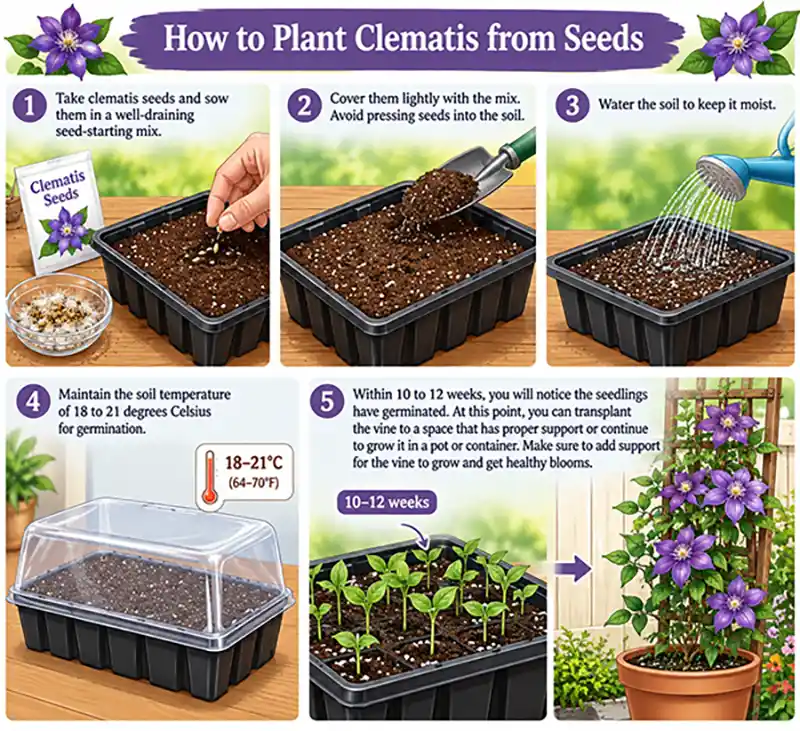
There are several methods to grow clematis, including seeds, layering, and propagation. Growing clematis from seeds is one of the safest options. Here are some essential steps to plant clematis from seeds:
- Take clematis seeds and sow them in a well-draining seed-starting mix.
- Cover them lightly with the mix. Avoid pressing seeds into the soil.
- Water the soil to keep it moist.
- Maintain the soil temperature of 18 to 21 degrees Celsius for germination.
- Within 10 to 12 weeks, you will notice the seedlings have germinated. At this point, you can transplant the vine to a space that has proper support or continue to grow it in a pot or container. Make sure to add support for the vine to grow and get healthy blooms.
How to Propagate Clematis?
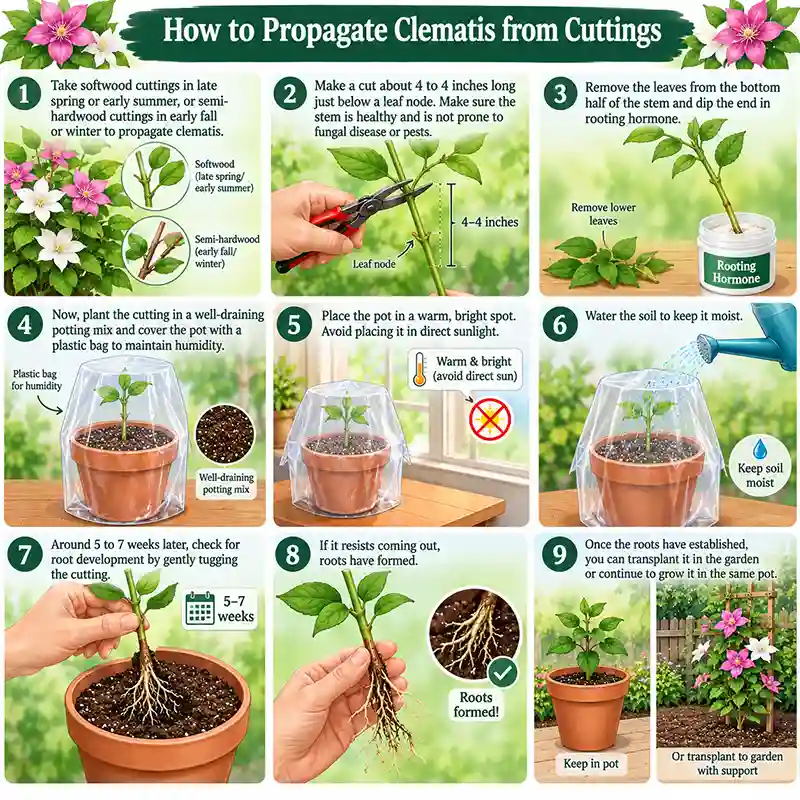
Clematis can be propagated by cutting and layering methods. But it is better to propagate them using the stem cutting method, as it is more reliable and easier. Here are a few steps that you can follow to propagate your vine:
- Take softwood cuttings in late spring or early summer, or semi-hardwood cuttings in early fall or winter to propagate clematis.
- Make a cut about 4 to 4 inches long just below a leaf node. Make sure that the stem is healthy and is not prone to fungal disease or pests.
- Remove the leaves from the bottom half of the stem and dip the end in rooting hormone.
- Now, plant the cutting in a well-draining potting mix and cover the pot with a plastic bag to maintain humidity.
- Place the pot in a warm, bright spot. Avoid placing it in direct sunlight.
- Water the soil to keep it moist.
- Around 5 to 7 weeks later, check for root development by gently tugging the cutting.
- If it resists coming out, roots have formed.
- Once the roots have established, you can transplant it in the garden or continue to grow it in the same pot.
Read more: Heuchera: Taxonomy, Care Tips, Ideal Growing Conditions, Pests and Diseases & Much More
Pests and Diseases Associated With Clematis Vine
Clematis can be affected by several pests and diseases like powdery mildew, aphids, clematis wilt, and many more. Below is a list of pests and diseases that can attack your vine, along with solutions to cure them:
| Pests and diseases | Solution |
| Slugs and snails | They can chew on the plant leaves, creating irregular holes and damage. To get rid of them, either handpick them or use diatomaceous earth or copper tape around the plant base. |
| Spider mites | They are tiny pests that feed on plant sap, causing stippling, yellowing, and eventually causing browning of leaves. You can avoid them by using horticultural oil or introducing predatory insects like phytoseiulus persimils. |
| Aphids | They are sap-sucking insects that can cause distorted plant growth, yellowing leaves, and sticky residue. They can be controlled using insecticidal soap or neem oil. You can also introduce beneficial insects like ladybugs and lacewings to get rid of them. |
| Clematis wilt | It appears as sudden wilting and collapsing of stems, accompanied by black foliage. To prevent this, remove the infected stems and leaves. |
| Root rot | One of the main causes of root rot is poorly draining soil. To ensure that your plant does not get root rot, choose a container with a proper drainage hole and avoid overwatering the plant. |
| Powdery mildew | It is a fungal disease that can attack your plant because of inadequate airflow and overhead watering. To avoid it, ensure that there is proper space between two vines for good air circulation, and do not overwater the plant. |
Read more: Oakleaf Hydrangea: Growing Process, Care Tips, Taxonomy, Ideal Growing Conditions & Much More
Takeaways
Clematis, or leather flower, is a perennial vine known for its vibrant, colourful flowers that bloom in various hues of pink, red, white, purple, and bicolour. The plant is native to Asia and North America and is known as a low-maintenance, easy-to-grow vine.
With the right care, your plant can produce more healthy blooms than it does in general. The essential care involves regular watering, direct sunlight, fertilisation, proper support for the vine, and mulching around the plant base.
If you are planning to plant clematis, you can grow it in spring, early summer, winter, and early fall from seeds or by propagation. Make sure the variety that you are planning to grow is suitable for your location.
Happy and safe planting!
FAQs
How to care for clematis?
When do clematis bloom?
Clematis bloom throughout the year, depending on the variety.
How fast does clematis grow?
Clematis grow slowly during the early years while they are establishing their roots, but afterwards, the plant grows several feet every season, depending on the variety.
Sources
Clematis: Britannica
Latest Blog