The easiest way to grow cilantro is from seeds. Directly sow seeds in a wide container or garden bed during spring.
How to Grow Cilantro Plant: Care Tips, Ideal Growing Conditions, & Much More
Author
Annette HirdReviewed By
Cody Allison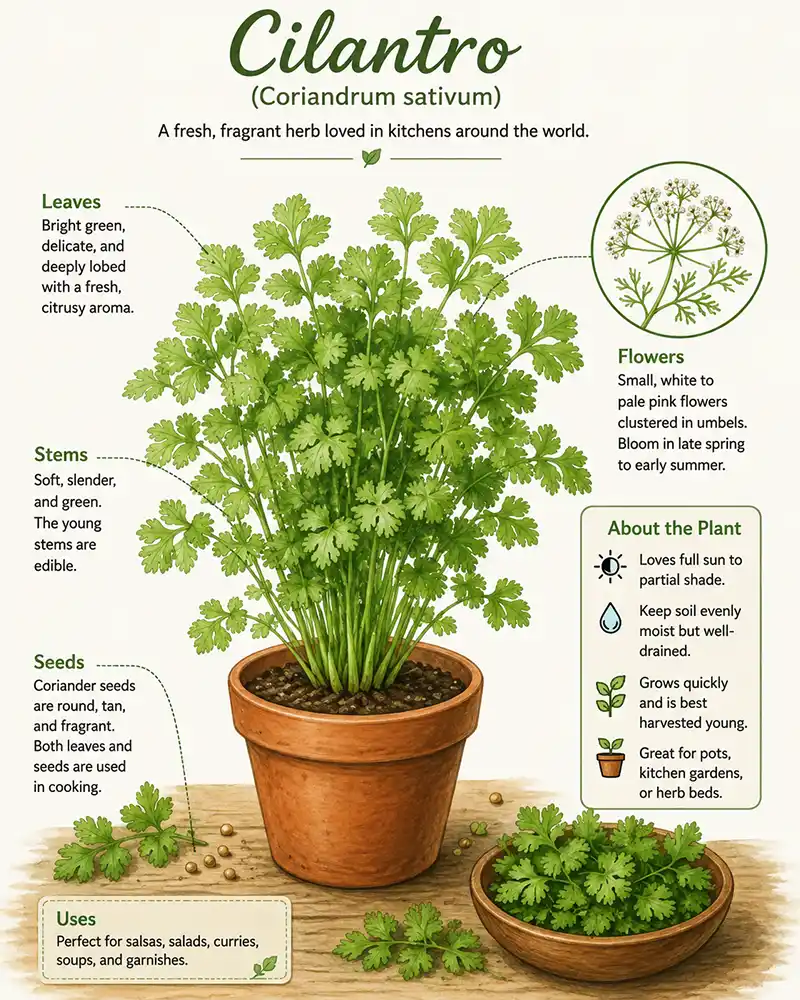
Cilantro is a fragrant herb that is also commonly referred to as coriander in most parts of the world, but in the United States, cilantro refers to the leaves and stems of the genus Coriandrum, while the seeds are called coriander. The plant is commonly used in Central American, Middle Eastern, and Asian cuisines.
There are many health benefits of adding this herb to your food, as it has been used medicinally since ancient times and adds freshness to your salads and dressings.
This easy-to-grow herb is ready for harvest in a maximum of 30 days and easily regrows. Read the article to learn how to grow cilantro, care tips, common pests and problems associated with it, and much more.
Table of Contents:
Taxonomy and Ideal Growing Conditions for Cilantro Plant
Cilantro herb has a refreshing fragrance with a citrusy taste. The plant grows around 1 to 2 ft. tall and 1 to 1.5 ft. wide. It has variable-shaped leaves, broadly lobed at the plant base and slender and feathery high on the stem. For more general information, here is the taxonomic overview and ideal growing conditions of the cilantro plant:
| Botanical name | Coriandrum sativum |
| Kingdom | Plantae |
| Common names | Dhania, coriander, and Chinese parsley |
| Order | Apiales (Carrots, ivies, and allies) |
| Family | Apiaceae (carrot or parsley family) |
| Genus | Coriandrum |
| Species | C. sativum |
| Native | Mediterranean, Southern Europe, Southwestern Asia, and North Africa |
| Hardiness | 2-11 USDA zone |
| Light Requirements | Bright, indirect sunlight for 4 to 6 hours |
| Plant type | Annual |
| Season of interest | Spring, summer, fall, and winter |
| Maintenance | Low |
| Soil | Well-drained, nutrient-rich, moist soil with pH levels of 6.2 to 6.8. |
| Water Requirements | Average; keep the soil moist. |
| Fertilizers | Light dose of organic liquid vegetable fertiliser or organic compost when planting. |
| Mature size | 18 to 24 inches tall and 12 to 18 inches wide. |
Fact
In a random case study, there is a portion of people who dislike the taste of cilantro. This includes around 21% of East Asians, 17% of South Asians, 4% of Hispanics, and 3% of Middle Easterners. The main reason is that they taste like soap due to a molecule called “aldehyde” that naturally occurs in cilantro but is also used to make soaps.
Read more: Pravi Celer Guide: Taxonomy, Ideal Growing Conditions, & Much More
How to Grow Cilantro Plant?
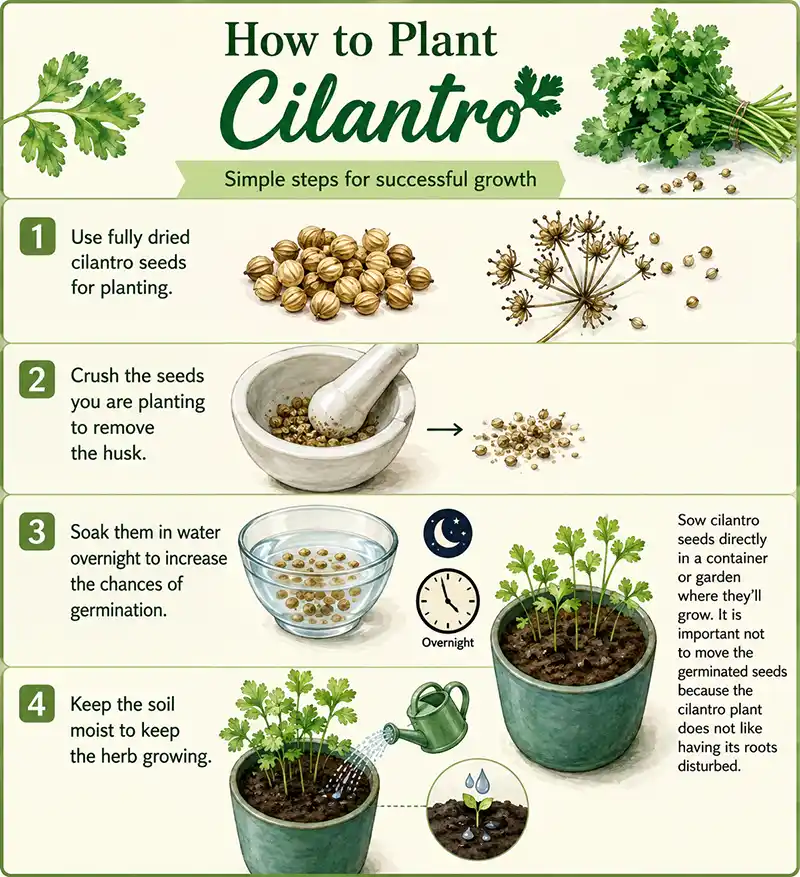
Cilantro often self-seeds in the garden and propagates itself. But you can start growing it using seeds for the first time. Here are a few steps:
- Use fully dried cilantro seeds for planting.
- Crush the seeds you are planting to remove the husk.
- Soak them in water overnight to increase the chances of germination.
- Sow cilantro seeds directly in a container or garden where they’ll grow. It is important not to move the germinated seeds because the cilantro plant does not like having its roots disturbed.
- Keep the soil moist to keep the herb growing.
Harvesting Cilantro Tip
- To harvest cilantro, simply pinch it around one-third of the stem. This promotes new growth and a fuller plant.
- If you see a flower stalk growing, trim it off to prolong leaf growth.
How to Keep Cilantro Fresh?
There are two common ways to keep cilantro fresh. First, use a clean jar filled with about an inch of water. Place the stems in the water and then zip-close a plastic bag over the jar mouth.
A second way to preserve cilantro is by laying it on paper towels in a single layer. Roll up the paper towels and place them in a zip-lock bag or an airtight container. Store it in the refrigerator.
Read more: Lyposingrass or Lemongrass: A Herbaceous Perennial Guide
Nutrient Profile and Health Benefits of Cilantro Plant
When we talk about nutrients in cilantro leaves, they contain vitamins, fiber, manganese, and iron. Here is the list of nutritional content in 10 gm of cilantro:
| Nutrient | Value (% RDI) |
| Dietary fibre | 1.1 |
| Vitamin A | 13.5 |
| Vitamin C | 4.5 |
| Vitamin K | 38.8 |
| Manganese | 2.1 |
| Iron | 1 |
| Magnesium | 0.6 |
| Copper | 1.1 |
| Potassium | 1.5 |
| Zinc | 0.3 |
| Phosphorus | 0.5 |
Did you know?
Fresh cilantro is around 92.2% water.
Health Benefits of Cilantro
Though there are no studies on humans, here are some of the health benefits of cilantro listed by different sets of people:
- Cilantro is packed with antioxidants that may help reduce inflammation.
- A study on animals by NIH shows that cilantro may reduce several risk factors of heart disease. However, one must not depend on herbs and should consult their doctor.
Read more: How to Grow Lemongrass? Guide to Plant Growth, Uses, and Care Tips
How to Care for Cilantro Plant?
Cilantro thrives best in cool weather. If you are not planning to plant it in spring, let the temperature cool down a bit before planting the seeds. Here is some important cilantro plant care:
- The ideal plant site for a cilantro plant is one that receives full sun with partial shade. Choose a location that does not receive direct sunlight in the afternoon.
- While planting, ensure that there is proper spacing between the seeds. It can be roughly 2 to 3 inches apart and around one-fourth inch deep.
- Cilantro prefers loose, loamy, fast-draining soil with slightly acidic soil.
- Keep the soil evenly moist but avoid making it waterlogged or soggy.
- Cilantro is not a heavy feeder. Therefore, they do not require fertilisers to grow. But you can add nutritious compost to the soil for the plant to thrive.
- Harvest the plant once it is around 6 to 7 inches tall. Avoid pinching more than a third of the leaves at a time.
What are the best companions of cilantro plants?
The best cilantro plant companions are leafy greens like spinach and lettuce. You can also grow them along root crops like potatoes and radishes.
Read more: Celery Plant: How to Grow This Nutritious Herbaceous Vegetable?
Common Pests and Problems Associated with Cilantro Plant
The strong fragrance of cilantro repels pests, so there are generally no serious insect issues. However, common pests like aphids, thrips, and leafhoppers might affect the plants. Using insecticidal soaps is one of the ways to deal with them. You can use a strong spray of water to remove these pests.
There are some common problems associated with cilantro plants. These are:
| Problems | Solution |
| Soft rot | Your plant can get brown leaves. This is usually because of overwatering. In order to reduce soft rot, stop watering the plant for a while and let the soil dry a bit between two watering sessions. |
| Yellow leaf | Yellow leaves can be a sign of less water. Make sure that you water the plant enough that its leaves do not dry. |
Read more: How to Grow Basil? Learn How to Plant This Culinary Herb in your Garden
Takeaways
Cilantro, or coriander, is a super easy-to-grow plant that can be planted both in containers and in the ground. It adds citrusy flavor to your food and is rich in nutrients like vitamins A, C, and K. The herb is also known for its anti-inflammatory properties and helps maintain blood sugar levels.
If you enjoy the flavour of cilantro leaves, you can definitely consider growing them this spring and summer and enjoy the freshness of the organically grown leaves in your salads, dressings, and garnishes.
Safe planting!
FAQs
How do you grow cilantro plants?
When to plant cilantro?
The best time to plant cilantro is in early spring or in late summer.
Does cilantro need full sun?
Yes, cilantro likes full sun, but it does not need it all day long. The best location to grow a cilantro plant is one that receives sunlight with partial shade.
What does cilantro look like?
Cilantro has bright green leaves with rounded, scalloped, or lobed edges.
How to cultivate cilantro?
Here are three simple steps to cultivate cilantro: choose a location with full sun to partial shade, keep the soil moist, and water the plant regularly.
Are cilantro and coriander the same?
Yes, cilantro and coriander are extracted from the same plant, but cilantro refers to the plant leaves, and coriander generally refers to the dried seeds.
Sources
Coriander: Britannica
Cilantro, coriander: Yahoo
Latest Blog