Celery is a vegetable used both for culinary and medicinal purposes. With its high-fiber and low-calorie content, this herbaceous plant is considered beneficial for health.
Celery Plant: How to Grow This Nutritious Herbaceous Vegetable?
Author
Annette HirdReviewed By
Cody Allison
With leaves almost identical to coriander, anyone would confuse the celery plant with the latter, and so did I, but that introduced me to this herbaceous leafy vegetable.
As I explored this biennial nutritious plant, I got even more curious to plant this one at home, and ever since, it has become a kitchen garden staple. As a curious gardener myself, I do not like to gatekeep interesting information about unique plants.
If you are also keen on knowing a bit more about the celery plants, let me take you through this immersive planting and care guide about this biennial plant.
Table of Contents:
- What is a Celery Plant? A Herb or a Vegetable?
- Nutritional Value of the Celery Plant
- What are the Common Varieties of Celery to Grow?
- What are the Ideal Growing Conditions to Grow the Celery Plant?
- How Can I Grow Celery Plant?
- How to Care for the Celery Plants?
- How to Harvest and Store the Celery Plant?
- Celery Plant Benefits Backed By Scientific Research
- Celery Plant Recipes That You Must Try!
- Concluding Remarks
- FAQs
What is a Celery Plant? A Herb or a Vegetable?
The celery plant is a herbaceous biennial green leafy vegetable native to the Mediterranean regions, like the broccoli plant. Part of the parsley family, all parts of the plant (roots, stalks, and leaves) are edible and used as a culinary staple in many cuisines around the globe.
Majorly grown as an annual, the celery plant is a cool-season crop that is best grown in temperatures between 13 °C and 24 °C. The major usage of the celery plant centres around cooking, which was unlikely in ancient times, as it was primarily used for medicinal purposes.
Reaching up to a height of 4 feet, with soft, tender stalks and leaves, celery is often confused with coriander due to its similar appearance, but they have quite distinct taste profiles, with coriander having a more pungent, lime-like flavour.
Explore the scientific classification of the celery plant to get a clearer picture of the same:
 | |
| Botanical name | Apium graveolens |
| Kingdom | Plantae |
| Division | Tracheobionta |
| Class | Magnoliopsida |
| Order | Apiales |
| Family | Apiaceae Lindl. |
| Genus | Apium L. |
| Species | Apium graveolens L. |
Nutritional Value of the Celery Plant
Celery is consumed as a low-calorie snack that is rich in vitamins K, A, and C, as well as water. Not only is celery a great source of energy, but it also keeps the body hydrated.
According to the USDA, the following is the nutritional value of the celery plants:
| Nutrient | Content ( per 100g) |
| Water | 95.2 g |
| Protein | 0.49 g |
| Energy | 17 kcal |
| Potassium | 256 mg |
| Magnesium | 10.9 g |
| Iron | <0.25 g |
| Phosphorus | 22 mg |
| Sodium | 97 mg |
| Vitamin B6 | 0.052 mg |
What are the Common Varieties of Celery to Grow?
There are three main types of celery plants: Pascal, Leaf celery, and Celeriac, and they differ based on the different parts of the plant they are grown for, and having said that, the planting steps also vary for different types, unlike the types of lettuce.
Take a look at the different varieties and their distinct features:
| Name | Image | Features |
| Pascal |  |
|
| Leaf celery | 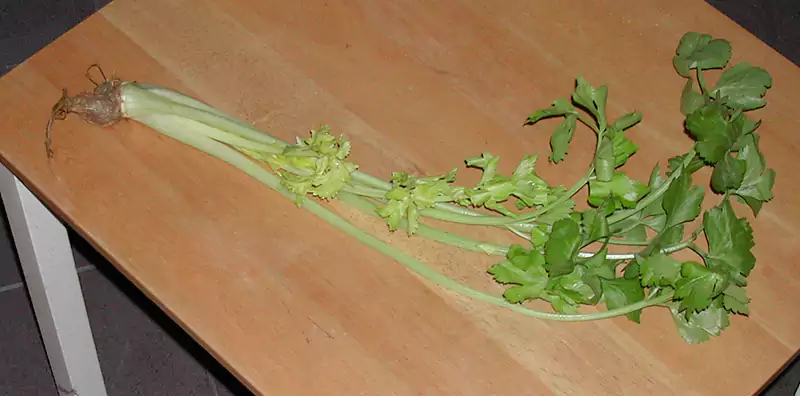 |
|
| Celeriac |  |
|
According to AGMRC, the pascal celery is the most commonly grown variety in the US, followed by the celeriac in Europe.
What are the Ideal Growing Conditions to Grow the Celery Plant?
The celery plant is a cool-season plant and requires a consistently moist soil with 6 hours of direct sunlight. If you are planning to grow the celery plant at home, make sure you tick all the following boxes:
| Planting Time | Early spring |
| Sunlight | 6-8 hours of direct sunlight |
| Water | 2 inches per week |
| Fertiliser | Heavy feeders, balanced slow-release fertiliser every 3rd week |
| Soil type and pH | Well-draining loamy soil pH- 6.0-7.0 |
How Can I Grow Celery Plant?
Growing celery starts with selecting the variety of the pascal celery, which, for me, was the Utah 52-70R improved, the easiest one to grow for home gardens.
According to me, the best way of planting is by growing celery using seeds,
as transplants are less reliable. Here is my planting guide for celery that has always worked for me:
Pre-germination
- Soak the seeds in warm water overnight. This will help in speeding up the process of germination.
- The next day, lay the celery seeds almost 1 inch apart in a pot filled with a well-draining potting mix.
- Make sure you do not cover the seeds with soil.
- Keep sprinkling water daily and keep the soil moist.
- Be patient with the process as the germination might take about 2-3 weeks.
- After the seedlings appear, keep the plant under a fluorescent light for about 14 hours to fulfill the light requirements of the plant.
Outdoor Planting/ Hardening off
- After the seedlings have produced at least 3-4 leaves, it is time to take the plant outdoors; this process is called hardening off. Since the fragile seedling can not be exposed to the outdoor temperatures, take gradual steps.
- For the first few days, place it in a shady spot for a few hours and bring it indoors.
- Then gradually plant it in well-draining soil, ensuring the nighttime temperature does not drop below 4 °C.
- Water regularly, but do not overwater as that can lead to root rot.
How to Care for the Celery Plants?
According to me, the best care advice for the celery plant would be to make sure all the growth requirements are met.

The answer to “what is wrong with my celery?’ in the Reddit query is yellowing leaves due to over- or underwatering, and if you do not want to end up in the same situation, I have listed down my best care guide for the celery plant:
- Watering: Do not let the soil of the plant dry out, as the celery plant loves moisture and needs to be watered consistently without letting the soil become soggy.
- Fertiliser: Celery plants are heavy feeders and should be fed with a balanced 4:1:3 NPK ratio fertiliser every 3 weeks. Yes, that frequently!
- Protections from the pests: The celery plants are susceptible to various pests, which can directly impact the growth and the quality of the yield. Here is a table for better clarity:
Pests Target Solution Aphids Yellowing and curling leaves. They can be hand-picked( wear gloves) or can be treated with an insecticidal soap. Carrot flies Damages the roots, which causes deformed growth. Use a parasitic nematode or row covers to prevent the attack by carrot flies. Flea beetles Makes small holes in the leaves, which also results in stunted growth. Apply insecticidal soap or Neem oil.
Also read: Essential Aloe Plant Care Tips to Keep Your Plant Green, Plump, and Problem-Free
How to Harvest and Store the Celery Plant?
Ideally, the best time to harvest celery is late August to October, like the kiwi tree. Particularly, my favourite part of planting is harvesting the celery, which is relatively easier than planting.
Here is how I harvest and store my celery every fall:
- The celery plant should be at least 12 inches tall before being harvested.
- While the celery stalks can be hand-picked, I would prefer to use a garden knife to snip off the stalks in order to avoid any damage to the roots.
- Remove the stalks as you require them, rather than cutting the whole plant. This encourages new growth and more yield.
- After harvesting, refrigerate them in a plastic bag, and they will last for weeks.
Celery Plant Benefits Backed By Scientific Research
The celery plant is packed with nutrients and water. The high Vitamin K content makes it beneficial for bone health, but I believe these claims should be verified by trusted medical portals.
Take a look at a medical paper I came across while researching about planting celery plants :
| Research summary box Study year: 2022 Aim: To analyse the effect of celery powder on cardiometabolic factors in obese individuals with type-2 diabetes. Sample type: 50 adults with type 2 diabetes, divided into 2 groups:
Key findings: After 12 weeks of analysis, it was observed that:
It was concluded that further studies are needed to validate the claims of the celery powder having cardiometabolic potential. Source: National Centre of Biotechnology Information |
Celery Plant Recipes That You Must Try!
Celery can be consumed raw or cooked for an added flavour in salads and curries. The first step after harvesting celery is to try out some interesting and unique recipes.
These are my top 2 most favourite recipes I found online:
1. Celery Roasted Stalks

Ingredients:
- 1 tbsp Olive oil
- 1 tbsp white vinegar
- ½ tbsp dried parsley
- ½ dried thyme
- 5-6 celery stalks
Recipe
- Preheat the oven to 400°F.
- Wash and cut the celery stalks and lay them on a baking tray.
- Coat the stalks with white vinegar, olive oil, salt, parsley, thyme, and pepper.
- Bake it for 30 minutes until crunchy.
- Serve hot.
2. Celery Soup

Ingredients
- 200 g Celery
- 1 onion
- 1 leek
- 2 finely chopped potatoes
- 1 tbsp Olive oil
- 75 ml oat milk
- 10 g chopped chives
Recipe
- Heat the oven to 200 °C/180°C and on a baking tray, lay finely sliced celery stalks coated with olive oil and salt.
- Roast this for 20 minutes until soft and a little crispy.
- In a pan, heat the olive oil on medium heat and saute the chopped onions with salt until brown.
- Now add the vegetables and boil them all together.
- Remove the celery stalks from the oven and add them to this mixture, and cook for 10 mins.
- Now blend this mixture, garnish with chopped chives, and serve hot.
Concluding Remarks
Planting celery is a learning experience. Similar to learning how to grow basil, it was rewarding and interesting, and now this herbaceous plant also graces my kitchen garden in the backyard.
The best part about cultivating celery is that it seems like a lot of work, but it just requires a little attention and maintenance during the growing stage. First-time planting is never perfect, and gardeners make mistakes, but if you are starting a garden from scratch and want to grow something easy and beneficial, my suggestion would be the celery plant.
Happy gardening!
FAQs
What is celery used for?
Is celery the same as coriander?
No, celery and coriander are not the same. They belong to the same family and look similar, but coriander is a herb and celery is classified as a vegetable.
What is the most commonly grown celery plant?
Pascal celery is the most commonly grown celery plant.
How long does it take to grow the celery plants?
It takes about 3-4 months to grow the celery plant after germination.
Is celery a negative-calorie food?
No, there is no such thing as a negative-calorie food. Celery is a low-calorie food and can help in weight management, but it does provide a significant amount of energy to the body.
Sources:
Celery recipes– BBC
Latest Blog