A kiwi takes at least 3-4 years to bear fruit after planting.
Kiwi Tree: How to Grow and Care for This Superfood?
Author
Annette HirdReviewed By
Cody Allison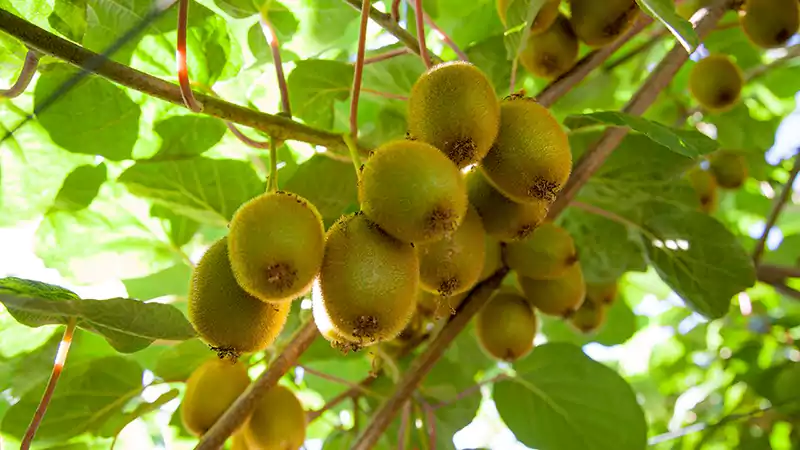
Kiwis are packed with nutrition and taste. No matter how you consume it, it has benefits beyond its sweet flavor, and that in itself is the biggest reason to plant kiwi trees at home.
I have loved and cherished kiwis since childhood, and as much as this fruit is a core memory, I have been consuming and growing kiwi for the longest time in my garden.
By now, not only have I been able to decipher all the possible health benefits it offers, but I have also discovered a few growing kiwi tricks that make planting and care even easier.
If having a yard with climbing vines of kiwi is on your bucket list, then let me take you through this comprehensive guide about the kiwi tree:
Table of Contents:
- What is Kiwi? Grown as Vines or on Trees?
- What is the Nutritional Value of Kiwi?
- Are Kiwi Fruit and Kiwi Berry Different?
- Can I Grow the Kiwi Tree at Home?
- How to Care for the Kiwi Berry Plant?
- How to Harvest the Kiwi Fruit?
- Scientific Research and Findings About the Kiwi Berry Plant
- Popular Kiwi Recipes That the Internet Loves!
- Concluding Remarks
- FAQs
What is Kiwi? Grown as Vines or on Trees?
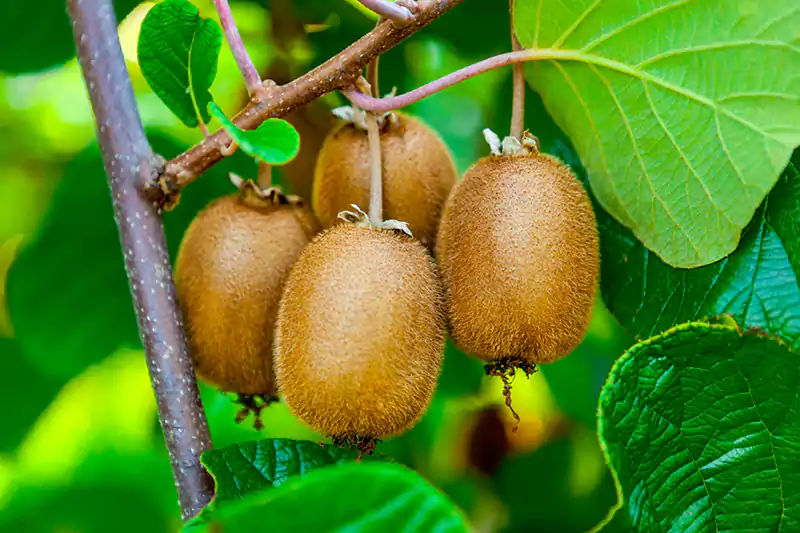
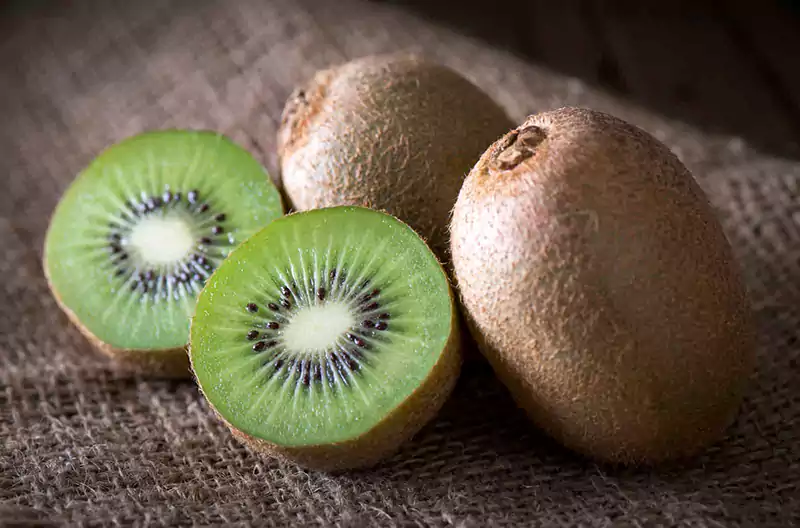
Belonging to the Actinidiaceae plant family, the kiwi fruit is a small berry-like fruit with brown, fuzzy skin, green flesh, and black seeds.
Native to the region of southeastern and central China, this name is widely associated with New Zealand, mainly due to a unique bird native to the country.
Contrary to popular belief, the kiwi is grown in the form of a climbing vine like the loofah plant and not as a kiwi tree. There are originally two main types of kiwis: Green kiwi (with fuzzy skin) and Golden kiwi (slightly smooth skin and golden flesh), and both have further classifications into male, female, and self-fertile varieties.
Susceptible to frost, this fruit is considered a “superfood” due to its high antioxidant and vitamin C content, but before discovering the nutritional details and the care guide, take a look at the scientific classification of the kiwi fruit.
 | |
| Botanical Name | Actinidia |
| Kingdom | Plantae |
| Division | Magnoliophyta |
| Class | Magnoliopsida |
| Order | Theales |
| Family | Actinidiaceae |
| Genus | Actinidia Lindl |
| Species | Actinidia chinensis Planch. |
What is the Nutritional Value of Kiwi?
Kiwi is considered a “superfood” that is packed with nutrients like vitamin C, fiber, and antioxidants that help regulate the plasma levels, which helps boost immunity levels.
Let me take you through the nutritional value of the kiwi berry plant, including both varieties:
| Nutrient | Green Kiwi | Golden Kiwi |
| Vitamin C | 92 mg | 161 mg |
| Fiber | 3 g | 1.4 g |
| Protein | 1.14 g | 1.02 g |
| Carbohydrate | 14.7 g | 15.8 g |
| Fats | 0.52 g | 0.28 g |
| Potassium | 312 mg | 315 mg |
| Magnesium | 0.098 mg | 0.05 mg |
| Iron | 0.31 mg | 0.21 mg |
| Calcium | 34 mg | 17.0 mg |
Are Kiwi Fruit and Kiwi Berry Different?
Yes, kiwi berries are a different variety of the kiwi fruit and not a name used to describe the same fruit. Both these varieties differ in nutrient content and taste.
So, before you choose which variety to plant, make sure the difference is well understood:
| Kiwi Fruit | Kiwi Berries |
 | 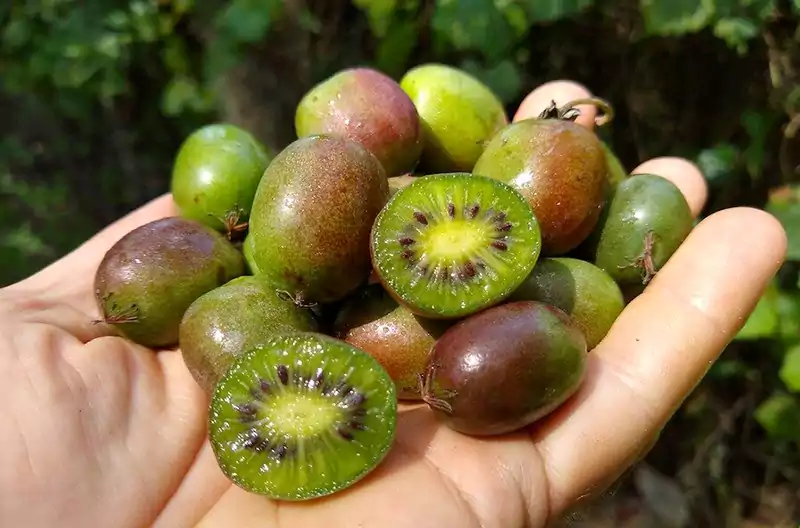 |
| Scientific name: Actinidia deliciosa | Scientific name: Actinidia arguta |
| The kiwi fruit has brown, coarse, and fuzzy skin with green flesh. | Contrary to the fruits, the kiwi berries are smaller in size and have a smoother red-green skin. |
| Additionally, the taste profile is sweet and tangy. | The berries are sweeter than the fruits. |
Can I Grow the Kiwi Tree at Home?
Kiwi is grown in the form of climbing vines, not a tree, and is easily grown in a home garden and on lawns. They just need a vast area, as sufficient space is required for them to spread evenly.
The growing guide starts with making sure all the growth requirements are met:
| Soil Type and pH | Well- drained sandy or loamy soil pH – 5.5 – 6.5 |
| Sunlight | 6 hours of direct sunlight |
| Water | 1 inch per week and more frequently during summers |
| Hardiness Zone | USDA 3-9 |
| Fertiliser | Balanced nitrogen-rich fertiliser |
| Planting season | Early to mid spring |
Gardener’s Insight
To grow a kiwi tree, both the male and female varieties of the plant are needed, as the male variety produces flowers and the female variety also produces fruit. However, if the space is limited, you can go for the self-fertile variety called ‘Issai’.
If the question, “How do kiwis grow?” has been lingering in your mind, here is my tried and tested kiwi-growing guide:
- Dig up the chosen spot and loosen up the soil. Add a layer of compost to make the soil more fertile.
- Now dig a hole twice as large as the root of the kiwi transplant.
- Place the plant carefully in the hole and cover the root with soil, ensuring the crown is not under the soil surface.
- The kiwi berry plant is drought-sensitive and should be watered thoroughly without being waterlogged.
- Add a layer of mulch to the garden bed to retain moisture and suppress weeds.
- Since the kiwi plant is a climbing vine, it requires a strong support like a trellis to survive and grow.
- The kiwi vine requires a balanced nitrogen-rich fertiliser for healthy growth. The best time to fertilise the kiwi plant is during February and March.
Also read: Honeysuckle Flower: How to Grow this Fragrant Garden Vine?
How to Care for the Kiwi Berry Plant?
Kiwi is a high-demanding plant, especially in the initial years. It requires proper support and a pruning schedule in order to survive and bear healthy fruits.
I have grown kiwi fruits for quite some time now, and according to me, the answer to“how do kiwi plants grow into healthy fruit-bearing vines?” is the following 2 steps.
Training the Kiwi Berry Plant
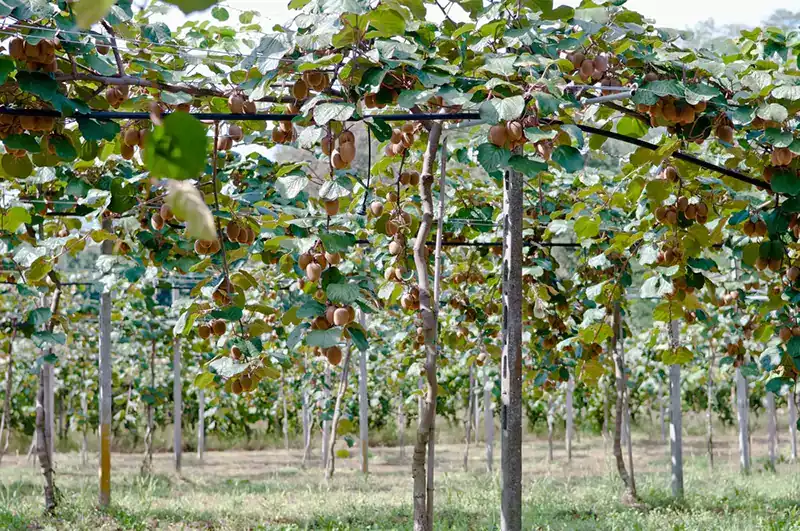
- Training the kiwi vine is the process of establishing a strong support system ( trellis) for it to grow and spread evenly.
- I use a T-bar trellis as it is more convenient and does not need much labour as compared to the Pergola system.
- Use two wooden central posts with a horizontal bar at the top( which forms a T) as shown below:
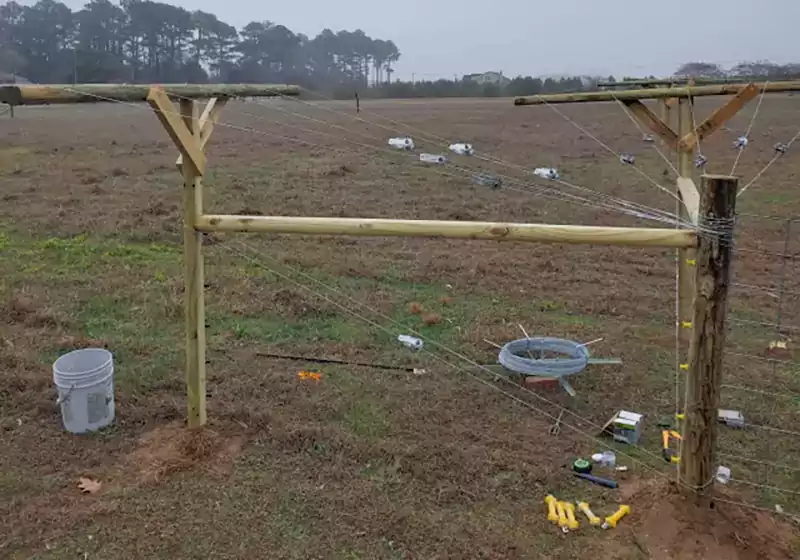
- Connect them using at least 4 trellis wires spaced 12 inches away from each other to give the vines space to grow.
- Plant the kiwi vine at the base of the structure and attach it to the bar to promote vertical growth, and once it reaches the top, pinch it to promote sideways growth.
Pruning the Kiwi Plant
Pruning the kiwi vine is done twice annually, with winter pruning being the most significant. Timely deadheading prevents overcrowding and helps maintain a clean structure.
- Winter Pruning:
- The winter pruning happens from December to March and is the time for heavy deadheading.
- Ensure this takes place during early winter to prevent frost damage.
- Remove the dead leaves and canes of the plant.
- Ensure there is at least a 12-inch gap between all the branches for better air circulation.
- Summer Pruning:
- Summer pruning happens between June and August.
- It focuses mainly on fruit exposure; hence, remove any foliage back to 2 to 3 buds to expose the fruit to receive adequate sunlight.
Do you know?
Just like the Christmas cactus plant, the kiwi berry plant is also a perennial plant and can survive for up to 50 years.
How to Harvest the Kiwi Fruit?
The best time to harvest kiwis is from September to November. Do not leave them on the vine after maturing to prevent rotting.
Here is how I harvest kiwis at the right time:
- Pick the kiwis during September or October; by then, they have reached maturity.
- Always check the softness before picking the fruit.
- Early picking prevents the damage that frost can cause to the kiwis.
- After harvesting, store them in the refrigerator for a few days before consuming if they are ripe.
- Store them in a cool and dry place. Kiwis can last up to 4 months after harvesting.
Scientific Research and Findings About the Kiwi Berry Plant
The kiwi plant is known to have antioxidant properties and nutrients that boost immunity and overall health.
Kiwi as a superfood has been credited for years by science and medical research, and here is a clinical human trial that has verified the usefulness of kiwis for human health:
| Research summary box Study year: 2011 Sample type: 2 men and 22 women assessed based on the CPSQI test ( Chinese Pittsburgh Sleep Quality Index test Aim: To analyse the effects of kiwis in improving sleep quality in humans Key findings: 2 kiwis were consumed by the 24 people 1 hour before bedtime.
|
Popular Kiwi Recipes That the Internet Loves!
The fitness influencers love kiwi, and so do I. Kiwi can be so versatile in the way it is consumed. Either eat it raw or in a cake, or a morning fruit salad, the options are endless.
I have shared my top 2 kiwi recipes that I love and recommend to all the fruit and fitness lovers.
1. Kiwi Chia Pudding  | |
Ingredients
| Recipe
|
2. Kiwi Banana Smoothie  | |
Ingredients
| Recipe
|
Bursting the myth
It is not illegal to own a kiwi tree in the U.S as it can be misinterpreted. The ownership of the bird Kiwi is banned globally as it is a highly protected species of New Zealand and is nearly threatened, according to the IUCN Red List.
Concluding Remarks
Kiwi fruit is a nutrition-packed fruit that is never a waste, neither for the garden nor for you. I have been growing the kiwi long enough to comment that, yes, growing the kiwi tree can be a little time-consuming and requires patience, as it fruits after 3 -5 years.
The only advice to newbie gardeners while growing a kiwi plant is to focus a lot on the training and pruning, especially in the first year. Whichever variety you wish to grow, it remains intact in your garden for years to come.
FAQs
How long does it take to fruit?
Are kiwis perennial or annual?
The kiwis are long-lived perennials which can live upto more than 20 years.
Can you eat the skin of a kiwi?
Yes, the skin of the kiwis can be consumed as it is highly nutritious. Just wash them thoroughly before use.
Do kiwis grow on trees?
No, kiwis are climbing vines and grow with the support of a trellis, which might appear like a tree due to the T-bar or pergola structure.
Where kiwi fruit grow?
The kiwi fruit essentially grows in the region of China that is the largest producer of the fruit, followed by India, New Zealand, and Italy.
Source:
How to grow kiwis – BBC Gardeners