Mandevilla is a climber, a perennial plant that blooms in beautiful colours like white, orange, red, and pink.
Mandevilla Plant Guide: Taxonomic Overview, Ideal Growing Conditions, Care Tips, & Much More!
Author
Rashika Gupta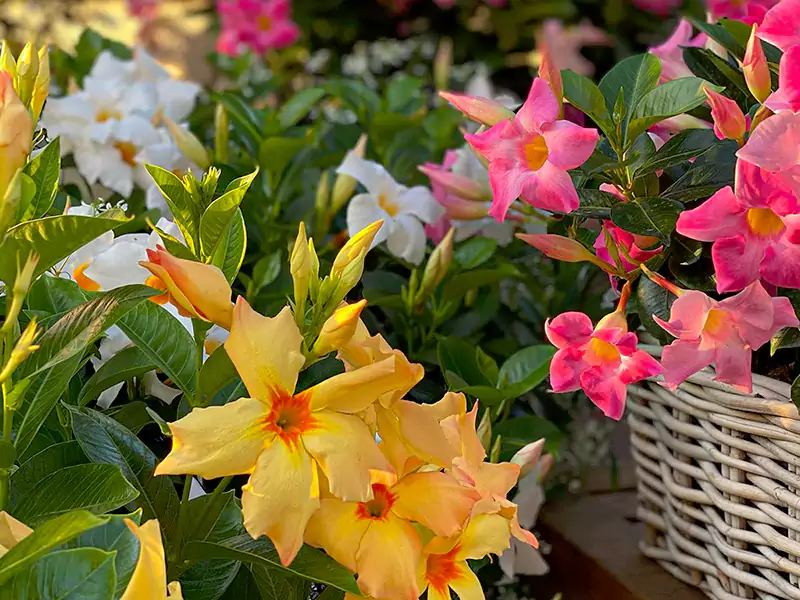
Mandevilla is an aesthetic flowering plant used for creating fences, trellises, and mailboxes. The plant is a genus of tropical and subtropical flowering vines. It is native to the Southwestern United States, Mexico, Central America, South America, and the West Indies.
The Mandevilla vine thrives best in warm and humid weather conditions. It is an evergreen, semi-evergreen, or deciduous woody climber or perennial plant, which offers flowers in deep rose pink, red, and white colours.
Let us delve into more details regarding the beautiful mandevilla plant, from mandevilla care tips to its taxonomy and common problems associated with the plant.
Table of Contents:
Taxonomy and Ideal Growing Conditions For Mandevilla Plant
Mandevilla is a fast-growing plant that typically produces flowers in clusters at the end of the stem. For more general information, here is the taxonomic overview and ideal growing conditions of the plant
| Botanical name | Mandevilla |
| Kingdom | Plantae |
| Order | Gentianales |
| Family | Apocynaceae (Dogbane family) |
| Subfamily | Apocynoideae |
| Genus | Mandevilla |
| Species | Mandevilla splendens, Mandevilla sanderi, and Mandevilla boliviensis |
| Hardiness | 9-11 USDA zone |
| Light Requirements | Bright, direct sunlight, partial shade |
| Plant type | Perennials, annuals, and climbers |
| Season of interest | Late spring, summer, and fall |
| Maintenance | Low |
| Soil | Well-drained, moist, loamy soil with acidic, alkaline, and neutral pH levels. |
| Water Requirements | Average watering. Water the plant only when the top layer of soil starts to dry. |
| Characteristics | Showy |
| Fertilizers | Balanced fertiliser every 2 to 3 weeks during the growing season, that is, spring and summer. Stop fertilising the plant in the fall. |
| Mature size | 10 ft. tall |
| Flowers | Trumpet-shaped flowers in different colours like rose pink, white, and red. |
| Toxicity | The plant is toxic to dogs, cats, horses, and humans. Note: The plant sap can cause skin irritation and allergic reactions for some people. It is advised to use gloves while dealing with mandevilla sap. |
What is the Difference Between Mandevilla and Dipladenia?
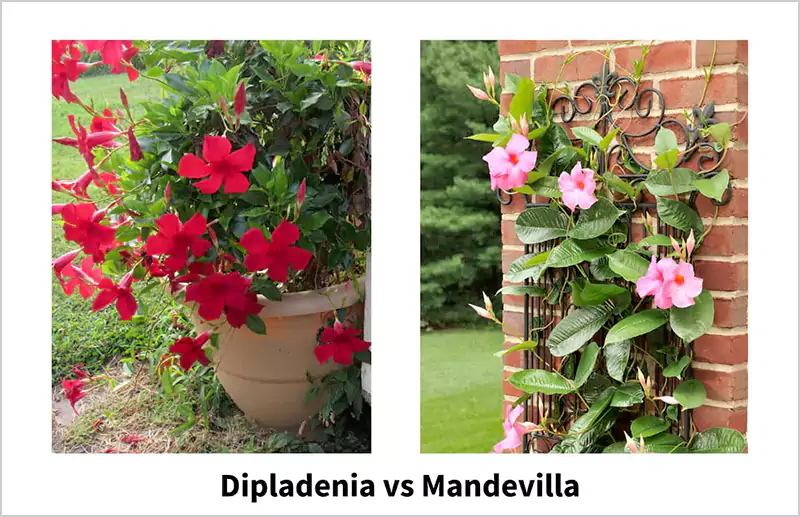
Often, people use mandevilla and dipladenia interchangeably. This is probably because the two plants and their flowers are very similar in appearance and belong to the same family. But there are a few differences between the two plants elaborated in the table below:
| Difference | Mandevilla | Dipladenia |
| Appearance | Larger, woody vines | Smaller, compact plants |
| Native Region | Tropical and subtropical regions of Americas. | Tropical and subtropical regions of Americas. |
| Hardiness Zone | 9-11 USDA Zone | 10-11 USDA Zone |
| Blooming Period | Late spring to the first autumn fall. Peak flowering takes place during midsummer. | Late spring through first frost. |
| Plant size | Vines can grow up to 10 ft. long. | Compact plant with a height of 5 ft. |
| Flower size | Large, trumpet-shaped flowers. | Small, star-shaped flowers. |
| Leaves | Oblong and rounded at the tip. | Ovate and pointed at the tip, glossy and dark green leaves. |
| Growth habit | Vining | Shrub-like |
| Care tips | Mandevilla needs a proper structure to support the climber. | Dipladenia requires proper watering and sunlight. |
Read more: Calathea Plant: Varieties, Growing Conditions, Features and Care Guide
How to Grow Mandevilla Plant?
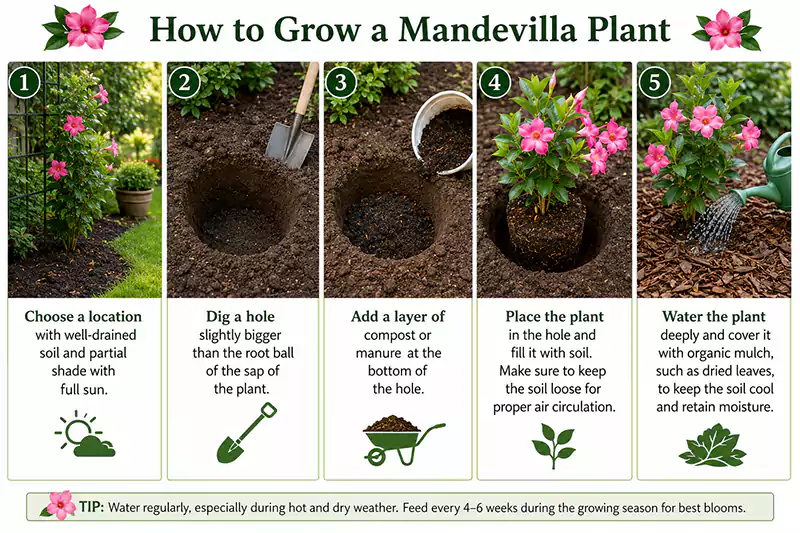
Growing mandevilla is as easy as growing any other plant. It can be grown in a container and, when grown, can add a beautiful appearance to your place. Here is the step-by-step process of growing a mandevilla plant:
- Choose a location with well-drained soil and partial shade with full sun.
- Dig a hole slightly bigger than the root ball of the sap of the plant.
- Add a layer of compost or manure at the bottom of the hole.
- Place the plant in the hole and fill it with soil. Make sure to keep the soil loose for proper air circulation.
- Water the plant deeply and cover it with organic mulch, such as dried leaves, to keep the soil cool and retain moisture.
In case you are planting it in a container:
- Choose the pot with the drainage hole for the removal of excess water and proper air circulation.
- Fill it with a well-drained potting mix.
- Plant the mandevilla plant at the same depth it was growing in its original container.
- Lastly, water the plant thoroughly and keep the soil evenly moist.
How to Propagate Mandevilla Plant?
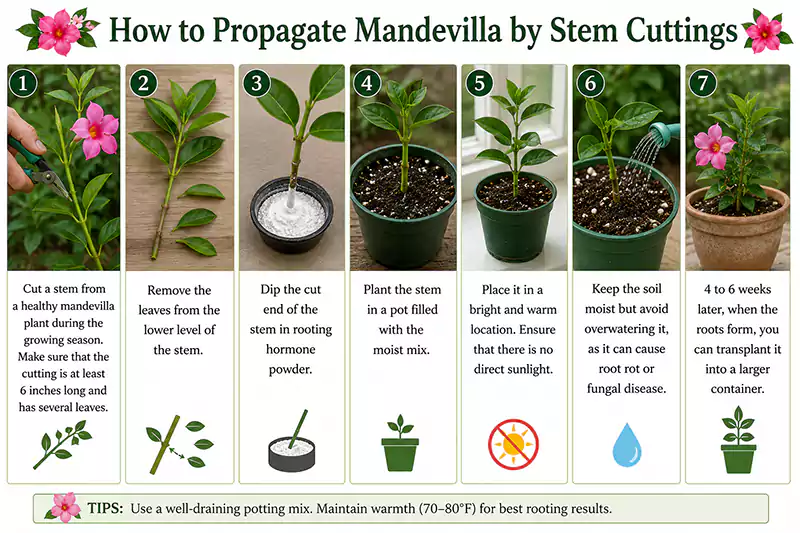
Mandevilla can be propagated by the stem cutting method. Here is the step-by-step process to propagate a mandevilla plant:
- Cut a stem from a healthy mandevilla plant during the growing season. Make sure that the cutting is at least 6 inches long and has several leaves.
- Remove the leaves from the lower level of the stem.
- Dip the cut end of the stem in rooting hormone powder.
- Plant the stem in a pot filled with the moist mix.
- Place it in a bright and warm location. Ensure that there is no direct sunlight.
- Keep the soil moist but avoid overwatering it, as it can cause root rot or fungal disease.
- 4 to 6 weeks later, when the roots form, you can transplant it into a larger container.
Read more: Lucky Bamboo Plant: Growth, Care Tips, and Symbolism Explained
Ideal Caring Tips for a Mandevilla Plant
The Mandevilla plant requires low-maintenance and is beginner-friendly. Here are some Mandevilla plant care tips:
- Mandevilla requires indirect sunlight for around six hours a day. Therefore, it becomes important to choose the correct location.
- Water the plant regularly, but make sure not to overwater it, as it can cause root rot, which will further lead to the death of the plant.
- The mandevilla plant only requires fertilisation during the growing season, that is, spring and summer. Avoid fertilising the plant in the fall.
- Mandevilla plant requires support while growing. Ensure using a trellis or other support structure to help the plant climb.
Pests and Diseases Associated With Mandevilla Plant
Pests are one of the common problems while growing any plant. Mandevilla plants can be susceptible to a variety of pests. Some of them include spider mites, whiteflies, mealybugs, and anthracnose.
In order to get rid of these pests, it becomes important to examine your plant every day and check if there are any pests. If detected in an early stage, you can handpick them. But in case they
spread throughout the plant, here are some tips that might be helpful for you:
- Use organic pesticides like neem oil. Spray it all over the plant.
- You can spray insecticidal soaps to remove the pests from the plant.
- To control whiteflies, you can use a sticky trap.
- Anthracnose can be controlled by practising good sanitation in the garden.
The two common diseases associated with Mandevilla plants are root rot and powdery mildew. Root rot can be caused by overwatering the plant, and can be prevented by not watering the plant too much.
Powdery mildew is a fungal disease and can cause a white coating on plant leaves. Using a good fungicide spray helps the plant fight powdery mildew.
Tip
To remove powdery mildew, you can also use a mixture of baking soda and water. Spray it thrice a week for better results.
Takeaways
Mandevillas are tender perennial plants that can survive in winter. The plant is admired for its aesthetic flowers that also attract pollinators. Following some simple steps helps the plant to thrive in any season, including proper sunlight, watering, and fertilisation.
If you are a beginner and want to plant mandevilla, it is the perfect choice. Bring your plant this spring and see it bloom throughout the year. Happy planting!
FAQs
What is Mandevilla?
Is it Mandevilla or Dipladenia?
Mandevilla and dipladenia are two different flowering plant which belong to the same family. There is a slight difference between the shapes of the leaves and the flowers of the two plants.
What is the blooming season for Mandevilla?
Late spring and summer are the blooming season for the Mandevilla plant. Some species also grow during winter.
Do Mandevilla attract pollinators?
Yes, the beautiful, colourful flowers of the mandevilla plant attract pollinators like bees and butterflies.
What is the best time to plant Mandevillas?
The best time to grow mandevillas is late spring.
How to care for mandevilla?
It is important to place the plant in bright, indirect sunlight and water it only when the soil starts drying.
Sources
Latest Blog