Green beans are average maintenance plants that require full sunlight, consistent watering, and well-drained acidic soil to thrive.
Green Bean Plant: Major Types, Growing, and Cultivation Tips
Author
Annette HirdLast Update
September 30, 2026
Commonly eaten as a vegetable in many households, the Green Bean plant is well-known for its nutritious value. Grown both as a bush and a climbing plant, green beans are cooked in various ways across the globe.
Beyond that, they are also known for improving the soil quality, making them a significant crop among gardeners.
So, if you are thinking about growing green beans at home? Continue reading for essential cultivation tips and the various benefits and uses of this nutritious vegetable.
Table of Contents:
Origin and History of the Green Bean Plant

As per NC State Extension, Green bean plants originated in Peru and parts of Central and South America. Later, they were spread to other parts of Europe by Christopher Columbus in the 15th and 16th centuries.
Initially, they were used as ornamental plants by the Spanish people. According to the legends, the process of cooking green beans was accidental after they fell into the pot of hot water.
Native American people grew green beans in the three sisters planting method with corn and squash.
The first botanical drawing of bush beans was made by Leonhart Fuchs in 1542. Later in 1889, Calvin Keeney developed snap beans, which were popular until Tenderbeans first appeared in 1925.
With the development of Bush Blue Lake Bean in 1962, green beans became popular worldwide, and people started experimenting with their different recipes.
Botanical and Taxonomic Structure of the Green Bean Plant

Understanding the botanical and scientific classification of the green bean plant is important before diving into the various types and cultivation tips of this herbaceous annual.
| Scientific Classification | |
|---|---|
| Kingdom | Plantae |
| Division | Angiospermae |
| Class | Dicotyledonae |
| Order | Fabales |
| Family | Fabaceae |
| Genus | Phaseolus |
| Species | Phaseolus Vulgaris |
Also Read: Best 15+ Small Evergreen Garden Plants Perfect for Compact Spaces
Major Types of Green Bean Plant
Based on their growing pattern, green beans are divided into two types: bush beans and pole beans.
Bush Beans

They are a compact variety of green beans that are smaller and do not require any support to develop. Although they take less time to grow, about 50–55 days, bush beans are more prone to diseases such as mildew and mosaic virus, and produce fewer bean pods.
| Scientific Name | Phaseolus Vulgaris |
| Height | 2–3 feet |
| Soil Type | Well-drained soil |
| Maintenance Level | Average (lesser than pole beans) |
| Sun/Shade Preference | Full sun exposure |
| Watering Needs | Consistent watering |
The bush beans further have different types of green beans, including Derby, Roma II, Royal Burgundy, Tendercrop, and Blue Lake, among others.
| Name | Image | Description |
| Derby |  | Derby bushes are one of the most low-maintenance varieties of bush beans, which have pods up to a height of 7 inches. Additionally, they are self-sufficient and resistant to the common mosaic disease that affects various other varieties. |
| Roma II |  | Roma II beans have flat bean pods that grow up to a height of 6 inches. Excellent for freezing and canning, they are resistant to mosaic disease and several bacterial infections. |
| Royal Burgundy |  | Royal Burgundy beans are purple colored and turn green after cooking. They can grow well in containers up to a height of 2 feet and require relatively less watering than other bean types. |
| Bush Kentucky Wonder |  | The Bush Kentucky Wonder beans grow in clusters up to a height of 20 inches. They have flat and thick bean pods that produce higher yields throughout the season, with a shorter germination period of 7–10 days. |
| Tendercrop |  | Tendercrop beans have stringless pods and a great taste, making them perfect for culinary uses. They are low-maintenance varieties that grow up to a height of 4 inches and are a good choice for canning and freezing as well. |
| Blue Lake |  | Blue Lake beans are easy-to-grow compact beans that grow up to a height of 20 inches. They have tender and stringless pods that are perfect for cooking, freezing, or canning. |
| Improved Golden Wax |  | Improved Golden Wax beans are an enhanced version of Golden Wax beans, known for their higher yield. Growing up to a height of 7 inches, they have stringless, yellow pods that are perfect for cooking, canning, freezing, and in salads as well. |
Pole Beans

Pole beans are large climbers that, unlike bush variety, require the support of a trellis or tepees to grow. They have a longer harvesting period, about 55–65 days, and yield more beans. Although they require more maintenance than bush beans, pole beans are resistant to various diseases and infections.
| Scientific Name | Phaseolus Vulgaris |
| Height | 10–15 feet |
| Soil Type | Well-drained soil |
| Maintenance Level | Average maintenance |
| Sun/Shade Preference | Full sun exposure (can bear partial shade also) |
| Watering Needs | Consistent watering |
Popular varieties of pole beans include Seychelle, Blue Lake, Rattlesnake, Romano Italian, Scarlet Runner, and Kentucky Blue, among others.
| Name | Image | Description |
| Seychelle | 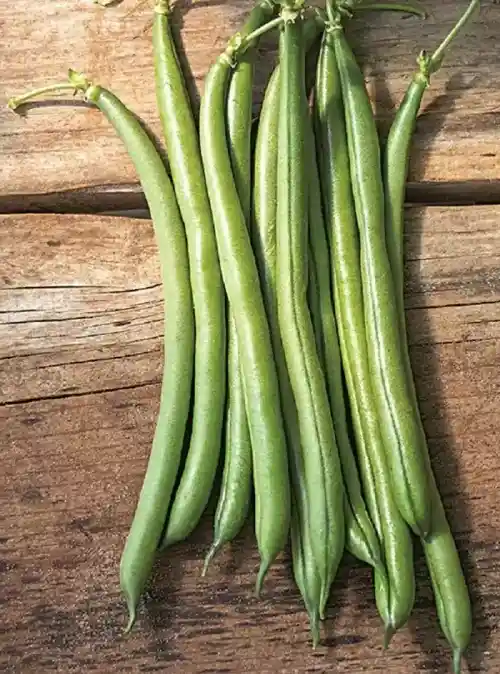 | Pods of Seychelle beans grow up to a height of 6 inches with the support of trellis vines. They have round, dark green pods with a higher yield but slow growth. With their disease resistance, they are ideal for canning, freezing, and fresh eating. |
| Blue Lake |  | Blue Lake beans are grown both as bush beans and pole beans and are perfect for freezing, canning, and pickling. While their pods grow up to a height of 7 inches, they have vines that are 8 feet tall. |
| Rattlesnake |  | Rattlesnake beans have up to 10-inch-long pods with purple streaks on them. With the support of trellis or teepees, their vines can reach up to a height of 10 feet. They turn completely green after cooking, and their seeds can be used in soups. |
| Romano Italian |  | The pods of Romano Italian beans are flat and wide, and can grow up to a height of 12 cm. These are resistant to rust and can be used in canning, freezing, and fresh eating as well. |
| Scarlet Runner |  | Scarlet Runner beans are from a different species, Phaseolus Coccineus, and are popularly grown as ornamental plants. With vines growing up to a height of 15 feet, Scarlet Runner has striking red flowers and dark green leaves. |
| Kentucky Blue |  | Resistant to diseases such as mosaic disease and rust, pods of Kentucky blue beans grow up to a height of 8 inches on a 6-foot-tall vine. Additionally, these beans are high-yielding if their pods are picked regularly. |
| Kentucky Wonder Wax |  | Kentucky Wonder Wax beans have yellow-colored, wax pods that grow up to a height of 8 inches and can also be eaten raw. These are considered one of the top varieties of pole beans, known for their high quality and great taste. |
Complete Care Guide for Growing Green Beans

Green bean plants are average maintenance annual plants that can thrive when provided with the appropriate growing conditions.
| Growing Conditions for the Green Bean Plant | |
|---|---|
| Water Needs |
|
| Soil Type |
|
| Hardiness Level |
|
| Average Size |
|
| Sunlight |
|
| Fertilizer |
|
| Pruning |
|
Also Read: 25 Best Hummingbird Flowers: Trumpet Vine, Beardtongue, Lantana and More
How to Grow Green Beans at Home?

Some steps need to be followed properly if you want to grow green bean seeds at home.
- Sowing the Seeds – Directly plant the green bean seeds into the ground when the climate is warm. The distance between bush bean seeds should be 2–4 inches, whereas pole bean seeds should be planted 4–8 inches apart from each other.
- Choosing the Right Spot – As green bean plants thrive in full sun exposure and a temperature of at least 55 degrees Fahrenheit, choose a spot in your garden that receives maximum sunlight.
- Regular Watering – 1 inch of water is required per week for effective green beans cultivation. However, you should avoid overwatering as it will make the soil soggy.
- Providing Trellis Support – This is an optional step, as a trellis is only required in the case of pole beans in order to support their growth.
- Mulching and Weeding – Mulching helps in retaining the moisture in the soil, whereas weeding removes the growth of unwanted plants that can hinder the development of the main plant.
Benefits and Uses of Green Beans
There are several benefits and uses of the green bean plant, including health advantages, culinary uses, landscaping purposes, and soil improvement.
- Health benefits – They are rich in fiber, antioxidants, and vitamins A and C, which help in preventing various diseases and improving overall health and digestion.
- Culinary uses – Apart from providing several health benefits, they are used in cooking worldwide. Several dishes can be made using green beans, and they can also be used in salads and stews.
- Landscaping purposes – While pole beans give height to your garden, bush beans can be used in borders, containers, ground cover, and to fill the empty spaces in the garden.
- Soil improvement – Green bean plant helps in improving the fertility of the soil by increasing the concentration of nitrogen. Therefore, it is commonly grown in crop rotation with crops such as corn that require nitrogen-rich soil.
To Sum Up
Tracing back to the 15th century, the green bean plant is well-known for its culinary uses globally. Rich in minerals, fibres, and vitamins, green beans provide several health benefits as well.
Furthermore, there are different types of green beans under bush beans and pole beans, which include varieties such as Blue Lake, Tendercrop, Royal Burgundy, and Rattlesnake, among others.
Additionally, green beans cultivation can be easily done at home with average maintenance and proper growing conditions.
Frequently Asked Questions
How to care for a green bean plant?
How long does it take green beans to grow?
While the bush beans take 50–55 days to grow, pole beans need 55–65 days to mature completely.
Do green beans like sun or shade?
Green beans love full sun and require at least 6–8 hours of sunlight every day. However, pole beans can also tolerate partial shade.
What is the best month to plant green beans?
As green beans thrive in warmer climates, late spring and early summer, from May to July, is considered the best time to plant green beans.
Do green beans come back every year?
No, green beans do not come back every year, as they are herbaceous annuals. While some varieties may be perennial, most of them need to be planted every year.
Latest Blog