These houseplants are versatile and can be easily grown indoors and outdoors. If indoors, keep them in a humid room like a bathroom or near the window. If kept outdoors, they grow best in indirect sun exposure.
How to Grow Asparagus Fern? Explore the Varieties, Care Guide and Common Problems of the Houseplant
Author
Rashika GuptaLast Update
October 3, 2026
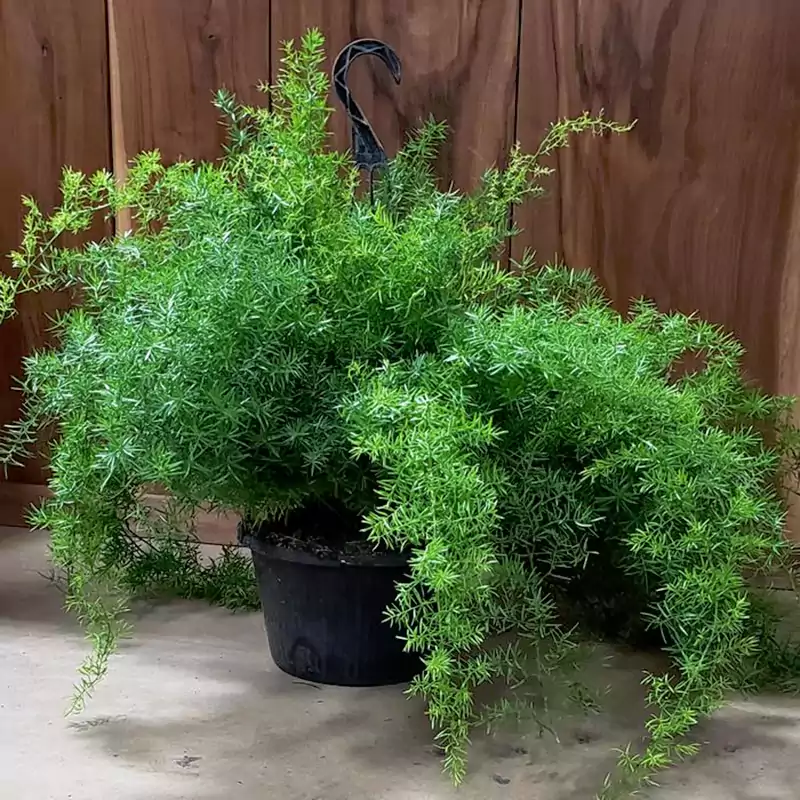
The asparagus fern plant, also famous as foxtail fern, is famous for its feathery foliage that adds an airy aesthetic to homes and gardens alike.
When I was growing the houseplant along with a cypress tree, I understood it is an ideal plant for beginners as it requires minimal care from my side.
Let’s discuss their varieties, common problems, and care guide of these spreading plants, but to start with, have a look at their taxonomy first.
Table of Contents:
What is the Asparagus Fern?
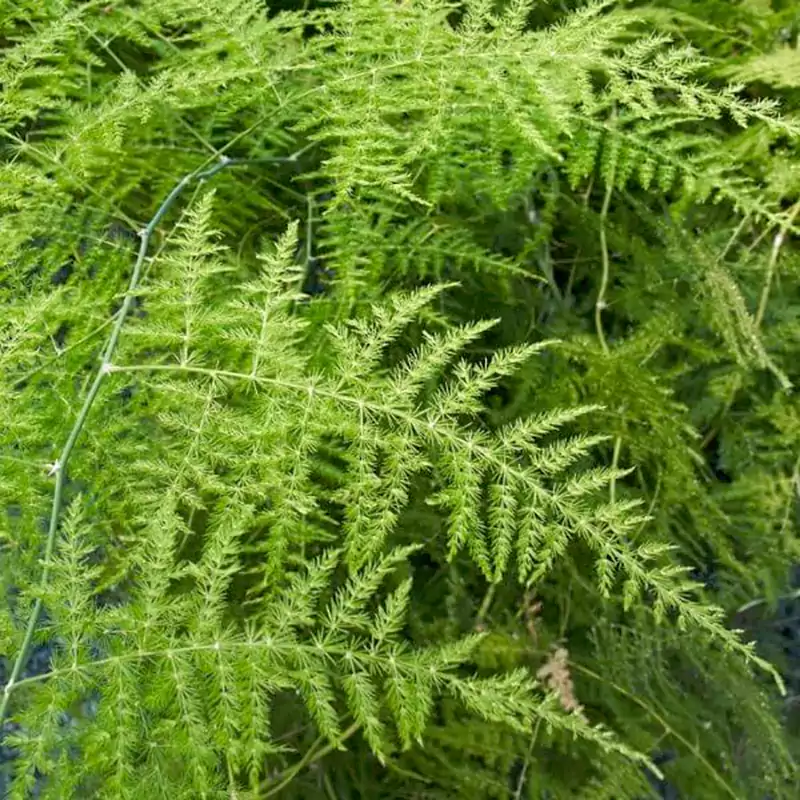
Being an easy-to-care houseplant, asparagus fern is a spectacular ornamental plant that features needle-like soft foliage, creating a cascading or upright mound. After some time, it blooms with small white and pink flowers followed by berries that are considered toxic to humans and pets.
Interestingly, despite its name, it is not part of the fern family but rather of the Lily or Asparagaceae family. It features hummingbird flowers and produces red berries, whereas the true ferns reproduce through spores.
| Biological Name | Asparagus aethiopicus ‘Sprengeri’, Asparagus setaceus, Asparagus densiflorus ‘Myers’, and other types |
| Kingdom | Plantae |
| Division | Tracheophyta |
| Class | Liliopsida |
| Order | Asparagales |
| Family | Asparagaceae |
| Genus | Asparagus L. |
Distinct Varieties of Asparagus Fern
While searching for the types of asparagus ferns, I got to know that, though there are more than 300 species of the Asparagus genus, only a few varieties are cultivated as asparagus ferns worldwide, including Foxtail fern, Sprengeri fern, and Plumosa fern. Here are the details of the well-known types:
| Name of the Variety | Image | Description |
| Foxtail Fern (Asparagus densiflorus ‘Meyersii’) | 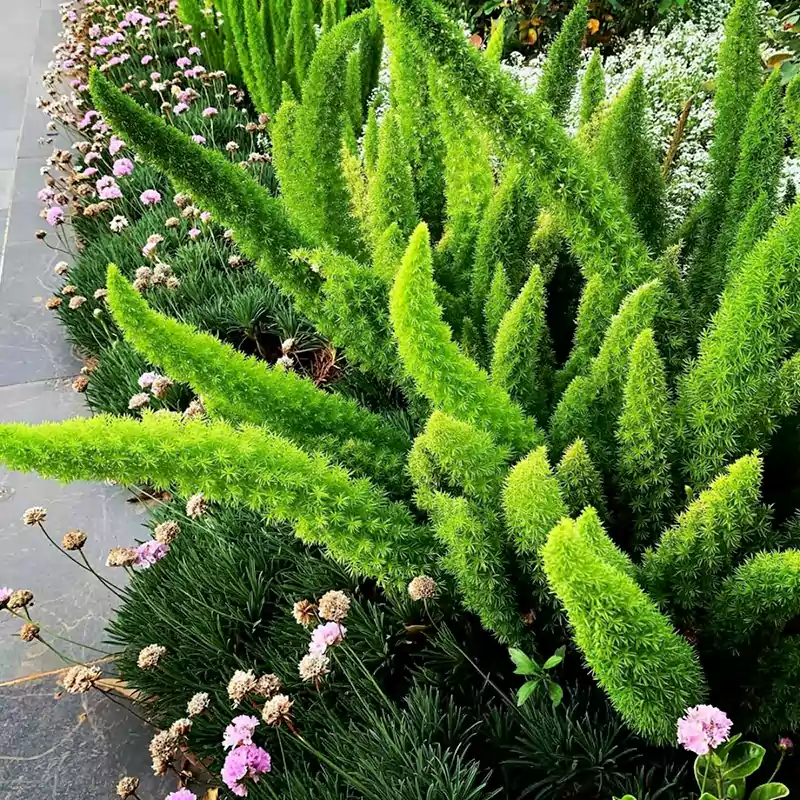 | Foxtail fern, true to its name, features stems that look like a bushy fox tail. Growing approximately 2 feet tall and 3-4 feet wide, they are excellent for containers and hanging baskets. |
| Sprengeri Fern (Asparagus densiflorus ‘Sprengeri’) | 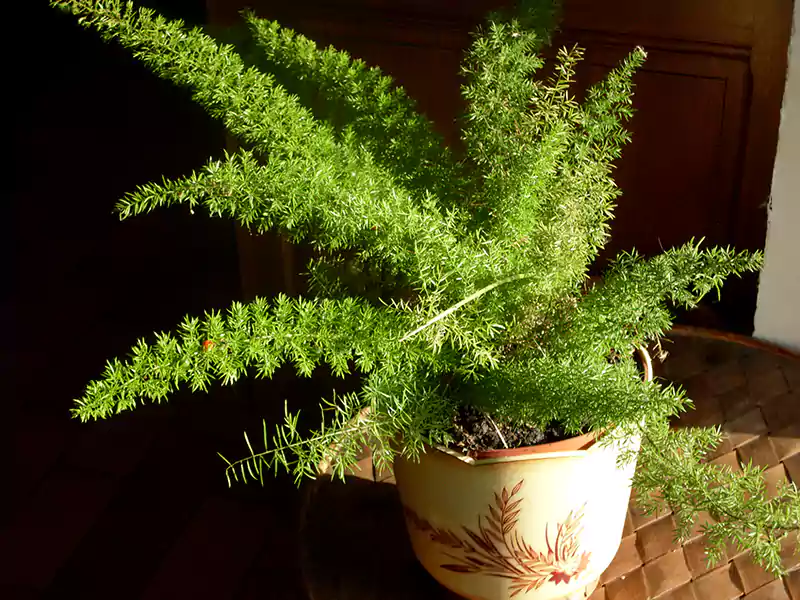 | Sprengeri fern, sometimes referred to as Asparagus aethiopicus, is a trailing perennial that has needle-like, bright green foliage. It can grow roughly 1-2 feet in height and 2-4 feet in width, producing white flowers and red berries. |
| Plumosa Fern (Asparagus setaceus or plumosus) | 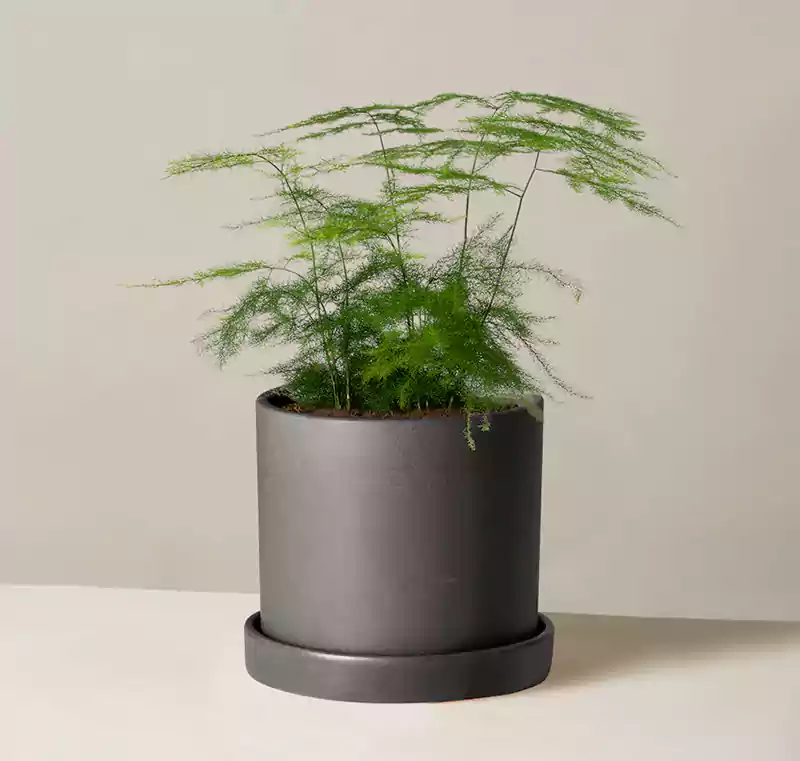 | Plumosa fern is an evergreen vine that can climb up to 20 feet, featuring feathery needle-like foliage that creates a beautiful lacy effect, reminiscent of a celery plant. Additionally, it blooms with tiny white flowers that turn into green berries over time. |
| Ming Fern (Asparagus macowanii or umbellatus) | 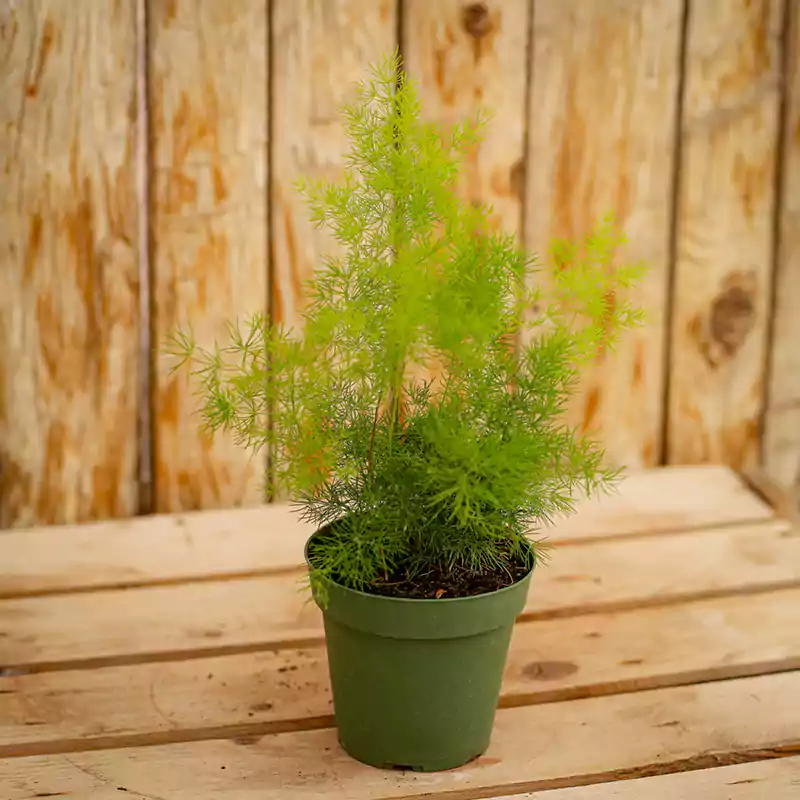 | Ming fern is a slow-growing, shrubby, edible type of asparagus fern plant. It has dense feathery bright green “poms” of foliage on the zigzagging branches, which makes it well-suited for an accent plant or bonsai tree. |
| Cwebe Fern (Asparagus densiflorus ‘Cwebe’) | 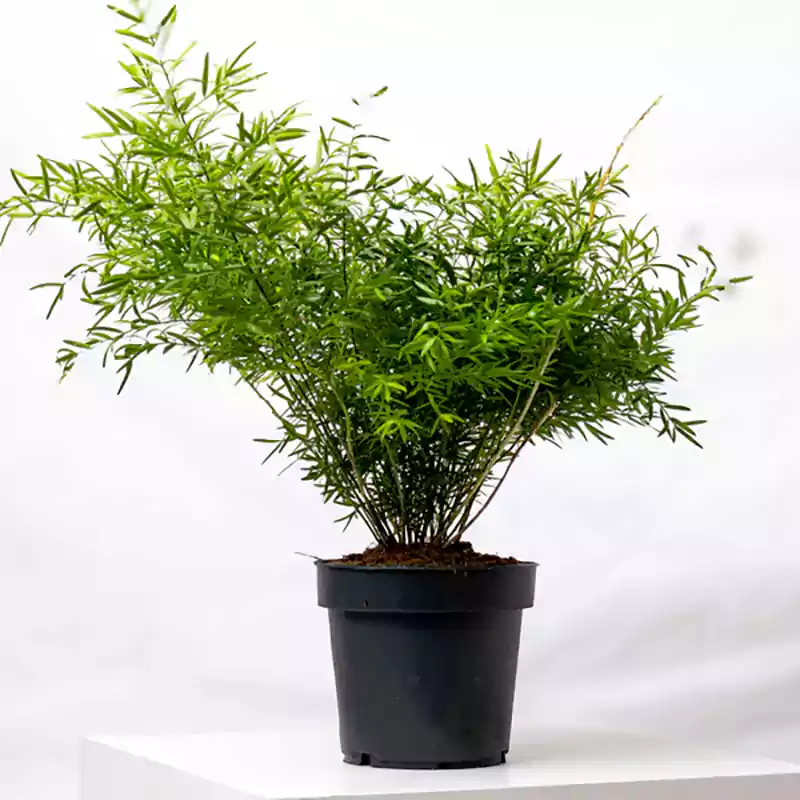 | Cwebe fern is a common asparagus fern that is well known for its fine foliage that emerges in striking copper bronze colour before turning to green. Growing best in dappled shade, the perennial is excellent if you want to grow an asparagus fern outside. |
How to Grow Asparagus Fern?
Asparagus ferns can be grown by both methods, propagation and seeds, easily. In spring, I planted this evergreen garden plant using the propagation method, which provides faster growth and a ready-made structure. Let’s see both the methods in detail:
By the Propagation Method (Easiest Way!)
- Remove the fern from the pot by using a trowel or shovel. Wash or shake off the soil to see the root structure clearly.
- Look for the natural separations in the tuberous roots and split the root ball into half or more sections using a knife or a spade. Also, cut away any overtly long or rotting roots.
- Plant each new section into separate pots with fresh, well-draining potting mix.
- Water new plants thoroughly, but avoid waterlogging and keep them in indirect sunlight.
From Seeds
- Extract seeds from the ripe red berries. Soak them in water for a day to soften the hard outer casing.
- Plant 3-4 seeds per pot about ¼ inch deep and keep the pot in a brightly lit area.
- Wait for germination that will take place in about 3-6 weeks.
- Once the leaves have developed, transplant them into large individual pots to support their growth.
Ideal Growing Conditions and Care Guide of Asparagus Fern
After learning how to grow an asparagus plant, the equally worth discussing part is its ideal growing conditions and how to care for an asparagus fern. Mastering its care means focusing on critical factors like well-drained soil, regular watering, adequate spacing, and seasonal pruning.
Ideal Growing Conditions of Asparagus Fern
| Soil | Well draining nutrient rich soil |
| Sunlight | Grows best in bright indirect sunlight but is tolerant of partial shade |
| Water Needs | Water deeply when the top 1-2 inches of soil get dry, avoiding waterlogging |
| Hardiness Zones | USDA zones 9-11 |
How to Care For Asparagus Fern to Support Its Optimal Growth?
- Fertilizing
Proper fertilising is essential for these long-lived perennials to build the energy reserves in the roots and maintain the plant’s health. I use the balanced liquid fertiliser every spring and summer on my Asparagus densiflorus sprengeri fern. It is important to avoid fertilising in winter as it can cause burns and weak growth.
- Pruning
I prune the plant regularly to maintain its growth and shape. The best time to cut the brown leggy stems is spring or late fall every year. When talking about the indoor plants, trim up to one-third of the plant to favour its old woody stems. It’s suggested to wear gloves as they have sharp thorns.
- Spacing
Proper spacing of the plants reduces the competition for nutrients and sunlight among them. It also helps in reducing the risk of fungal diseases and allows space for mature growth. For borders and mass plantings, they should be planted at least 12-18 inches apart, and for containers, consider planting them 10-12 inches apart to avoid the over-crowding.
- Pests and Diseases
While simple to care for, the plants are susceptible to pests such as spider mites, mealybugs, aphids, and scales, which can lead to issues including leaf drop, brown bumps on stems, stunted growth, and ultimately the weakening of the plant.
The perennials can also be affected by diseases such as rust, wilt, Botrytis, and leaf blight, which cause root rot, yellowing, and premature death of the plant. To prevent these problems, growers can use insecticidal soaps and cut back the diseased foliage to the soil level to promote new growth.
Common User Problems with Asparagus Fern
Every plant brings in new challenges for the grower! While scrolling through Reddit, I noticed that many users are suffering from these houseplants becoming too leggy and pale. Managing these issues is certainly crucial to prevent them from becoming a dishevelled mess. I have mentioned some of the queries and their solutions below:
- Query: Why has my asparagus fern grown so big and tall?
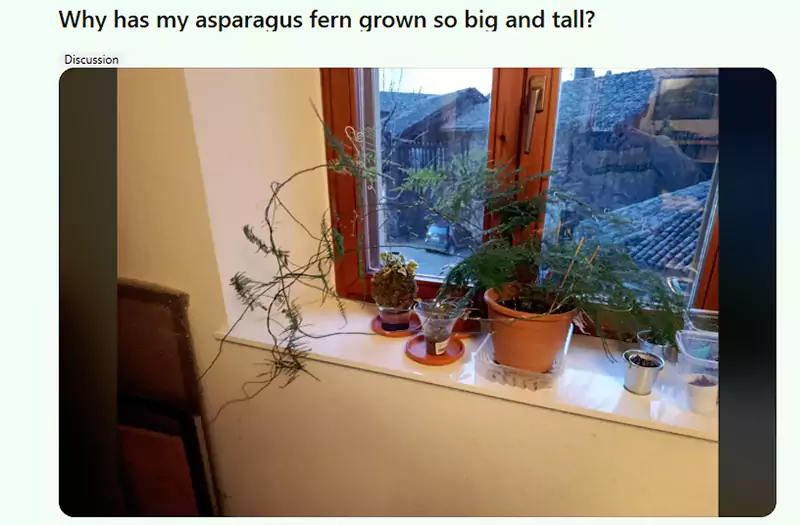
Solution: When the plant is growing rapidly, it is actually a sign that it’s healthy, well taken care of and currently in its spreading phase. If the climbing stems are causing issues, then you can easily prune the long stems to the desired length and encourage the plant’s compact growth.
- Query: What should I do with this gigantic offshoot from my asparagus fern? Do people just cut them off?

Solution: Yes! It is recommended to cut off the unruly offshoots from the perennial plant. Though they are a sign that the plant is healthy, to maintain the shape and structure, it is suggested to prune it from time to time to support its bushy shape.
- Query: My asparagus fern has been pale for months now, and I don’t know what to do.
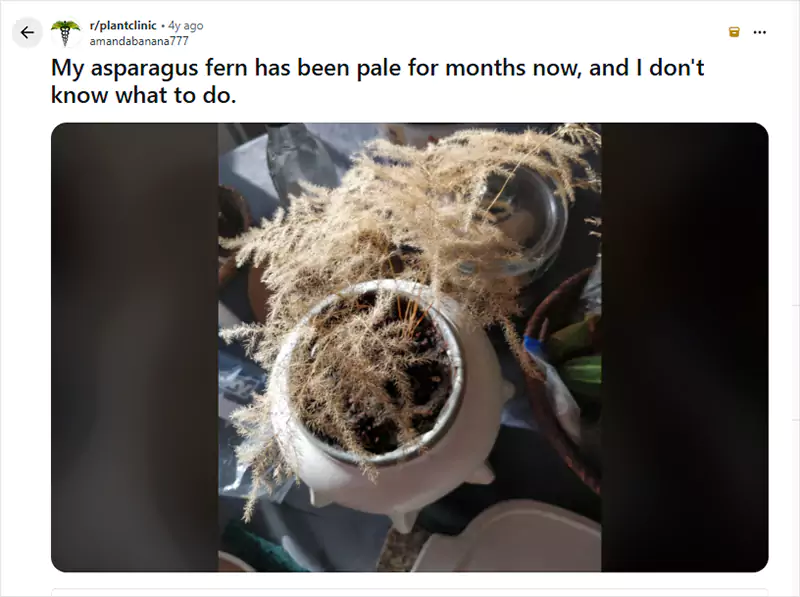
Solution: If the plant is pale or yellow, it can be caused by too much direct sunlight, underwatering or low humidity. To revive it, you can move the plant to indirect light, keep the soil consistently moist and go for daily misting to solve the humidity issue.
Scientific Research and Analysis on Asparagus Fern
Over the years, numerous studies have been conducted on improving the health of the asparagus ferns. The mentioned studies are conducted to control the issue of Stemphylium purple spot in these ferns, and the results show that the new fungicide combination is helpful in protecting the fern with fewer applications.
| Research Box Study Year- 2025 Aim- To evaluate the efficacy of non-registered fungicides (pydiflumetofen + fludioxonil and fluxapyroxad + pyraclostrobin) compared to standard registered fungicides (azoxystrobin, mancozeb, chlorothalonil) for managing Stemphylium purple spot on asparagus. Method- Field trials were conducted in 2022 and 2023 on asparagus ferns. Treatments included the new fungicides and standard registered fungicides, all alternated with chlorothalonil. Sprays were applied based on three schedules. The study measured disease severity and used the relative area under the disease progress curve to assess disease reduction compared to an untreated control. Results- The new fungicide combinations provide an effective, efficient strategy for protecting asparagus ferns. Source- ScienceDirect |
Interesting Facts about Asparagus Fern
When I got to know some amazing facts about these evergreen perennials, I understood these plants are far from a boring houseplant, as they carry a fascinating history with the botanical deception with them. Take a look at some interesting facts about their Victorian popularity, leaves and invasive nature:
- During the 1800s, there was a huge craze in England of growing ferns, which is known as “fern fever”. Due to their fern-like appearance, asparagus ferns also gained immense popularity as a Victorian parlour plant.
- As mentioned in the article of the University of California Agriculture and Natural Resources, it is considered a serious agricultural weed in Florida, Hawaii, New Zealand and Australia because of its fast growth and tough nature.
- Unlike other edible asparagus species, its berries are highly toxic to humans and pets, causing significant digestive stress if ingested.
- The needles of the plant are actually cladophylls that are modified stems, often confused with leaves. The leaves are actually very small and present at the base.
Bottomline
That’s the wrap to our discussion on the asparagus fern! According to me, the houseplant is a must-have for both the new plant parents who want to start a garden from scratch and the seasoned gardeners.
The easy-to-grow nature, fluffy growth, and unique appearance make it an incredibly versatile addition to hanging baskets, lush groundcovers in warm climates and tabletop containers.
Remember to be careful about the right growing conditions and the common problems, and you will have your evergreen perennial adding a feathery touch to your home or garden all year round.
FAQs
Where is the best place to grow asparagus ferns?
How to keep the asparagus ferns bushy?
To keep these plants bushy, make sure to place them in partial shade, provide proper watering and maintain their shape with regular pruning.
Is asparagus fern pet-friendly?
No, the perennial is not considered friendly to cats and dogs. If ingested, the berries and leaves can cause vomiting, stomach ache and diarrhoea, and physical contact with the plant can cause dermatitis.
Can I grow an asparagus fern plant indoor?
Absolutely! The plants are ideal to be grown indoors, especially in bathrooms, as they need indirect light and high humidity. They can also be kept near the window with sheer curtains to prevent direct sunlight.
How to do asparagus fern spacing in the right way?
The plants should be spaced at least 12-18 inches apart to prevent diseases and competition for nutrients.
Sources:
Asparagus fern, Asparagus densiflorus – Wisconsin Horticulture
Asparagus Fern – Britannica
Growing Vegetables: Asparagus– University of New Hampshire
Latest Blog